
Celebrating Psychological Research in Morocco
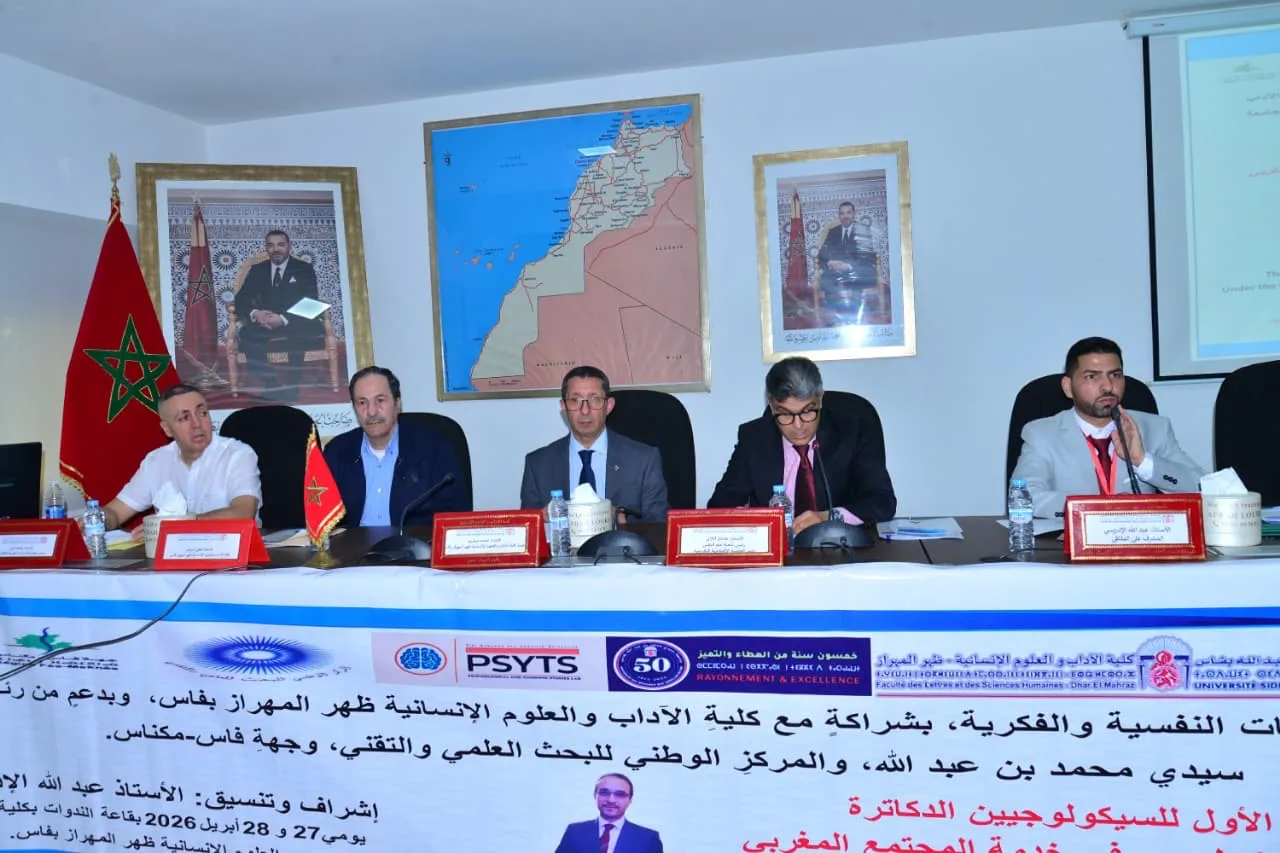
The Moroccan academic landscape is currently witnessing a vibrant scientific dynamic aimed at fostering connections between rigorous academic research and pressing societal needs. In this context, the Laboratory of Psychological and Intellectual Studies organized the First National Conference for Doctoral Psychologists on April 27 and 28, 2026, in partnership with the Faculty of Arts and Humanities at Dhar el Mehraz in Fez. Supported by the presidency of Sidi Mohammed Ben Abdallah University and the National Center for Scientific and Technical Research, this event was held under the theme "Psychological Research in the Service of Moroccan Society," in honor of Professor Bennis Zghabouch, a distinguished psychology professor at Sidi Mohammed Ben Abdallah University.
Coordinated by Dr. Abdullah Idrissi, also a psychology professor at the same university, the conference served as an exceptional platform to celebrate specialized scientific research and honor the academic figures who laid the foundations of psychology in Morocco, embodied by Professor Zghabouch. The event welcomed a distinguished guest, Professor Ghali Ahrachao, one of the pioneers of Moroccan psychology in both Morocco and the Arab world. Over two days filled with scientific discussions and training workshops, the conference aimed to create a roadmap for young researchers that strikes a balance between methodological rigor, ethical commitment, and scientific integrity.
Fostering a Collaborative Scientific Environment
This significant national scientific event took place in the conference hall of the Faculty of Arts and Humanities in Dhar el Mehraz, Fez, attracting a substantial presence of professors, researchers, and students from within and outside Sidi Mohammed Ben Abdallah University. The importance of the First National Conference for Doctoral Psychologists lies in its establishment as a national scientific space that unites an elite group of researchers and doctoral students, facilitating the exchange of experiences and the cross-pollination of ideas, thereby enhancing the dynamics of research in psychology. Additionally, it aims to appreciate national scientific contributions and encourage young researchers to engage with societal issues through robust scientific approaches.
The conference's relevance is underscored by its alignment with the social, cultural, and economic transformations currently unfolding in Morocco, which present increasing psychological and behavioral challenges. As such, psychological research becomes a crucial tool for understanding and responding to these changes. The conference theme, "Psychological Research in the Service of Moroccan Society," strategically reflects the aim to connect scientific knowledge with community needs and contribute to developing professional practices rooted in scientific foundations.
The program of this remarkable edition included an opening and honorary session, referred to as the "Session of Loyalty and Acknowledgment," presided over by Professor Adnan Al-Tazani, head of the psychology department at the Faculty of Arts and Humanities. This session began with formal remarks from the Dean of the faculty and the laboratory director, emphasizing the university's role in addressing current societal issues and celebrating the scholarly and humanitarian spirit of the honoree, Professor Bennis Zghabouch. A special "Moment of Loyalty" occurred during this session, where Professor Ahrachao presented a profound testimonial highlighting the honoree's contributions to introducing an experimental scientific spirit in Moroccan psychological research and humanizing pedagogical relationships. The session chair expressed satisfaction with organizing such gatherings and valued the idea of honoring significant contributors.
The first scientific session focused on Work Psychology and Executive Functions, addressing topics such as the relationship between mental sports (like chess) and the development of executive functions, cognitive inhibition mechanisms in children with Attention Deficit Hyperactivity Disorder (ADHD), the review of Neurofeedback techniques as a modern tool for enhancing cognitive performance, and the analysis of job satisfaction and organizational commitment within Moroccan institutions. The second scientific session explored the intersection of technology, health, and professional identity, covering issues like the transformations in professional identity amidst the encroachment of artificial intelligence in the job market, the phenomenon of "technostress" and how healthcare professionals adapt to digital pressures, the effectiveness of virtual reality therapy in addressing anxiety disorders, and the importance of professional inclinations in guiding young energies towards suitable educational and career paths.
The third scientific session delved into neuropsychological assessment and cognitive functioning, with discussions on sports psychology, the impact of traumatic events on competitive performance, the centrality of neuropsychological assessment in understanding addiction cases, learning difficulties, and cognitive processes in children with reading difficulties (Dyslexia), as well as aging psychology, specifically measuring the ability to recognize emotions through facial expressions in the elderly. Finally, the fourth session explored the psychological analysis of social and developmental issues, focusing on the analysis of psychological vulnerability and resilience mechanisms in the face of social shocks, representations of mental illness in Moroccan popular imagination and their impact on therapeutic processes, and the challenges of early diagnosis and educational and social integration strategies for Autism Spectrum Disorder.
Moreover, the conference program featured a scientific workshop on international publication thresholds and research ethics, led by Dr. Ghazlan Merzaq, who focused on technical aspects, offering guidance on how to craft titles and abstracts for indexed journals (Scopus, DOAJ), distinguishing between legitimate citations and scientific plagiarism using software like iThenticate, and the necessity of obtaining approvals from ethics committees while respecting the confidentiality of respondents. She underscored the importance of scientific integrity in presenting statistical results, asserting that "scientific research is integrity above all."
It is noteworthy that the "First National Conference for Doctoral Psychologists" at Sidi Mohammed Ben Abdallah University marked a pivotal moment in the trajectory of Moroccan psychological research. It successfully presented a rigorous scientific perspective on societal realities and challenges through the lenses of young researchers who blend academic knowledge with a commitment to the public good. The discussions at the conference, from scientific sessions covering diverse psychological fields to specialized training workshops and final recommendations, demonstrated that the path toward building an effective "Moroccan Psychology" necessitates two parallel approaches: one that embraces the latest techniques and international protocols, including artificial intelligence, and another that adheres strictly to professional ethics and scientific integrity, as exemplified by the honoring of Professor Bennis Zghabouch as a symbol of this dedication.
This conference is not merely a transient scientific event; it serves as a "knowledge declaration" affirming that Moroccan psychology is now poised to propose solutions and formulate strategies that promote mental health and social well-being. Consequently, the resulting recommendations place the responsibility of continuity on universities and researchers, ensuring that this conference becomes a sustainable annual platform that unites the scientific community and aligns perspectives for the benefit of the Moroccan populace and the elevation of national scientific research toward global horizons.
As reported by alaan.ma.