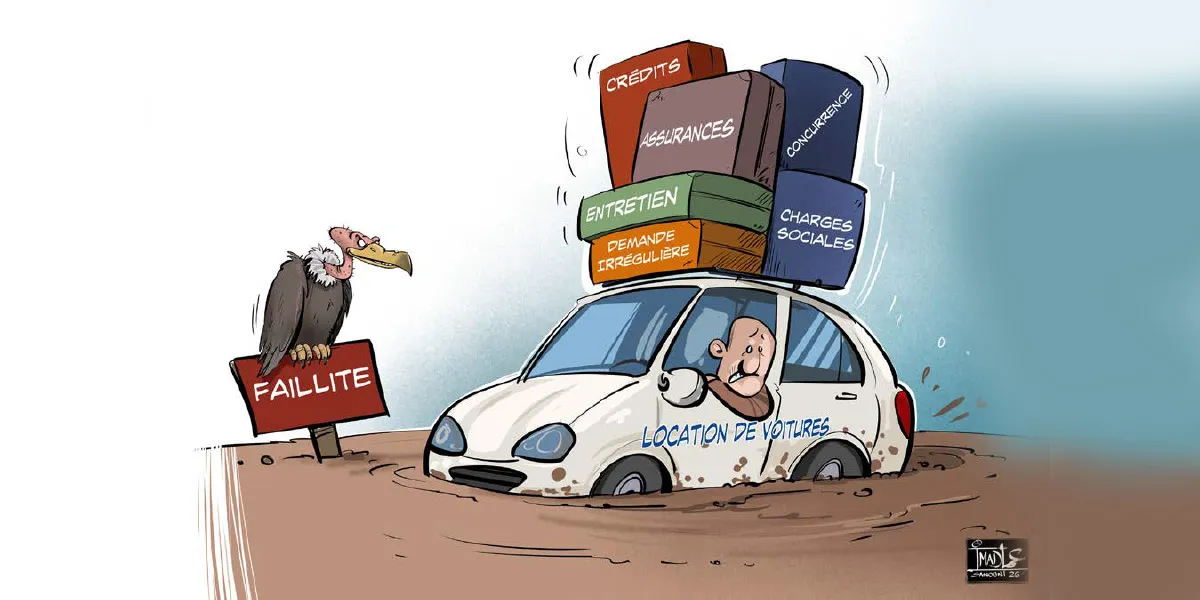

The Car Rental Sector: Expansion Amidst Fragility
The car rental industry in Morocco is witnessing remarkable growth, with an unprecedented number of agencies emerging to meet the increasing demand. However, this expansion masks a more precarious reality within the sector. Despite the proliferation of rental agencies, many are struggling to maintain profitability due to various financial pressures, including mounting credit obligations, soaring insurance costs, and significant social charges. As a result, numerous car rental companies are finding their financial viability increasingly uncertain. Compounding these challenges is a persistent lack of professional structuring within the industry, which only exacerbates the vulnerabilities faced by operators.
By 2025, Morocco boasted approximately 12,000 car rental agencies—a staggering figure that does not necessarily indicate a flourishing market. While new companies are continuously entering the field, many are also exiting, unable to meet their financial commitments to lenders, insurers, or social organizations. This cycle of creation and dissolution highlights a sector that is both accessible and increasingly difficult to navigate. According to industry experts, the turning point for the market occurred in the mid-2010s, when regulatory relaxations facilitated the entry of numerous operators. Although the minimum capital requirement of 500,000 dirhams and the necessity of having at least five vehicles remained intact, the expanded possibilities for shareholder evolution and corporate structure have led to a surge in new businesses that lack the financial robustness necessary for long-term success.
Challenges of Financial Viability and Market Dynamics
According to Mohamed El Manouni, Vice President of the Federation of Car Rental Companies Without a Driver in Morocco (FLSCAM), the market is currently experiencing a troubling trend: many new agencies fail to survive beyond three years due to insufficient financial management and an inability to meet their obligations. The harsh reality is that a small fleet often struggles to cover fixed costs, while a larger, underutilized fleet can quickly turn monthly payments into a financial burden. Agencies with fewer than 15 vehicles typically find it challenging to generate enough revenue to sustain their ongoing expenses. This paradox forces operators to invest heavily to reach a critical size, while simultaneously increasing their financial exposure.
Furthermore, the tightening grip of financing presents another layer of risk. With increasing defaults and a rise in industry risk, many lenders have become more stringent in their approval processes. While the sector remains a natural client for financing institutions due to its reliance on credit for fleet renewal and expansion, this dependence is becoming increasingly costly. The FLSCAM indicates that financing terms can range from 9% to as high as 15% before taxes, making profitability highly sensitive to vehicle usage rates, daily rental pricing, and seasonal demand fluctuations.
For new entrants, the challenge is daunting: acquiring multiple vehicles on credit, managing monthly payments from day one, and waiting for demand to stabilize. A slight dip in demand can dramatically reduce their operational flexibility, while financial institutions continue to tighten their requirements for collateral and guarantees, creating a vicious cycle. As risk increases, financing costs rise, further jeopardizing the stability of weaker agencies.
Alongside these financial pressures, structural changes in demand have emerged. Traditionally, summer represented the peak season for car rentals, but recent trends indicate a significant concentration of demand around August, with a much shorter window for high-season activity. This shift forces companies to amortize their fleets over a much shorter period, leading to volatile revenue patterns throughout the year. Operators note that while there is some revival of activity between mid-December and mid-January, followed by dips in February and March, the overall market remains unpredictable, making it essential for agencies to manage their resources wisely.
In light of these challenges, industry professionals are advocating for clearer guidelines regarding their responsibilities when a rented vehicle is involved in legal issues or infractions. Currently, the lack of a standardized rental contract recognized by authorities adds to the uncertainty, as each company utilizes its own contractual model. The Federation is pushing for a common contract framework with enhanced legal standing, which is part of ongoing discussions with the Ministry of Transport. Furthermore, FLSCAM is advocating for stricter capitalization requirements and mandatory professional competency criteria for agency leaders to ensure a more robust industry moving forward.
As the car rental sector in Morocco stands at a crossroads, the anticipated growth in tourism, professional travel, and significant sporting events presents a unique opportunity. However, the pressing question remains: will operators be resilient enough to capitalize on these opportunities? As the market prepares for a major tourism and event cycle, the focus shifts from merely increasing the number of agencies to ensuring that those that remain are strong enough to thrive in an evolving landscape.
As reported by leseco.ma.