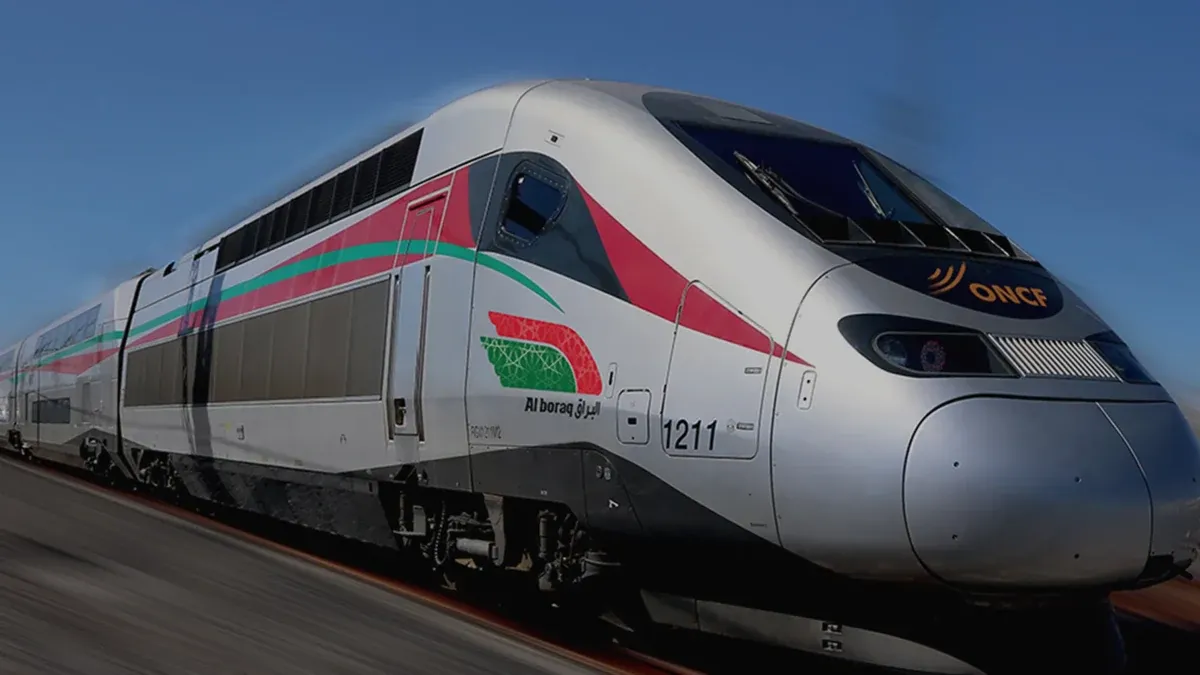

The extension project of the high-speed train towards Agadir has once again taken center stage in political and parliamentary discussions, following a verbal inquiry made by MP Hassan Tabii to the Ministry of Transport and Logistics. In his inquiry, he requested the disclosure of the timeline associated with the implementation of the project that aims to connect Agadir to the "Al-Boraq" train, while also considering the future connection of this route to the southern regions of the kingdom.
This inquiry arises in the context of the growing expectations among the residents of Agadir and Souss-Massa regarding this strategic project, which is no longer seen merely as a new railway line, but as a potential gateway to alleviate the historical railway isolation faced by the capital of Souss, thereby linking it with the hubs of Marrakech, Casablanca, Rabat, and Tangier.
In his parliamentary speech, Tabii emphasized that the railway transport sector in Morocco has been undergoing significant transformation in recent years, as part of a national vision aimed at modernizing infrastructure, enhancing regional connectivity, and positioning rail transport as a catalyst for economic and social development.
He highlighted the achievements that the kingdom has made in the field of railways, noting that Morocco boasts a network stretching over thousands of kilometers, with a significant percentage of electrified lines. Additionally, he mentioned the exemplary experience of the "Al-Boraq" high-speed train, which has reduced travel time between Tangier and Casablanca, establishing a new image for rail transport in the kingdom.
However, the most pressing question for Agadir and Souss-Massa pertains not only to what has been accomplished in the north and center but also to what remains to be anticipated in the south. The residents of Agadir, along with vast areas of Souss and the southern provinces, are eagerly awaiting the transition from the study and announcement phase to a clear timeline that specifies when the high-speed train will reach the city.
Data published by the Ministry of Transport and Logistics confirms that the project to extend the high-speed line towards Agadir involves the creation of a new railway line between Marrakech and Agadir, spanning approximately 240 kilometers, with a substantial estimated cost that makes it one of the largest anticipated transport projects in the southern region of the kingdom.
The complexity of this project lies in its geographical and engineering nature, as it traverses a challenging area between Marrakech and Agadir, passing through mountainous regions and corridors that require massive engineering structures, such as bridges, tunnels, and technical installations, which makes the project much larger than a simple extension of the railway network.
Thus, the demand for a timeline disclosure is not merely a political request but a regional and economic necessity. The city of Agadir is preparing for major tourism, sports, and economic events, betting on enhancing its position as a southern hub of the kingdom, a bet that cannot be completed without a robust and rapid railway connection.
From an economic standpoint, the Marrakech-Agadir high-speed line could transform the relationship between the region and national markets. Reducing travel time will increase Agadir's appeal to investors, tourists, students, and professionals, and it will streamline connections between the city and major airports, ports, and economic centers.
Touristically, the project will have a direct impact on the Agadir destination, which currently relies primarily on air connections and highways. The presence of a high-speed train would open a third option for visitors, making the connection between Marrakech and Agadir smoother, which could support joint tourism programs between the two cities.
Socially, the project means a lot to the residents of Souss-Massa. It is not just a comfortable mode of transport, but a sign of spatial justice and the region's right to benefit from the same level of major infrastructure that other regions have experienced. Hence, the parliamentary question acquires a significant symbolic dimension: when will the south enter the era of speedy rail transport?
Through his inquiry, Tabii raises another dimension concerning the future connection of Agadir to the southern provinces. This proposition aligns with the vision that considers Agadir as a natural gateway to the south, a connecting point between central Morocco and its southern provinces, whether in terms of human mobility, logistics, or economic development.
However, turning this ambition into reality requires more than just expressing the desire. It necessitates clear funding, a precise schedule, and regular communication with the public, so that the project does not remain confined to a state of waiting or vague promises.
Moreover, the residents of Agadir and Souss-Massa need to understand the project's position within national priorities: will it come immediately after the line extension towards Marrakech? What are the next stages? Have the technical studies been completed? What are the funding sources? And are there approximate timelines for the actual commencement of works?
These questions become increasingly important as Morocco is experiencing a phase of expansion in infrastructure projects in preparation for significant upcoming events, including the 2030 World Cup, in addition to the tourism and economic challenges associated with establishing the kingdom as a Mediterranean and African logistics and transport hub.
Furthermore, the project of the high-speed train towards Agadir cannot be separated from the current transport situation between Marrakech and Agadir. The highway currently serves as the backbone for transport between the two cities, yet it does not fulfill the need for a modern rail connection capable of transporting large numbers of passengers swiftly and safely, thereby alleviating pressure on the roads.
If completed, the project will also impact intermediate cities and areas, as well as the economic dynamics surrounding potential stations, and it will drive investment in services, hospitality, and urban transport, provided that it is considered within a comprehensive vision that not only focuses on constructing the line but also ensures its integration with other means of transport within Agadir and the region.
While awaiting a more detailed response from the Ministry of Transport and Logistics, the parliamentary question serves as a political indication that the Agadir train project is no longer just a technical matter confined to study offices; it has become a clear regional demand that is echoed in public and parliamentary discussions.
Agadir, which is betting on tourism, ports, agriculture, services, and sports, cannot remain outside the modern railway map indefinitely. Any delay in clarifying the timeline deepens the residents' sentiment that the south is still waiting for its share of major speed projects.
In conclusion, it seems that the question is no longer whether Agadir needs a high-speed train, but when will this project become a tangible reality? The city and the region are awaiting a clear answer, as linking Agadir to the Al-Boraq will not merely be a technical achievement, but a step towards more robust integration of Souss-Massa into the broader national dynamics.
As reported by agadir24.info.