
The Ambitious Project to Connect Europe and Africa
The concept of linking Europe and Africa through the Strait of Gibraltar has been a topic of fascination and study for many decades. This maritime passage, which separates Spain from Morocco by just 14 kilometers, is crucial for international trade and navigation. The aspiration to create a connection has evolved from mythological tales to modern technical studies, driven by the strategic significance of the region. While the idea dates back centuries, formal studies commenced in the 1970s, leading to geological and technical investigations designed to adapt the project to the seabed's conditions. Currently, efforts have shifted towards the construction of a railway tunnel reminiscent of the Channel Tunnel. However, successful implementation of such a project hinges on the cooperation and amicable relations between Spain and Morocco, particularly given current tensions surrounding issues like the migration crisis in Ceuta and Morocco's claims for autonomy over certain autonomous cities. Despite these challenges, there are no indications that the project will be adversely affected.
Technical Challenges and Bilateral Cooperation
Over the years, the Gibraltar Strait Tunnel project has encountered numerous technical and geological challenges that have hindered its progress. Seabed surveys conducted since the 1990s have enabled adjustments to the designs based on the conditions identified. Recently, cooperation between Spain and Morocco has intensified, with an updated preliminary project expected to be presented in 2026, resulting from recent research and collaboration with international scientific institutions. Spain confirmed on December 30, 2025, the selection of specialized companies tasked with these studies, aiming to define the tunnel's viability and its environmental impact in greater detail. If realized, this connection aspires to become a strategic point for trade and mobility between Europe and Africa. However, with the 2030 World Cup, which both countries are set to co-host, the tunnel will not be operational in time to facilitate transportation between venues; estimates suggest its opening will occur between 2035 and 2040.
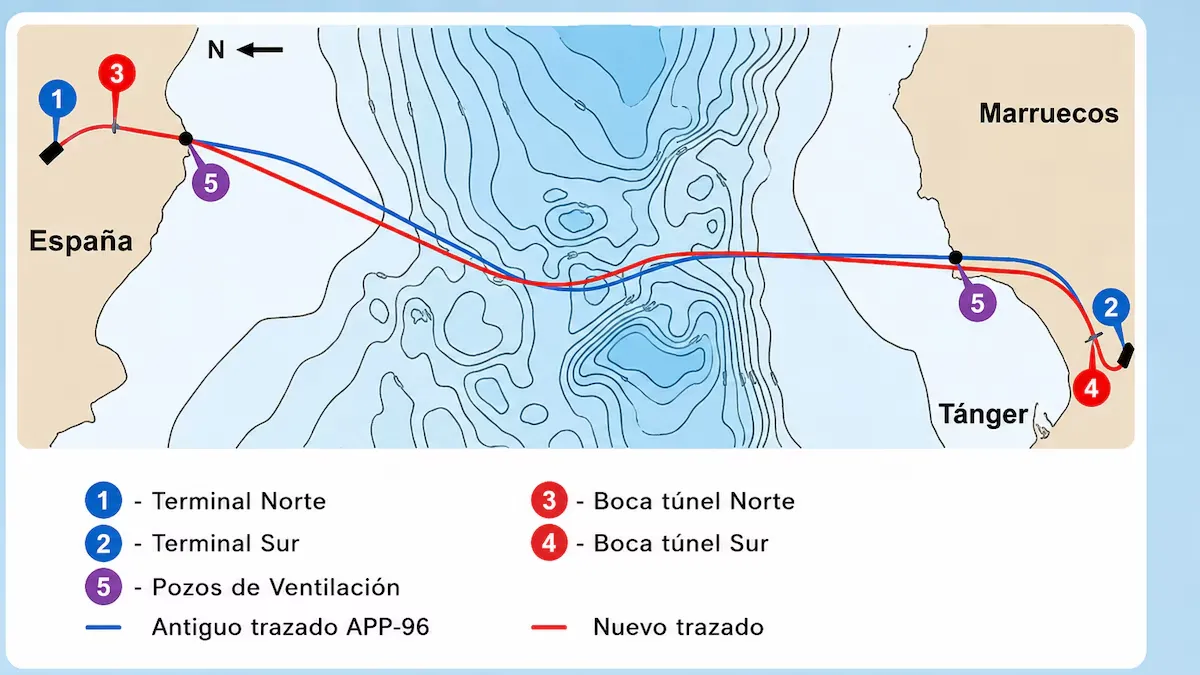
The Spanish Society of Studies for the Fixed Link through the Strait of Gibraltar (SECEGSA) and its Moroccan counterpart, the Société Nationale d’Études du Détroit de Gibraltar (SNED), are the two bodies responsible for this endeavor. Throughout the decades, various options have been evaluated, leading to the final consideration of a tunnel versus a bridge. The decision to opt for a railway tunnel was solidified after extensive technical and geological studies. The plan envisions connecting Tangier and Punta Paloma through two parallel single-track tunnels, each measuring 7.9 meters in diameter, alongside a central service and safety gallery of 6 meters. The total length between terminals would span 42 kilometers, with 38.5 kilometers underground and 27.7 kilometers submerged. The design includes access passages every 340 meters for maintenance and evacuation purposes.
While the initial proposal considered constructing a suspension bridge with three central spans of 3,550 meters and foundations extending up to 315 meters deep, this option was ultimately deemed unfeasible due to technical complexities, risks to maritime navigation, and exposure to extreme wind and wave conditions. In contrast, the tunnel minimizes the risks associated with maritime accidents, reduces environmental impact, and allows for better security control.
As reported by infobae.com.