
The city of Fnideq in Morocco lies just a few kilometers from the Spanish enclave of Ceuta, yet the chasm between those yearning to cross this boundary and those who choose to remain in Morocco is immeasurably vast. Following the events of July 30, when around 72,000 individuals attempted to make the perilous journey from Morocco to Ceuta, social media platforms became inundated with calls for another mass crossing attempt in mid-August. This surge in hopeful intentions comes despite the grim reality that approximately 100 people lost their lives during the previous crossing, and most of those who successfully reached Ceuta have since returned to Morocco. While precise figures remain elusive, estimates suggest that between 2,000 and 8,000 individuals who managed to enter the Spanish enclave still find themselves there, living in dire conditions, often sleeping on the beach as they await decisions from Spanish authorities regarding their fate.
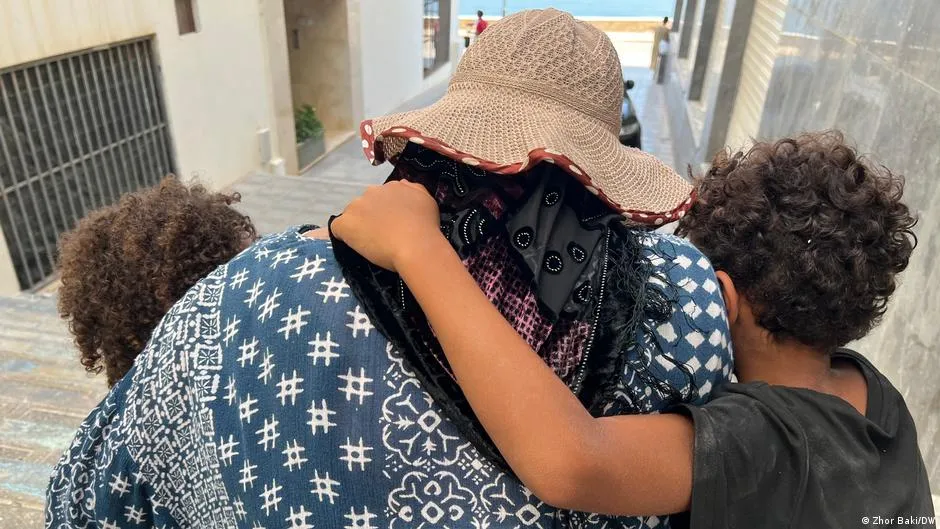
In Morocco, the dream of emigration persists among many hopefuls eager to reach Ceuta. One such individual is Malika, who traveled to Fnideq from Casablanca with her two children after hearing that some people had successfully crossed on July 30. Out of respect for her personal circumstances, she requested that her full name not be disclosed. "My life is below zero," she expressed tearfully, "I have no life." Malika remains in Fnideq, fueled by rumors of a potential crossing opportunity in August. Over the past weeks, she has wandered the streets in search of food for her children, enduring nights spent outdoors without shelter. The prospect of another crossing attempt has also caught the attention of Moroccan and Spanish authorities. Reports indicate that on August 15, there was a significant deployment of Moroccan security forces around Ceuta and Melilla, another Spanish enclave to the east, complete with multiple checkpoints, patrol boats monitoring the coastline, and water cannons stationed at the border. The Moroccan police claimed to have detained 111 individuals attempting to enter Ceuta.
On that fateful date, the anticipated mass crossing did not materialize, leaving Malika still stranded in Fnideq. "I am in a situation where I could harm myself at any moment," she confided to DW. "My children are starving. I have virtually no home. I lack employment and stable housing, and my husband suffers from depression due to extreme poverty. Sometimes he just disappears, leaving me alone with the two children, without money or shelter." Despite these challenges, Malika continues to aspire to reach Ceuta, convinced that there, she and her children would find some form of assistance: "Our situation is incredibly difficult… That’s why I want to go to Ceuta. There, they will study, and we will be okay."
Despair and the Quest for a Brighter Future
Ahmed Amhid, another individual encountered by DW in Fnideq, reflects a slightly better situation. At 22 years old, he arrived from Oued Zem in central Morocco, driven by news of the upcoming crossing. Currently, he sells drinks on the street with a relative. Ahmed asserts that job opportunities are scarce in his hometown, leading him to perceive no future for himself there. "The situation is deplorable; there is nothing in this country," he expressed with frustration. "I want to emigrate from Morocco. I have no hope in this country." After pausing to serve a customer a glass of orange juice, he continued, "There is nothing here: no jobs, no industries, no businesses, nothing. My current earnings are insufficient for my survival or to build a future." Many young individuals like Ahmed have recently come to Fnideq, drawn by what they see on social media. Ahmed al-Dafri, a Moroccan media and culture expert, explains that such online calls represent "a new model of digital mobilization that doesn’t necessarily require a single leader or central authority." When videos documenting successful crossings circulate widely, they create a perception that everyone wants to emigrate and no one wants to stay behind, potentially fostering feelings of exclusion among those who do not join the collective movement.
Conversely, not everyone in Fnideq is eager to leave Morocco. Mohamed al-Dami, a 30-year-old local merchant, observes the throngs attempting to leave but has no intention of joining them. He acknowledges the nation's economic instability but maintains, "Personally, I have never thought about emigrating. I buy, sell, and work normally. I could emigrate, but I am not going to throw myself into the sea for a journey that might not even lead me to my destination. Even if you manage to enter Ceuta, all the effort and risk may not be worth it. Why put yourself in danger?" Al-Dami recalls witnessing crowds heading toward the border in late July but never felt tempted to join them. "In my opinion, if a person can make a living and secure their future, then, thank God. As for the future, it is in God's hands." He also heard the calls for another crossing attempt on August 15 but doubted the likelihood of success given the heightened security measures. "Honestly, since many young people entered Ceuta and then returned here, the morale of the people has plummeted, and there is little enthusiasm for such endeavors," he concluded.
As reported by dw.com.