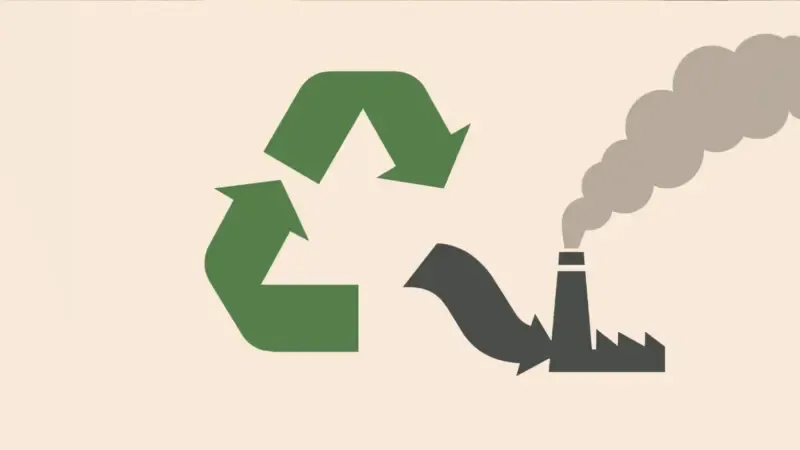

In the small town of Mediouna, located southeast of Casablanca, residents grapple with an alarming reality marked by poor air quality and health concerns. Eight-year-old Fatima's son has been coughing persistently throughout the night, prompting her to express deep worries about her child's well-being. "The doctor advised me to move away, but we have nowhere else to go," she laments, unfolding tattered medical reports that tell a grim story of ongoing health challenges. The Moroccan government has issued 416 permits for the importation of waste from Europe, including items such as textiles and industrial by-products, which are incinerated and used as fuel in cement kilns scattered throughout the Casablanca-Settat region, just fifteen kilometers from Fatima’s home. European companies reap significant financial benefits, saving around $52 million annually by shipping their waste to Morocco instead of managing it in their own countries. While Fatima remains oblivious to these economic intricacies, she is acutely aware of her son's struggle to breathe and the pungent odor wafting from the nearby landfill that can be detected many kilometers away.
A comprehensive investigation conducted by Basel Action Network, which utilized trade data and customs records alongside responses obtained under freedom of information laws, unveiled that European nations exported at least 36,611 tons of waste to Morocco between September 2024 and September 2025. Shockingly, 93% of this waste was classified as "reusable materials," despite being declared at a meager value of just €0.10 ($0.11) per kilogram. In contrast, the market price for truly reusable clothing ranges between €0.50 and €1.50 ($0.57 to $1.70) per kilogram, indicating that the reported prices barely cover sorting and shipping expenses. This disparity underscores significant differences in product quality and market valuation, suggesting that many of the goods designated as low-value are intended for disposal rather than resale.
Economic Implications of Waste Dumping
The economic dynamics of waste management present a stark contrast. In Europe, the cost of processing waste stands at approximately $100 (€88) per ton, while transporting it to Morocco and incinerating it in cement kilns costs a mere $36 to $39 (€32 to €34). Based on Morocco's reported import of 821,500 tons in 2024, this discrepancy translates to an estimated profit of $50 million (€44 million) annually, prompting a surge in trade activities ahead of the impending EU ban on plastic waste exports set to take effect on November 21, 2026.
Among European countries, Spain emerges as the dominant exporter, shipping as much as 4.5 million kilograms of waste to Morocco in a single month—far exceeding the contributions of all other EU nations combined. The reported figure of 36,611 tons reflects only the waste that Europe continues to export under specific waste codes (textiles, plastics, paper, electronic devices). According to the Moroccan Ministry of Energy Transition and Sustainable Development, the total imports are considerably higher, including 517,000 tons of ferrous metals and 200,600 tons of organic waste, which European nations categorize as raw material rather than waste. This significant difference highlights the volume of materials that are reclassified as non-waste when shipped to Morocco, often obscuring the true nature of these exports.
The Human Cost of Pollution
The invisible toll of pollution on health is growing increasingly concerning. Communities residing near cement factories face heightened risks of respiratory diseases, cancer, and mortality. A study focusing on cement kilns processing hazardous waste revealed that dioxin emissions quadrupled when such materials were included in the fuel mix. In Morocco, exposure to cement dust has been definitively linked to chronic obstructive pulmonary disease (COPD), a leading cause of respiratory-related deaths. The Mediouna landfill itself receives around 1.2 million tons of waste annually and is nearing capacity. In November 2024, the World Bank approved a $250 million program aimed at modernizing waste disposal facilities in Morocco, implicitly acknowledging the inadequacy of national resources even before the additional pressure from imported waste.
When the Moroccan government authorized over two million tons of additional waste imports in August 2024, activist Mohamed Benata condemned the decision as "contradictory to the principles of citizenship" and unconstitutional. In 2016, faced with a similar scandal, the government had temporarily halted waste imports from Italy. European legislation regarding corporate responsibility does not extend to events occurring after containers leave the port. As noted by Miriam Saage-Maaß, legal director at the European Center for Constitutional and Human Rights, the scope of the 2024 Corporate Sustainability Due Diligence Directive "effectively ends at the point of delivery." Thus, whether European exporters bear legal responsibility for the fate of their waste in Moroccan cement kilns hinges on their direct involvement in the incineration process.
With the upcoming EU ban on plastic waste exports to non-OECD countries like Morocco slated for November 2026, and a similar ban on non-hazardous waste set for May 2027, the pressure on Morocco to regulate its waste imports intensifies. The country has applied for status as an authorized importer as of February 2025. According to Italian Green/EFA Member of the European Parliament Cristina Guarda, "the circular economy cannot become a neat solution for offloading health and environmental impacts onto other communities, creating sacrifice zones outside Europe." In Mediouna, Fatima finds herself trapped in a dire situation, inhaling toxic fumes from both locally produced and imported waste from a continent that no longer wants its own refuse.
As reported by fr.globalvoices.org.