
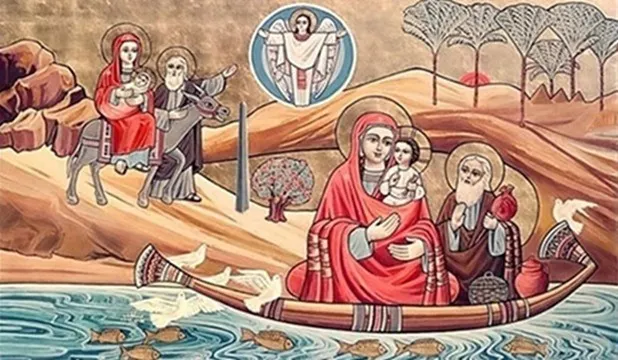

The journey of the Holy Family in Egypt is intricately tied to the nation's rich cultural heritage, encompassing a variety of archaeological sites that continue to narrate the tales of this sacred pilgrimage. Entering Egypt through Sinai, specifically from the regions of Al-Arish and Farama, the Holy Family traversed numerous Egyptian cities. Historical and religious sources have categorized their journey into three distinct phases: the first phase includes Al-Arish, Farama, Tell Basta, Mashtred, Bilbeis, Samannud, Sakha, and Wadi Natron; the second phase covers Al-Matariya, Babylon (Old Cairo), Memphis, and Maadi; while the third phase extends to Al-Bahnasah, Jabal Al-Tair, Al-Ashmounin, Phyllis, Qusqam, Mir, Jabal Qusqam, and Jabal Darnaka.
The Coptic Orthodox Church has attained a unique religious significance among Christian communities worldwide, primarily due to its historical connection to the Holy Family's journey in Egypt. This land has served as a sanctuary for those in search of refuge. It is noteworthy that the prophets of God have found solace here; the Prophet Abraham and Joseph, son of Jacob, have both sought sanctuary in Egypt. During their sacred escape from King Herod, Joseph the carpenter brought the Virgin Mary and her child to this welcoming land. The Holy Family did not settle in a single location; instead, they journeyed from the Sinai coast, through the Delta, along the Nile Valley, and eventually reaching Upper Egypt.
Journey Through Al-Melawi
The book "Melawi Baladi" by journalist Mohamed Shehata Al-Jazzar narrates the story of Jesus Christ during his time in Al-Melawi. The Holy Family traveled from Jabal Al-Tair in Eastern Samalout and arrived at Al-Ashmounin after a journey spanning 60 kilometers. This city was home to a horse standing on four pillars, which would neigh upon the arrival of a stranger, prompting the guards to respond. However, when the Holy Family arrived, the horse fell. In Al-Ashmounin, the Holy Family encountered five camels, and upon the cry of Jesus, the camels turned to stone.
In Al-Melawi, a local man named Qalom welcomed the Holy Family. The next morning, the Virgin Mary ventured into the streets, entering a temple from the Greco-Roman era where its statues shattered upon their entrance. News of this incident spread throughout the city, prompting Qalom to advise Joseph the carpenter to leave the town to ensure their safety.
The Holy Family continued their journey to Ansena, then headed to the ruins of Akhenaten in Tel El-Amarna before crossing the Nile westward to Al-Qusiya and then to Jabal Qusqam, which is known for its sacred ties. On their return, they revisited Al-Ashmounin.
It is worth noting that in 2016, a committee was formed to prepare the file for the Holy Family's route in Egypt for submission to UNESCO. Over a hundred researchers and experts in Egyptian heritage contributed to this file, meticulously documenting the celebrations associated with the Holy Family through the compilation of all available documentation related to the celebrations held in Egyptian monasteries. This was done in coordination with the monks of the churches and monasteries and involved recording the festivities that occur at various stops along the Holy Family's journey across several governorates, including Greater Cairo, Beheira, Kafr El-Sheikh, Gharbia, Sharqia, Minya, and Asyut. Additionally, a documentary video in both Arabic and English was produced, showcasing the celebrations, alongside a pictorial catalog that captures these significant events.
Egypt presented this file in February 2021 to the Intergovernmental Committee for the Safeguarding of the Intangible Cultural Heritage, which discussed it during its session in Rabat. The proposal received overwhelming support, with 21 out of 24 votes in favor, securing a unanimous agreement from all participating countries.
As reported by gate.ahram.org.eg.

