
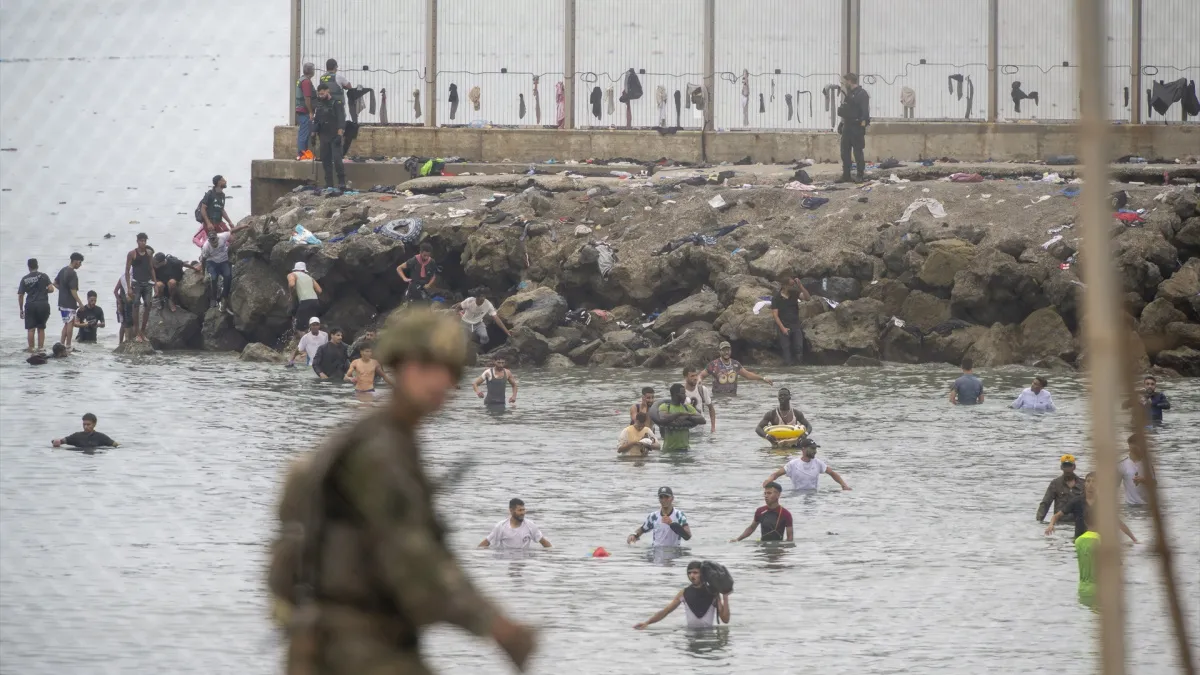

The ongoing humanitarian crisis at the Tarajal border crossing between Morocco and Spain, where **67 people have tragically lost their lives** following the attempted entry of **50,000 citizens** by swimming, is far from a typical migratory crisis. Instead, it serves as a **political message** from Morocco to Spain, reminiscent of the events in May 2021 when Spain granted medical assistance to Brahim Ghali, the leader of the Polisario Front. This incident has escalated tensions between the two nations, underscoring underlying social discontent in Morocco, particularly in response to Spain's proposal to grant Spanish nationality to individuals born in the **Western Sahara**, which is under Spanish administration.
The political context of this situation reveals that Morocco is dissatisfied with Spain's decisions regarding the Sahrawi population, whom they consider Moroccan. The proposed **Saharawi Nationality Law**, introduced in Congress in February 2025 by the political party Sumar and subsequently rejected by the PSOE, aims to offer citizenship to Sahrawis born before August 11, 1977. Although the PSOE attempted to amend the proposal to avoid directly mentioning the Sahrawi people—following advice from the Ministry of Foreign Affairs to prevent aggravating Morocco—these efforts were unsuccessful. On July 14, the President of the Congress of Deputies, Francina Armengol, welcomed a **hundred Sahrawi children** who are part of the _Vacaciones en paz_ program into Spanish families, marking a historic visit to the hemicycle.
In a poignant speech, Armengol condemned the conditions faced by the Sahrawi people in the **Tindouf refugee camps**, asserting the just cause for the Sahrawi people to achieve dignity and freedom after enduring years of struggle. Morocco has long sought to have the **Polisario Front** listed as a terrorist organization, with support from lobbyists in the United States. Following this, they aim to persuade other nations to cease humanitarian assistance to the Sahrawi people, viewing Spain's potential law as an affront to their position.
Social Media Organizing and Youth Mobilization
Young Moroccans have been mobilizing through social media for months, awaiting the opportunity to leave their country after the police suppressed the **GenZ212** social protests in 2025, resulting in sentences of up to **15 years in prison** for demonstrators. The recent surge at the border occurred when they learned of a strategy involving **passive resistance** at the border, spurred by information regarding a Supreme Court ruling that would prevent Spain from returning individuals who entered by sea. A Moroccan journalist noted that such a massive influx of civilians could not happen without directives from high military and security authorities to withdraw surveillance posts.
As the situation escalated, security forces deployed **water cannons and tear gas** in Castillejos, struggling to manage the influx of over 40,000 people arriving in Ceuta. Since 2020, Morocco has moved the Tarajal border more than a kilometer towards Castillejos, tightening police control and distancing it from the Ceuta crossing. This is particularly notable as King Mohammed VI vacations in this region, with heightened security measures in place due to his presence, coinciding with the **27th anniversary of his ascension to the throne** celebrated on July 30 and 31.
International Repercussions and Regional Inequality
Spanish Prime Minister Pedro Sánchez described the entry of 50,000 Moroccans into Ceuta as **“violence” and “territorial attack,”** attributing the responsibility to human trafficking mafias, a narrative that aligns with the Moroccan perspective. Despite this incident, Spain is negotiating with Morocco to avoid a diplomatic crisis similar to that of 2021, which forced Spain to make concessions in the **Western Sahara conflict** and align itself more closely with Rabat's autonomy plan. The Ministry of the Interior intends to **repatriate** the individuals who entered this week, requiring cooperation from Morocco. Reports indicate that around **40,000 people** have already returned to Morocco via the same border, while Spanish security forces estimate that approximately **69,500 migrants** have crossed back into Morocco in the last 30 hours.
The situation in Morocco is dire, with a youth unemployment rate of **37%** and widespread restrictions on rights and freedoms fueling the desire to escape to Spain. The economic disparity between Spain and Morocco is stark, as Morocco remains the most unequal country in North Africa, with wealth concentrated among the king and the prime minister, as highlighted in Oxfam reports. The average age of the Moroccan population is **30 years**, with nearly **three million individuals** lacking employment, education, or training opportunities.
On the international stage, **the United States and Israel** stand to gain significantly from this crisis, having formed strategic alliances with Morocco since entering the **Abraham Accords** in 2020. Control over the Strait of Gibraltar is a key objective for these nations. American pro-Israel lobbying groups have been pushing narratives that encourage Moroccans to undertake a **“Green March”** towards the Spanish autonomous cities, labeling them as “occupied prisons.” Figures such as historian and former Pentagon official **Michael Rubin** have circulated statements suggesting that if Spain were to return Ceuta and Melilla to their legitimate Moroccan sovereignty, the current turmoil could be avoided.
In this ongoing **hybrid war** that Morocco is waging against Spain for territorial expansion, political pressure tactics are being employed, initially focused on the territorial integration of Western Sahara, but increasingly targeting Ceuta and Melilla, along with the surrounding territorial waters and airspace near the Canary Islands.
As reported by publico.es.

