
Morocco's Football Legacy: A Journey Through Time
Over the decades, Morocco has firmly established itself as a formidable force in African football, showcasing its prowess on both continental and global platforms. The country’s recent triumph at the Africa Cup of Nations, although marred by some controversy, marked a significant achievement as the Atlas Lions claimed victory on home soil. Furthermore, Morocco's impressive journey to the semi-finals of the last FIFA World Cup held in Qatar underscored its growing stature in the world of football.
From trailblazers like Ahmed Faras, who earned the title of African Footballer of the Year in 1975, to contemporary stars such as Achraf Hakimi, a two-time UEFA Champions League champion, Morocco's football narrative is rich with talent and character. These remarkable individuals have played pivotal roles in shaping the national identity through their contributions on the field, uniting fans and instilling pride in their homeland.
Ten of the Greatest Moroccan Football Players in History
In this article, we delve into the ten most influential and talented figures in the annals of Moroccan football, each of whom has left an indelible mark on the sport.
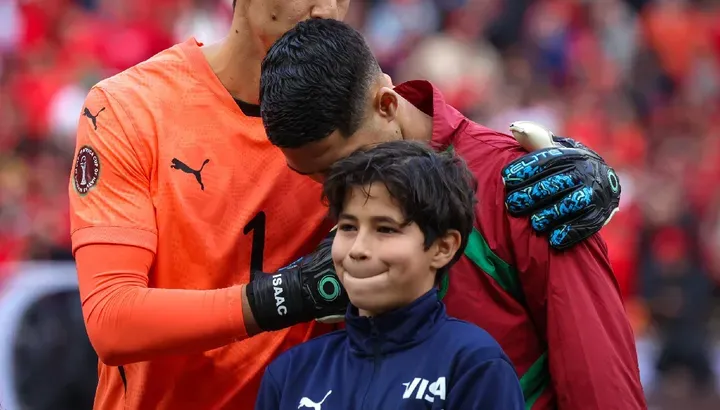
A shining beacon during Morocco's historic 2022 World Cup campaign, Yassine Bounou became a household name after his remarkable performance in the penalty shootout against Spain during the round of 16, executing three critical saves. His achievement of being the first Moroccan to be recognized in the top 20 of the Ballon d'Or rankings speaks volumes about his skill and impact. At the club level, Bounou's contributions to Sevilla, where he clinched the UEFA Europa League title in both 2020 and 2023, have solidified his reputation as a decisive player.
Another legendary figure is Aziz Bouderbala, who showcased his extraordinary football intelligence at the 1986 World Cup, guiding Morocco to the round of 16. With a total of 78 caps, Bouderbala made his mark in France's Ligue 1 with notable stints at RC Paris and Olympique Lyonnais. His tactical vision and technical skills earned him recognition from the Confederation of African Football (CAF), securing his spot among the 200 best African players over the past 50 years. His assist that led to Lyon's victory over Saint-Etienne in 1984 was a pivotal moment that underscored his ability to shine during crucial matches.
Mehdi Benatia, who carved out a successful career in Europe with teams such as Roma, Bayern Munich, and Juventus, served as the backbone of the Moroccan defense with 66 international caps. A charismatic leader, he won two Bundesliga titles with Bayern, marking him as the first Moroccan to excel in a major European league. His versatility as a defender and capability to drive the ball forward made him a standout player, with five goals accrued during the 2013–14 Serie A season while playing for Roma.
Salaheddine Bassir is forever remembered for his significant contributions during the 1998 World Cup, particularly for scoring a brace against Scotland. Known for his speed and opportunistic play, Bassir's tenure at Deportivo La Coruna further demonstrated his adaptability in a demanding league, where he made 79 La Liga appearances. His memorable goal that clinched the 2002 Moroccan Cup final for Raja Casablanca solidified his legacy among supporters, alongside his participation in three Africa Cup of Nations tournaments.
Affectionately nicknamed "El Maestro," Abdelmajid Dolmy was instrumental in steering Morocco to victory at the 1976 Africa Cup of Nations and into the 1986 World Cup. His near 700 appearances for Raja Casablanca reflect his loyalty and significant impact on Moroccan football. Dolmy's assist in the semi-final against Egypt in 1976 was a defining moment that led to Morocco's triumph. Even in his late thirties, he displayed remarkable longevity by competing at the 1988 AFCON.
Noureddine Naybet's leadership over a span of 16 years, earning 115 caps, made him a cornerstone of the Moroccan defense. Captaining the team during the 2004 AFCON, Naybet's outstanding tactical awareness and leadership were crucial in navigating challenging matches. His extensive experience at Deportivo La Coruna, where he made nearly 300 appearances, further solidified his status as one of the club's most-capped foreign players, enhancing Morocco's reputation internationally.
Achraf Hakimi, trained at Real Madrid, has enjoyed a stellar career, winning the Champions League with both Real Madrid in 2018 and PSG in 2025. His versatility as a right-back has allowed him to shine in top leagues across Germany, Italy, and France while amassing impressive domestic titles. His remarkable statistics, including 11 goals and 15 assists in 73 Champions League appearances, highlight his attacking contributions. Moreover, his scoring prowess, demonstrated through two direct free-kicks at the 2021 AFCON and his leadership role in guiding Morocco to a bronze medal at the 2024 Paris Olympics, marks him as a player of great influence.
Badou Zaki etched his name in World Cup history with critical saves against England and West Germany during the 1986 tournament. His success as a manager, leading Morocco to the 2004 AFCON final, further cemented his legacy within the sport. Zaki's performances earned him the African Ballon d'Or in 1986, alongside the prestigious Zamora Trophy for best goalkeeper in Spain in 1989 with Mallorca, exemplifying his excellence in goalkeeping.
Mustapha Hadji, the 1998 African Ballon d'Or winner, is celebrated for his creativity and skill on the field. His stunning goal against Norway during the 1998 World Cup encapsulates his flair and dedication to the game. With a career spanning Spain, England, and France, Hadji's contributions included three goals across World Cup tournaments, leaving a lasting legacy and paving the way for future Moroccan talents in the English Premier League during his time at Coventry.
Lastly, Ahmed Faras, the first Moroccan to win the African Footballer of the Year award in 1975, remains a legend in Moroccan football history. His remarkable record of 36 goals in 94 international appearances is a testament to his scoring ability. As a pioneer at the 1970 World Cup and a standout performer during the 1976 AFCON, Faras's impact on the sport is undeniable. His tenure at Olympique de Casablanca, where he scored 17 goals in 34 matches during the 1972–73 season, showcases his versatility as a striker. Faras, who passed away in July 2025 at the age of 78, leaves behind a legacy that continues to inspire future generations.
The number 10 jersey in football is synonymous with creativity and leadership. Over the years, the role of the playmaker has evolved, balancing tactical discipline with creative freedom. Figures like Abdelmajid Dolmy and Mustapha Hadji have redefined this role, each embodying the essence of visionary playmaking in their respective eras. Dolmy's tactical intelligence and ability to orchestrate play, alongside Hadji's aerial technique and innovative style, have set benchmarks in Moroccan football.
The legacies of these footballing icons extend far beyond mere trophies. Ahmed Faras and Mustapha Hadji not only excelled on the field but also paved the way for the future of Moroccan football, blending sporting success with resilience and inspiring a new generation of players. In a nation where football transcends the realm of sport, these legends stand as enduring symbols of hope and aspiration for a modern and ambitious Morocco.
As reported by sportsmole.co.uk.