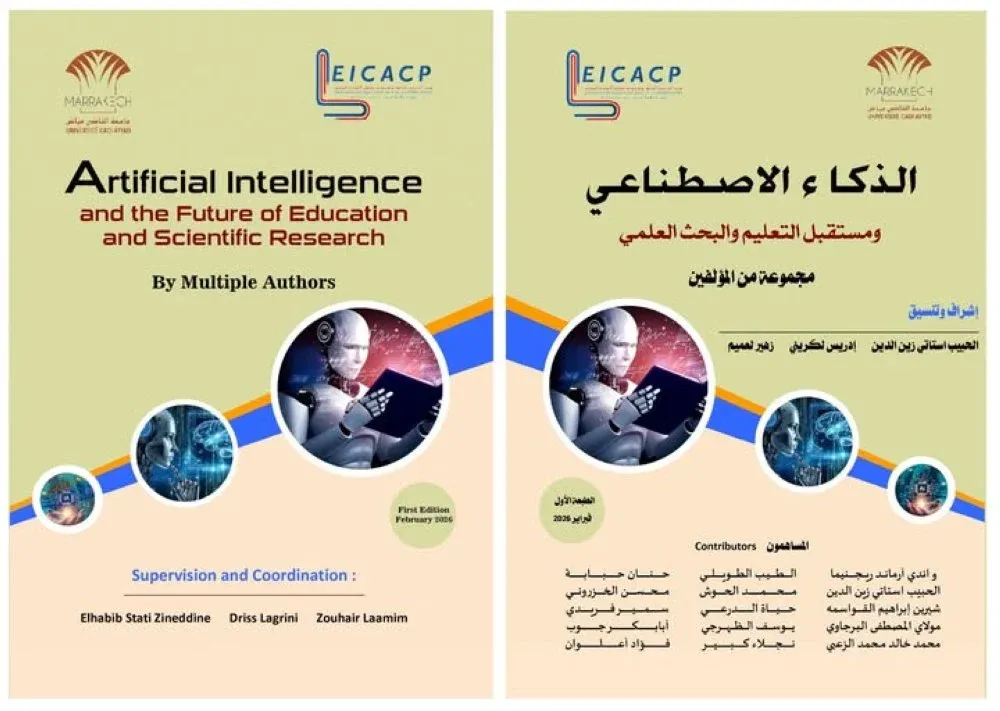

In a notable study conducted in 2022 at Vanderbilt University, it was found that the AI detection system from Turnitin mistakenly flagged one percent of student submissions—equating to about 750 students—potentially accusing them of submitting artificially generated work. This statistic, highlighted by Ivorian philosopher Ouandé Armand Régnima in a contribution to the book titled "Artificial Intelligence and the Future of Education and Scientific Research," sets the tone for a comprehensive examination of the challenges posed by the rapid algorithmization of knowledge. The book aims to navigate a middle ground, rejecting both naive techno-optimism and outright condemnation. André Comte-Sponville's assertion that "copying is not creating; repeating is not thinking" succinctly captures the dilemma at hand, opening up a vast horizon of challenges to explore.
The book compiles the proceedings from an international conference held on November 20 and 21, 2025, under the auspices of the Laboratory for International Studies and Constitutional Analysis of Crises and Policies (LEICACP), in collaboration with the Hanns Seidel Foundation. Coordinated by esteemed professors Driss Lagrini, El Habib Stati Zineddine, and Zouhaïr Laamim from the Faculty of Legal, Economic, and Social Sciences at Cadi Ayyad University, the volume spans 337 pages divided into thirteen chapters, showcasing a rich linguistic diversity with contributions in Arabic, French, and English. While most authors are Moroccan, the book also features contributions from Jordanian, Ivorian, and Sudanese scholars, promoting a dialogue between Arab and African experiences.
AI Reshaping Academic Evaluation
The coordinators posit in their introduction that AI has transcended its role as a mere technical crutch, emerging as a structural actor that redefines the very contours of knowledge production, research functions, and learning pathways. Mohsine Khazrouni, an educator at the Cadi Ayyad University’s School of Higher Education in Marrakech, provides a direct commentary on the need to reform academic evaluation practices. Through a qualitative survey conducted among educators across various countries, including Morocco, he highlights the erosion of traditional assessment methods such as homework, dissertations, and theses. While detection software like Turnitin, CopyLeaks, iThenticate, and GPTZero are widely adopted, none alone guarantees academic integrity. The proposed solution is a radical rethinking of evaluation methods, focusing on oral assessments, situational analyses, critical reasoning in class, and projects deeply rooted in the student’s locality.
This critical perspective is further developed by Régnima, who questions the shifting line between legitimate technological assistance and fraudulent substitution of human thought. Beyond the Vanderbilt case, he points out a disturbing bias: texts authored by non-native English-speaking students are more frequently labeled as artificial by detection systems. This phenomenon is particularly concerning for the Arab and Francophone academic communities. He also reminds readers that UNESCO, as early as November 2021, urged its 194 member states to establish a framework based on transparency, fairness, and human accountability. In a move reflecting this principle, the University of Montreal now requires that students disclose any use of AI tools to their research supervisors, while Morocco has yet to implement such institutional measures.
AI's Influence Across Various Domains
The book broadens its scope to examine AI’s incursion into political science, as El Habib Stati Zineddine and Youssef Dhaherjy explore both the analytical opportunities and the risks of algorithmic reductionism. Sherine Ibrahim Al-Qawasmeh contributes a significant discussion on the amplified risks of media misinformation driven by generative AI, a particularly pressing issue in the context of elections and influence operations. Najlaa Kabir delves into the realm of visual arts, recalling how the AI-generated artwork "Edmond de Belamy" fetched $432,500 at Christie’s in 2018, igniting a global debate on intellectual property, originality, and the value of art. Furthermore, the SAPGAN model, developed by researcher Alice Xue, managed to deceive over half of the observers during a visual Turing test focused on traditional Chinese landscapes, signaling that creation is no longer solely a human endeavor.
In the realm of public policy, Hanane Hababa offers an innovative reading of AI as an augmented evaluation tool for training policies, proposing an operational roadmap for the Moroccan system. Fouad Aalouane investigates a less explored area in Francophone literature: the application of AI in managing humanitarian crises, using the Gaza conflict as a case study. Real-time satellite mapping, image recognition, and the modeling of displaced populations exemplify how technology can save lives, yet it also raises formidable questions about data protection and unequal access to these tools in conflict zones.
The coordinators' introduction does not provide definitive conclusions; it positions Morocco as a "significant case" in the trajectory of integrating AI into public policy, referencing ongoing national strategies, university-business partnerships, and emerging initiatives within Moroccan faculties. However, they caution that the successful application of AI in the Global South hinges on reducing the digital divide, fostering local skills, and, as repeatedly emphasized, avoiding the "reproduction of new forms of cognitive dependency." The notion of scientific sovereignty, within the context of this work, has become as much about algorithms as it is about funding. Ultimately, the message is clear: rejecting AI is not an option; adopting it without a critical framework is even less so. The pressing question remains whether Moroccan universities, alongside Arab and African institutions, will leverage AI as a tool for autonomy or inherit it as a new form of servitude. The answer, as the book suggests, will not be penned in Marrakech or Berlin, but somewhere in between.
As reported by lematin.ma.