
On November 19, 2018, Pedro Sánchez made a significant diplomatic move by visiting Rabat, marking the traditional first international visit of a Spanish Prime Minister. During this visit, he proposed the idea of inviting Morocco to join the joint bid that Spain was preparing with Portugal to host the highly anticipated FIFA World Cup 2030. This initiative was aimed at strengthening the ties between the two neighboring countries, and Sánchez first presented the idea to Moroccan Prime Minister Saadedín Al Othmani, before discussing it with King Mohamed VI, who, according to Sánchez, was "very receptive" to the proposal.
However, complications arose as the notion had originated from the Royal Spanish Football Federation (RFEF) and its then-president, Luis Rubiales, who had merely suggested it as a possibility. Witnesses to these discussions indicated that FIFA officials learned about Spain's proposal to Morocco through the media, prompting FIFA President Gianni Infantino to send a letter to the RFEF, questioning how they could announce a candidacy without consulting them first. In response, Rubiales attempted to distance himself from the controversy through a public statement, while Sánchez confronted him via WhatsApp, reminding him of what had been discussed in their meeting with Infantino.
Initially a Bid Just for Spain and Portugal
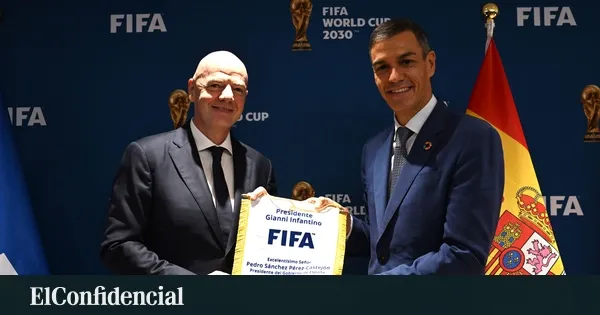
Interestingly, prior to this diplomatic exchange, on September 12, 2018, Infantino, accompanied by Rubiales, had made a courtesy visit to Sánchez, during which he presented him with a FIFA jersey emblazoned with his name and the number 9. However, this visit lacked any substantial outcomes beyond the customary cordiality expected of FIFA's highest representative. Despite Rubiales' later claims, the initial bid for the World Cup 2030 was solely between Spain and Portugal. After discussions between the RFEF and the Portuguese Football Federation (FPF), the proposal was officially dubbed the "Iberian bid." The then-president of the FPF, Fernando Gomes, participated as an invited guest at the Supercopa de España in Tangier in August 2018, where the collaboration was solidified.
On June 4, 2021, Spain and Portugal formalized their agreement at an event held at the Wanda Metropolitano, attended by Felipe VI, the President of Portugal, Marcelo Rebelo de Sousa, Pedro Sánchez, and his Portuguese counterpart, António Costa. In the early stages, there was consideration of including Morocco in the World Cup bid to enhance its chances of success, as more participating nations would translate to more votes in favor of the candidacy.
Rubiales reached out to Sánchez to discuss this potential inclusion, but it was during the aforementioned visit to Rabat that Sánchez unexpectedly proposed Morocco's participation. This was before FIFA had any knowledge, as Sánchez invited King Mohamed VI and later presented the bid as his own idea during a press conference.
Subsequent discussions with Infantino helped smooth over tensions, and the idea of including Morocco began to gain traction, prompting FIFA to revise its regulations that previously prohibited hosting the World Cup across multiple continents. As it stands, the 2030 World Cup is set to occur across three continents, rather than just two.
Ultimately, Infantino expanded the candidacy to include Uruguay, Paraguay, and Argentina, framing it as a celebration of the centennial of the first World Cup, with the inaugural match planned for Montevideo. This move also served to consolidate two competing bids into one, paving the way for a direct allocation of the 2034 World Cup to Saudi Arabia. The question remains: if Infantino continues in his role, will he similarly influence the final decisions regarding the 2030 World Cup?
As reported by elconfidencial.com.