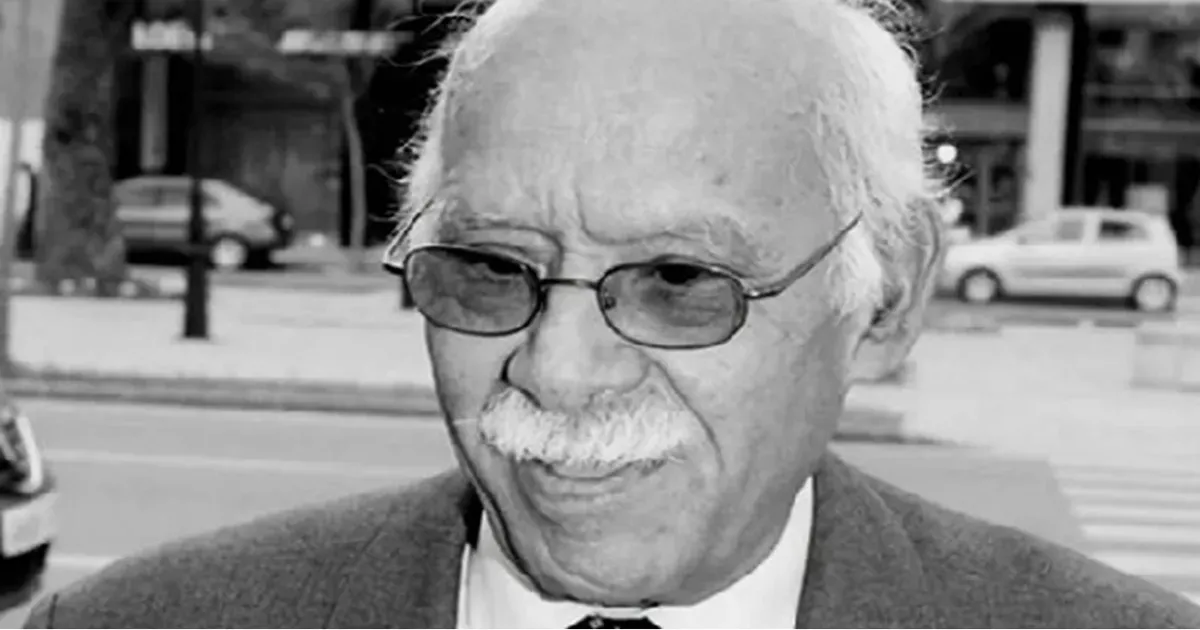

The Moroccan and Arab cultural scene has lost one of its most significant figures with the passing of writer, poet, critic, and university professor Dr. Mohamed Serghini. His career spanned several decades, during which he played a pivotal role in shaping the contours of modern Moroccan poetry and enhancing the tools for its reading and critique. The Moroccan Ministry of Culture announced his death, extending condolences to his family and the national cultural and artistic community. His passing has brought back to light the legacy of an individual closely linked to poetic renewal in Morocco since the 1960s, known for blending poetic experience with academic research and an openness to heritage as well as contemporary intellectual and artistic movements.
A Literary Giant from Fez
Born in Fez in 1930, the city significantly influenced his cultural and spiritual formation as well as his poetic journey. Dr. Serghini completed his early education at the historic Al Quaraouiyine University before moving to Iraq to study at Baghdad University. He continued his academic training in Morocco and France, obtaining a degree in comparative literature from Mohammed V University in Rabat in 1963, followed by a third cycle doctorate in 1970 and a state doctorate in 1985. Following his scholarly path, he became synonymous with the Faculty of Arts and Humanities in Fez, where he served as a university professor and contributed to the education of generations of students and researchers, also taking on the role of deputy dean for several years during his academic career. His university presence was inseparable from his literary project, treating the university as a space for research, teaching, and interaction with modern critical and intellectual currents, while poetry remained at the heart of his cognitive and creative experience.
A Pioneer of Modern Moroccan Poetry
Serghini is classified among the foremost poets of the 1960s generation in Morocco, alongside notable figures such as Ahmed Al Majati, Mohammed Al Khamar Al Kanouni, and Abdul Karim Al Tabbal, who all contributed to transitioning Moroccan poetry from its foundational phase to new realms of experimentation and modernity. His modernity was not merely a formal shift from traditional poetry to free verse but was linked to a more complex poetic project that sought to expand the relationship between poetry and knowledge, philosophy, mysticism, heritage, and the arts. Studies of his work indicate that he drew from a multitude of sources, ranging from classical and modern Arabic poetry to French and world poetry, as well as mysticism and various modern philosophical and artistic currents, which in turn reflected on his poetic language, symbolic structure, and imagery construction. His name is thus associated with what some scholars term the "learned poem," a form that transcends mere emotional expression and is grounded in extensive knowledge, invoking history, philosophy, myth, mysticism, and diverse cultural forms.
Among the notable characteristics of Serghini's poetic experience are mystery, condensation, and symbolism. He did not treat poetry as a text that should necessarily be easily digestible; instead, he made reading itself part of the adventure of the text, leading to a wide spectrum of critical interest, but also to interpretations suggesting that excessive symbolism and ambiguity could create distance between the text and the reader. Critics have described him as one of the foremost figures who laid the foundations for the poetics of mystery in Moroccan poetry, a poet who made continuous experimentation a core part of his creative identity. In an interview, Serghini stated that a poet does not always choose the moment of writing, and that the creative process is connected to the other, to reading, and to rewriting—insights that reveal his perspective on poetry as an open experience rather than a mere closed linguistic craft.
Serghini’s life story unveils a striking interplay between traditional education and modern academic training. Al Quaraouiyine represented his initial foray into an ancient Arab and Islamic knowledge space, while his studies in Baghdad, Rabat, and Paris transported him to different academic environments, culminating in his experience at the Sorbonne. This multiplicity of educational sources contributed to shaping his cultural persona, which harmoniously blended tradition with modernity, and Arabic culture with an openness to Western literature and modern critical theories. This may explain the strong presence of Sufi heritage in his work, paralleled by his receptiveness to contemporary philosophical and literary currents.
Serghini's influence extended beyond his poetic production; he left a wide impact within the Moroccan university landscape through teaching, training, and academic supervision. He was among those educators who regarded poetry and criticism as integral parts of a broader cultural project. His students described him as a figure who embodied the roles of professor, critic, and poet, with his lectures opening up to new methods in reading poetic discourse, including linguistic, psychological, and semiotic approaches. This facet is crucial for understanding his impact; Serghini did not merely write poetry; he participated in constructing the academic environment that would foster new generations of researchers, writers, and critics. Sources about his career indicate that he served as an assistant professor, then as a lecturer, and finally as a professor of higher education at the Faculty of Arts in Fez, before assuming the role of deputy dean from 1968 to 1991.
One of the concepts associated with reading Serghini's experience is what can be termed cultural poetic writing. For him, the text is inseparable from knowledge; the poet does not limit himself to invoking his personal experience but engages in a dialogue with accumulated knowledge, thought, and diverse symbolism. This is why his poems, in many critical readings, appear laden with references and symbols, requiring a reader equipped with cultural keys to decipher them. Critics have described his work as based on "thesis poetry," aiming to interpret events, unveil the unspoken, and dismantle the controlling structures within mental, mythical, and social frameworks. Thus, for Serghini, poetry was not a linguistic luxury but a means of contemplating humanity, the world, and existence.
Dr. Serghini left behind numerous poetry collections that marked his trajectory, including "And the Burning of Its Names Will Follow" published in 1987, "Seas of Mount Qaf" in 1991, "The Substantial Being" in 1992, and "Who Did This to Your Skulls" in 1994. These titles themselves reflect aspects of the nature of his poetic world; they open up to myth, symbolism, history, and existential questions, not offering the reader a single ready-made meaning. Serghini believed poetry is a space for reconstructing the relationship between language and the world, which led to his experience evolving continuously without settling into a single form.
In addition to poetry, Serghini was active in literary critique and research, particularly in reading poetic discourse. Researchers who attended his lectures described him as receptive to modern critical methodologies, especially semiology and approaches that allow dissecting the internal structure of poetic texts. Therefore, it is challenging to separate Serghini the poet from Serghini the critic; the two projects appear intertwined, one producing the text and the other exploring its production and interpretation mechanisms. This duality distinguished his presence from that of a poet who simply writes verses or an academic who treats literature merely as a research topic. Serghini wrote poetry, read poetry, and taught poetry, thus extending his experience from the page to the university lecture hall and to the generations that studied under him.
It was difficult to separate Serghini's experience from Fez. The city of his birth shaped a significant part of his cultural memory, embodying the legacy of Al Quaraouiyine, mysticism, the Arabic language, and deep historical roots. In his work, traditional Fez coexists with poetic modernity, and Sufi heritage is in constant dialogue with contemporary inquiries. This intricate relationship with heritage was not a return to the past but an attempt to reappropriate it within modern poetry. Thus, some writings have described him as "a modernist in a Sufi robe," highlighting the interweaving of poetic renewal and Sufi references that marked a significant aspect of his experience.
Serghini's departure does not signify the end of a literary presence that spanned over six decades. His legacy is distributed across his collections, studies, research, university lessons, and the writers and critics influenced by him, alongside his position in the history of modern Moroccan poetry. Academic studies have regarded him as one of the voices that instigated a transformation in the consciousness of modern Moroccan poetry, employing new cognitive tools to engage with the poem and developing poetic writing techniques and styles. His presence among the pioneers places him as part of a pivotal phase in the history of Moroccan literature; a phase during which Moroccan poetry transitioned from seeking to establish its presence to building a modern project characterized by its uniqueness and questions.
The official announcement of his passing by the Moroccan Ministry of Culture reaffirmed the stature of the late poet, with the minister expressing "profound sorrow" at his death and describing him as one of the key intellectual and literary figures in Morocco and the Arab world, extending condolences to his family and the national artistic and cultural community. This official mourning arrives at a moment when one of the most prominent symbols of a literary generation that contributed significantly to the cultural landscape is lost.
As reported by stadelahly.net.