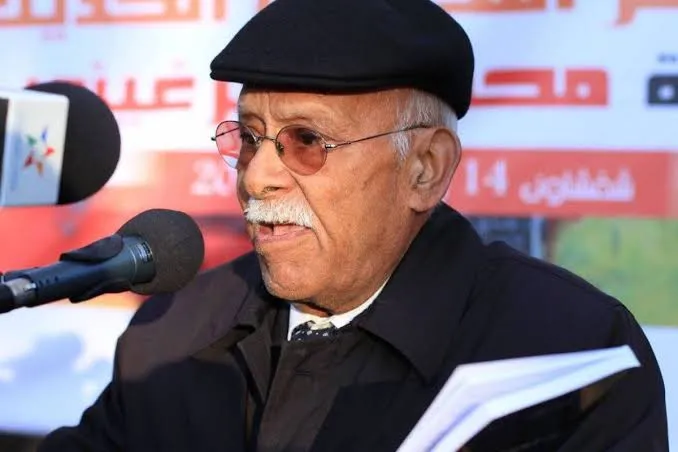

The Life and Influence of Mohamed Serghini
Yesterday, the literary world mourned the passing of Mohamed Serghini, born in 1930 in Fez, Morocco. He was a prominent figure in modern Moroccan poetry and a significant advocate for experimentation in literary writing. Serghini's texts have served as a dynamic workshop for writing, showcasing a daring blend of literary forms that often left critics struggling to classify his work accurately. His unique approach to poetry was deeply influenced by his extensive knowledge of Western culture, his profound understanding of Arabic heritage, and his early openness to global cultures. As a result, his books often appeared alien to those of his contemporaries, leading to accusations of excessive obscurity. However, Serghini's philosophy centered on the belief that a fundamental connection existed between himself and his readers, grounded in knowledge. This premise suggested that without this shared understanding, a considerable gap would emerge between the poet's intentions and readers' expectations. Serghini's works demanded a level of engagement and understanding that placed readers in a challenging position, as he did not write for an audience seeking comfort but rather for one that engages critically with his thoughts.
His poetry did not dwell in the realm of romanticism or cater to readers looking for emotional alternatives; instead, it targeted the intellect of the reader. The poems he crafted drew upon various fields of knowledge, with philosophy being at the forefront. Each text for him was an existential inquiry—a conceptual proposal that did not seek to explain the world but aimed to confront it. The essence of Serghini's writings emerged from a spiritual and inner turmoil, reflecting the existential battles faced by unique beings burdened by thought and consciousness, all seeking to transcend material confines.
A Rich and Diverse Life
Serghini's life was a tapestry woven between the cities of Fez, Baghdad, and Paris—each city contributing significantly to his cultural and intellectual formation. His early education at the Qaraouiyine University during the colonial period granted him a profound connection to Islamic and Arabic heritage, alongside the wealth of knowledge embedded in Moroccan traditional education concerning language and religion. His time studying in Iraq during the 1950s exposed him to the transformative landscape of Arabic poetry, which was evolving in form and substance, particularly in comparison to the Moroccan literary milieu. Furthermore, his studies at the Sorbonne allowed him to engage with the latest literary currents in France, especially the surrealist movement, which profoundly influenced his writing style, urging him to celebrate linguistic and aesthetic structures over mere meaning.
During a time when confidence in writing flourished in the 1970s, Serghini leaned towards skepticism—not only regarding the meanings embedded in his texts but also about the very language used to express those meanings. He distanced himself early on from the pastoral and chivalric traditions heralded by English and French literature during the Romantic period, instead gravitating towards writing that rendered human existence a matter ripe for interpretation and understanding. His belief in the enlightening role of writing compelled him to join the Communist Party in France, where he actively distributed pamphlets during protests related to third-world student issues. However, his literary awareness led him to realize that literature should not be confined to political or ideological frameworks, prompting him to exit the party and engage with broader societal issues, championing the causes of all marginalized individuals, regardless of their affiliations. Through his commitment to literature as a form of protest against all forms of authority and oppression, Serghini remained steadfast in his advocacy for innovation in writing well into his later years.
As a professor at the Faculty of Arts in Fez, he dedicated many years to nurturing young poets through workshops and annual festivals, significantly contributing to the advancement of poetic writing in Morocco. His literary oeuvre includes a rich blend of poetry, prose, drama, and criticism, with notable works such as "The Incineration of His Future Names," "The Seas of Mount Qaf," "The Sabaean Being," and "Who Did This to Your Skulls?" Alongside his experimental novel "I Found You in This Archipelago" and his play "The Ghost Train Song," Serghini's critical studies further enriched the literary landscape, including his book "Lectures on Semiotics" and analyses of the poetry of Salah Stetie.
Despite facing accusations of excessive obscurity throughout his career, which stemmed from his tendency to construct texts within metaphorical and abstract contexts that sometimes muddled the relationship between text and reader, Serghini attributed this spectral quality of his works to the nature of lived experiences in a "Karakizi" world. He believed it inconsistent for writing to be clear and its meanings easily accessible in a reality that is inherently ambiguous. In his view, a poet is akin to a philosopher, yet poetry must transcend philosophy; while philosophical inquiries aim toward truth, poetic questions navigate the known and the unknown. He firmly believed that poetry and thought are inseparable, thus making the poetic text a vast space for contemplation and inquiry, often necessitating a mental engagement with the reader. From his perspective, understanding poetry is often more challenging than understanding philosophy, requiring what he termed "esoteric knowledge."
Affectionately known as the "Sheikh of Moroccan Poets," Serghini once remarked on this title, reflecting on its implications regarding his age and experience in poetry. "If they mean my seniority in poetry, they are correct. However, if they imply that I am a mere replica of an ancient legacy, I would like to draw their attention to my vibrancy and drive for renewal, as I firmly believe that the future of the world lies in an inevitable evolution necessitating greater exposure and discovery through experimentation." When asked about his vision for the future of poetry in Morocco, he confidently stated, "If I depart this world for the next, I will do so with peace, knowing that the state of poetry in Morocco is experiencing remarkable growth."
As reported by independentarabia.com.