
The Foundation of Jewish Heritage in Morocco
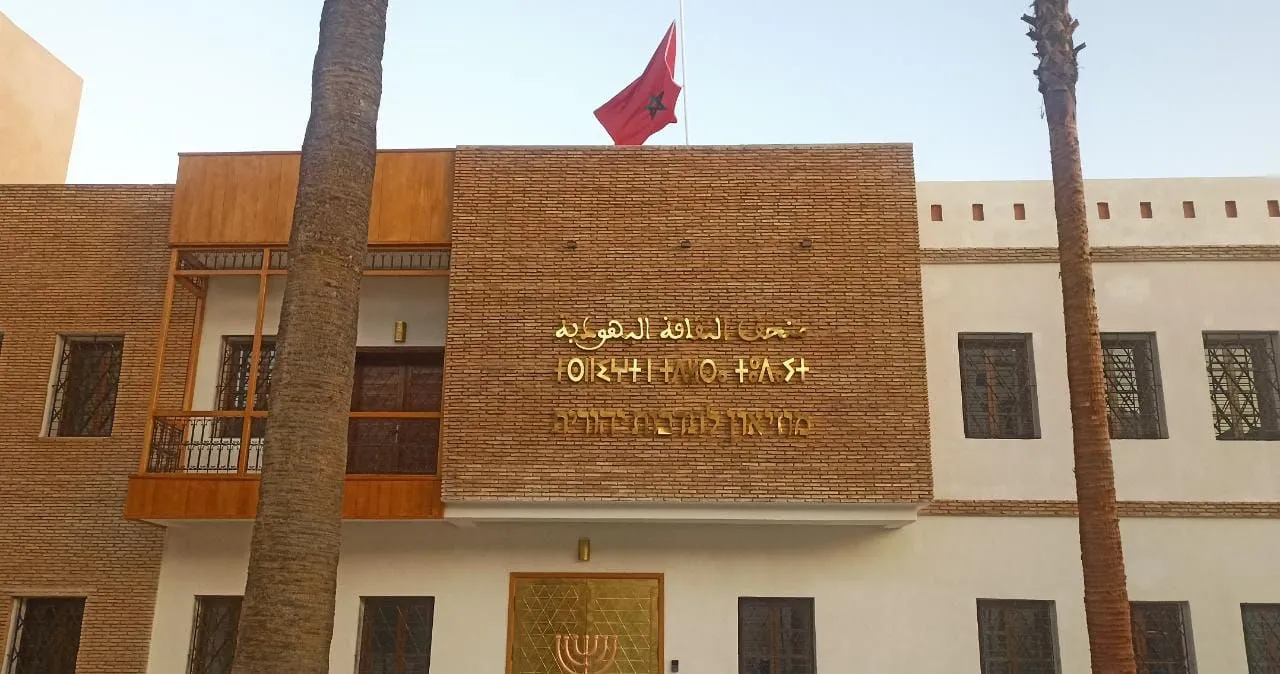
Located in the heart of the Mellah in Fes, the Moroccan Jewish Culture Museum opened its doors to the public on October 12, 2023. This museum is significant because it does not merely present Moroccan Judaism as an external culture or a separate memory; rather, it showcases it as an integral component of the national heritage. The museum aims to reconstruct a national memory that has been shaped in the shadows for centuries, including a Jewish component that is a fundamental part of Morocco's narrative, rather than being relegated to the margins.
The museum goes beyond being a mere repository for artifacts and documents. It serves as a space where objects regain their ability to communicate. Here, manuscripts testify to history, adornments become documents of culture, clothing narrates social stories, and the Torah scroll transforms into a religious and cultural relic. The Mellah itself is an open text reflecting centuries of coexistence, interaction, and exchange.
During a visit to Fes in April 2019, King Mohammed VI initiated the construction of the museum as part of a program to enhance the city’s historic heritage. Alongside this, the restoration of the Batha Palace commenced, which is set to open as an Islamic Arts Museum in 2025. The proximity of these two museums—just a hundred meters apart—symbolizes a deeper connection. Each museum represents a complementary facet of Morocco's multifaceted memory: one focuses on Islamic arts, while the other emphasizes Moroccan Jewish culture, both affirming that Moroccan heritage is never a monochrome tapestry.
A Journey Through Time and Culture
The importance of the Moroccan Jewish Culture Museum lies in its representation of Moroccan Judaism not merely as a foreign culture but as an authentic component of the national identity. The museum is designed with the participation of the Moroccan Jewish community, particularly Serge Berdugo, the founding president of the Moroccan Jewish Cultural Heritage Foundation. It acts as a space for memory, heritage transmission, and sharing. Its collections range from ritual and everyday items to ethnographic artifacts, rare manuscripts, clothing, jewelry, crafts, musical instruments, and documents that preserve the intricacies of daily life.
The value of these collections extends beyond their rarity or age; their deeper significance lies in their reflection of the lives people led—how they prayed, traded, learned, celebrated, married, and worked, leaving behind material traces of their presence in Moroccan cities, villages, markets, and Mellahs. The museum's location is no coincidence. Situated in the heart of the Mellah, it is deeply connected to the history of Moroccan Jews, with its establishment dating back to 1438, making it one of the oldest organized Jewish quarters in Morocco. Thus, a visit to the museum begins even before entering the exhibition halls; it starts from the very place itself, from the walls, alleys, and urban space that served as the backdrop for collective lives spanning centuries.
The building's design harmonizes with the architecture of the old city, incorporating authentic Moroccan elements such as zellij tiles, carved plaster, and painted wood, culminating in a marble fountain in the reception area. The project was executed by the Fes Development and Rehabilitation Agency, in coordination with the National Museum Foundation and specialized teams. The construction was completed in March 2023, covering an area exceeding 1,700 square meters, with approximately 1,200 square meters dedicated to exhibition spaces.
On the ground floor, visitors can explore over 2,500 years of Jewish history in Morocco. The journey begins with the earliest historical evidence, progresses through the founding of the Mellah in 1438, and the arrival of Jews expelled from Spain in 1492, and continues through the evolution of Jewish communities in areas such as science, commerce, and social and spiritual life, all the way to modern times. It is a temporal journey that seeks to portray Moroccan Jews not just as historical subjects but as active participants in Moroccan history. Documents, manuscripts, and audiovisual materials help contextualize this experience and highlight the contributions of Jewish communities to the economic, cultural, and social life of the kingdom.
One of the most striking aspects of the museum is the section dedicated to religious and intellectual figures, especially rabbis and prominent personalities in the Moroccan rabbinical tradition. This exhibit gains additional symbolic strength from the windows overlooking the Jewish cemetery, where the external view extends the internal exhibition, turning the cemetery into a living memory that gazes upon the museum.
While the ground floor narrates history in its temporal extension, the upper floor delves into the details of daily life. Here, visitors encounter the temple, Hebrew school, rabbinical court, Mellah, and its institutions, offering an interpretation that blends history with anthropology. The museum provides significant attention to life cycles, from birth and circumcision to adulthood, marriage, and death. Exhibits become keys to understanding the community: circumcision chairs, wedding attire, jewelry, talit bags, Jewish marriage contracts (ketubot), the bride's dress (ksuva), and curtains for the holy Torah ark. Through these details, it becomes evident that religion was not a separate ritual from life; rather, it was woven into the daily fabric, adapting to the diverse environments and regions of Morocco. Traditional clothing also reflects this diversity, from the 'Akhnef' of the south, a traditional men’s garment, to the Tafilalet outfits that carry nuances of local and social significance.
One of the most exciting sections of the museum, which emphasizes the value of material heritage, is dedicated to traditional crafts, particularly jewelry making, practiced by Jewish artisans in various Moroccan regions. A traditional jewelry workshop has been recreated with its tools and equipment, allowing visitors to step into the very workspace where skilled hands created necklaces, clasps, silver pendants, and various forms of traditional jewelry. However, the craft does not stop at metalwork; the museum also encompasses textiles, weaving, clothing, music, and elements associated with domestic architecture. Thus, each piece transforms from a mere object of display into a social document that narrates ways of living, tastes, social status, and regional peculiarities.
In an era where public relationships with museums are evolving, this space has been designed not merely as a treasury of heritage. The project takes into account preventive preservation, security, and collection tracking, while also incorporating audiovisual media and digital technologies. Cultural mediation plays a vital role in the experience, especially for children, youth, and school groups, through workshops, educational activities, and interactive spaces. The goal is not only for visitors to see the object but also to understand it, to discover the stories, contexts, and meanings behind it. Herein lies the modern function of the museum: to preserve the material while safeguarding its meaning; to protect the document while allowing it to engage in dialogue with the present.
Ultimately, the Moroccan Jewish Culture Museum in Fes resembles a page reopened from an ancient book. However, it does not merely do this out of nostalgia; it aims to restore value to a memory that is a crucial part of Moroccan society, integrating it into a broader national narrative. It is indeed a museum of Jewish culture, but fundamentally, it is also a museum of Morocco because the history of Moroccan Jews is not a history of a community separate from the country, but rather part of the country’s own history. From this perspective, its proximity to the Islamic Arts Museum is more than just an architectural coincidence. Together, these two museums in the historic space of Fes present a picture of a heritage formed through diversity and interaction, affirming that national memory is enriched not by erasing differences, but by knowing how to preserve, juxtapose, and interpret them within their shared context.
In this way, Fes reclaims its ancient role: a city that not only guards the past but also reinterprets it. Between the Mellah and the Batha Palace, between manuscripts and jewelry, between the Torah and zellij, visitors witness a Morocco that celebrates its multifaceted contributions, where histories, religions, and cultures converge. It is a Morocco that sees its Jewish heritage as an essential part of its identity, as something not alien to it; in its diversity, it finds richness; and in memory, when preserved with knowledge rather than selectivity, it builds a bridge connecting the past to the future.
As reported by i24news.tv.