
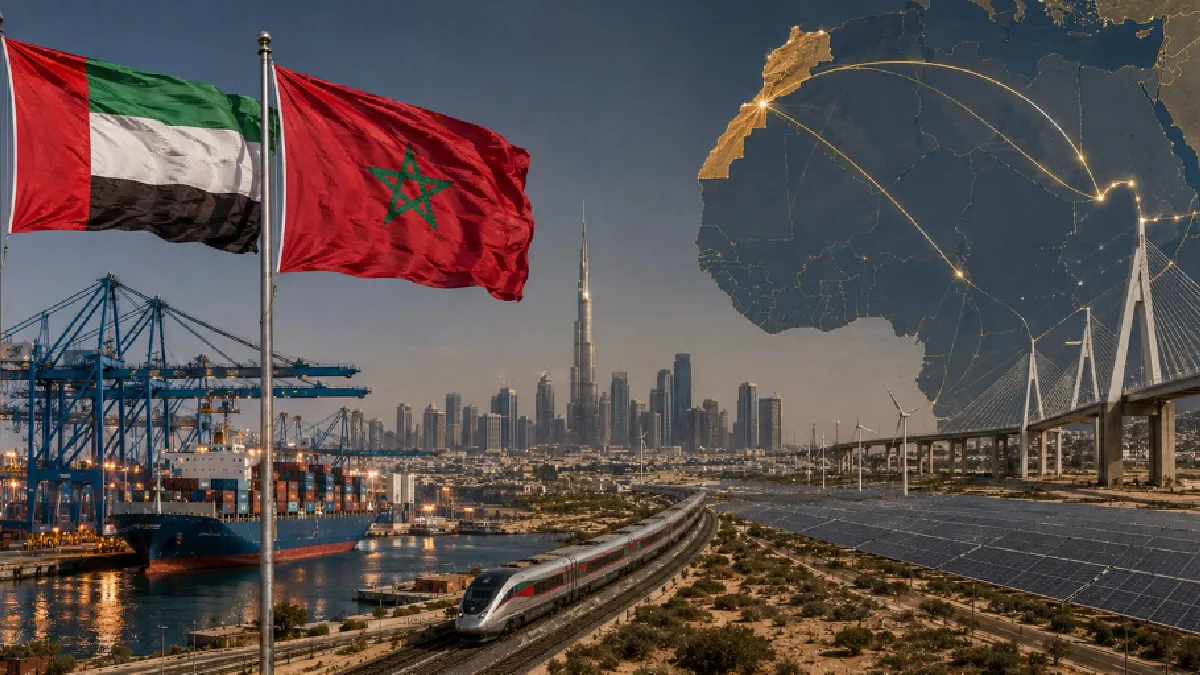

The staggering figures reveal a significant transformation in the economic landscape of Morocco, with Emirati investments exceeding a remarkable $15 billion. However, this influx of capital signifies more than just a collection of projects; it represents the emergence of a new geopolitical axis connecting the Atlantic to the Gulf, with a keen focus on Africa. According to a study published by the Observer Research Foundation Middle East on August 11, 2026, there is a burgeoning "geoeconomic alliance" forming between Rabat and Abu Dhabi. This partnership is not solely based on the political ties that exist between two monarchies but rather hinges on a structural complementarity: the Emirati capital is well-matched with Morocco's strategic geographical location, its robust infrastructure, and its openness towards the African continent.
In December 2023, a pivotal declaration was signed by Mohammed VI and Mohammed bin Zayed in Abu Dhabi, laying the groundwork for extensive collaboration across various sectors. The agenda includes ambitious projects involving high-speed railways, ports, airports, water management, energy, agriculture, tourism, financial markets, data storage, and even the Nigeria-Morocco gas pipeline. This pipeline, estimated to cost around $25 billion, will traverse eleven West African nations to connect Nigeria with Morocco. The Emirates have officially expressed interest in partnering with Rabat on this vital project. Similarly, within Morocco, a consortium that includes TAQA Morocco, Nareva, and the Mohammed VI Fund for Investment launched a colossal initiative in water and energy, focusing on desalination, water transfer, renewable energy capacity, a gas power plant, and a 1,400-kilometer high-voltage line, with projected investments nearing 130 billion dirhams by 2030.
Beyond Business: A Strategic Alliance
However, this deepening relationship transcends mere business dealings. As highlighted by Jeune Afrique in their August 17, 2026 article titled "Morocco-Emirates: Behind the Billions, a New Axis from the Atlantic to the Gulf," the grand projects are beginning to materialize into an alliance that extends far beyond commercial interests. The study elucidates the geopolitical ambitions of both monarchies, which stretch from the Sahara to the Abraham Accords. The Emirates have ascended to become the leading Arab investor in Morocco, with over $15 billion directed into the kingdom. Trade between the two nations, excluding oil, reached $1.3 billion in 2023, reflecting a 30% year-on-year increase. However, the real transformative shift lies in the establishment of an economic axis that connects the Gulf, Europe, and particularly Africa.
Morocco as the Gateway to Africa
The Observer Research Foundation posits that this burgeoning array of projects is gradually defining a much broader economic axis. The Emirates possess the capital and an international investment strategy, while Morocco boasts infrastructure tailored towards Europe and the Atlantic, alongside a well-entrenched economic and diplomatic network in West Africa. Consequently, Rabat is positioning itself as a pivotal support point for Emirati strategy on the continent. Amidst a rapidly shifting regional balance—characterized by normalization with Israel under American auspices, the resurgence of the Palestinian issue following the events of October 7, 2023, and the challenging decisions it imposes—the Moroccan-Emirati alliance emerges as one of the most robust pillars of this new economic geography. The billions of dollars invested are merely the visible tip of the iceberg; beneath the surface, a geopolitical axis is forming that stretches from the Atlantic to the Gulf, with Africa firmly in its sights.
As reported by lediplomate.media.
