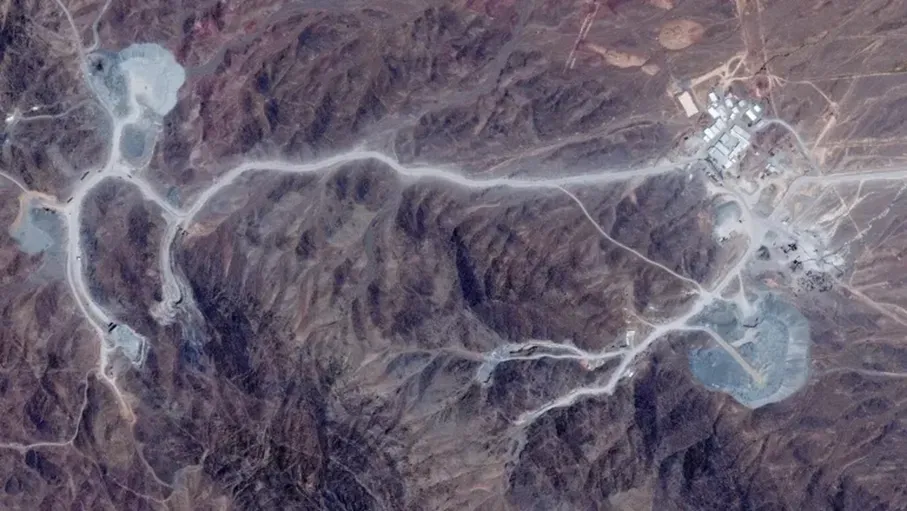

In the southern region of Tehran, a clandestine underground complex, known as Kuh Kolang Gaz La—translated as "Mountain of the Axe"—has emerged as a subject of intense debate and scrutiny. Located less than two kilometers away from the notorious Natanz uranium enrichment facility, experts believe this site is fortified against even the most powerful U.S. bunker-busting bombs. While Iranian officials assert that the complex is intended for the assembly and manufacturing of advanced centrifuges, U.S. and Israeli intelligence agencies harbor suspicions that it may serve as a clandestine alternative facility for uranium enrichment.
The Institute for Science and International Security in the United States has analyzed satellite imagery and indicated that the complex is yet to be operational, with construction activities still ongoing. This site has gained prominence as a primary target threatened by the U.S. during the U.S.-Israeli-Iranian conflict that erupted in 2026. On July 21, 2026, former U.S. President Donald Trump stated that a strike on the Mountain of the Axe could happen "relatively soon." In response, Iranian Foreign Ministry spokesperson Ismail Baqaei dismissed these claims, arguing that Washington's obsessive focus on Kuh Kolang—which is devoid of any nuclear activities—was merely a fabricated pretext for aggression and destruction.
The Location and Structure of Kuh Kolang
Kuh Kolang is situated in Isfahan province, approximately 220 kilometers south of Tehran, and just two kilometers from the Natanz facility. The mountain rises about 1,600 meters above sea level, nestled within the Zagros mountain range, surrounded by complex rocky terrain that provides an exceptional level of fortification, making it one of the most challenging military targets. The facility spans nearly one square kilometer at the mountain's base, enclosed by a security fence that stretches for several kilometers and connects with the perimeter fence around Natanz. Two paved roads lead to the entrances of the tunnels, as reported by the Anadolu Agency.
A report by the Institute for Science and International Security estimates that the facility's depth is at least 100 meters beneath the mountain. Construction of the site reportedly began in December 2020, following a fire at the Natanz facility, which Iranian authorities attributed to a "cyber sabotage" incident, while Western reports pointed to possible Israeli involvement. At that time, Ali Akbar Salehi, the head of Iran's Atomic Energy Organization, informed the National Security Committee of Parliament that Iran was committed to building a new complex for assembling centrifuges "within the heart of the mountain," asserting that construction had already commenced.
Strategic Importance and U.S. Threats
The strategic significance of the Mountain of the Axe is multifaceted, primarily stemming from the ongoing controversy regarding the purpose of the facility. While Tehran maintains that it is designed for the assembly and production of advanced centrifuges, U.S. and Israeli intelligence agencies suspect it may serve as a secret site for uranium enrichment, acting as a "safety umbrella" for Iran's nuclear program, according to the American Monitor website. The high level of fortification at the site, featuring two deeply buried tunnel complexes, heightens its importance. U.S. intelligence estimates suggest that these tunnels are carved beneath hundreds of meters of solid granite, rendering them resilient against the most powerful American bunker-buster bombs.
Conversely, Iranian sources assert that the site's significance transcends technical or military dimensions, extending into the political realm, as Tehran views the prevailing narrative as an Israeli disinformation campaign aimed at prompting the U.S. to escalate its military operations against Iran. In this context, Israeli army radio conveyed estimates that the site harbors components necessary to establish an underground facility capable of enriching uranium to a military-grade level of 90%, with the presence of enriched uranium potentially justifying U.S. action. However, these assessments have not been independently validated, and there has been no official announcement regarding the presence of enriched nuclear materials at the site.
In the wake of the U.S.-Israeli-Iranian war that ignited on February 28, 2026, and the failure to reach an agreement between Washington and Tehran, President Trump repeatedly threatened to annihilate the Mountain of the Axe. During an interview on "The Hugh Hewitt Show" on July 13, 2026, he asserted, "We will destroy the Mountain of the Axe. Tell the Iranians to be prepared." However, when asked on July 21, 2026, whether he believed Iran had transferred nuclear centrifuges to the site, he responded, "They might have done that, but we have no confirmed information on that," further clarifying, "This doesn’t mean anything unless they have the material (uranium). We are monitoring the material; therein lies the crux of the issue." He added that the U.S. was closely monitoring the site, stating, "We see no activity there. They are not doing well in their nuclear positioning. Each time we hear about it, we blow it up. That’s why they don’t like to talk about it. But we will probably strike (the Mountain) relatively soon."
Trump had previously promised that "any site they even think of using for nuclear purposes, we will hit it hard." In contrast, Iranian Foreign Ministry spokesperson Ismail Baqaei denied any nuclear activities at the site, emphasizing in a post on the platform "X" on July 22, 2026, that all Iranian nuclear activities "have been fully declared to the International Atomic Energy Agency, in accordance with the stipulated guarantees." He reiterated that Washington's obsessive focus on Kuh Kolang, which allegedly conducts no nuclear activities, was merely a fabricated excuse to justify aggression and destruction. Experts concur that the complex is fortified to a level that exceeds the capabilities of the most powerful U.S. bunker-busting bombs. The Institute for Science and International Security concluded that destroying the site would be more suitable through a ground attack, although potential vulnerabilities could still be exploited through aerial strikes.
As reported by alghad.com.