
Assessing the Development Landscape of Ouled Ayad, Saada, and Souihla
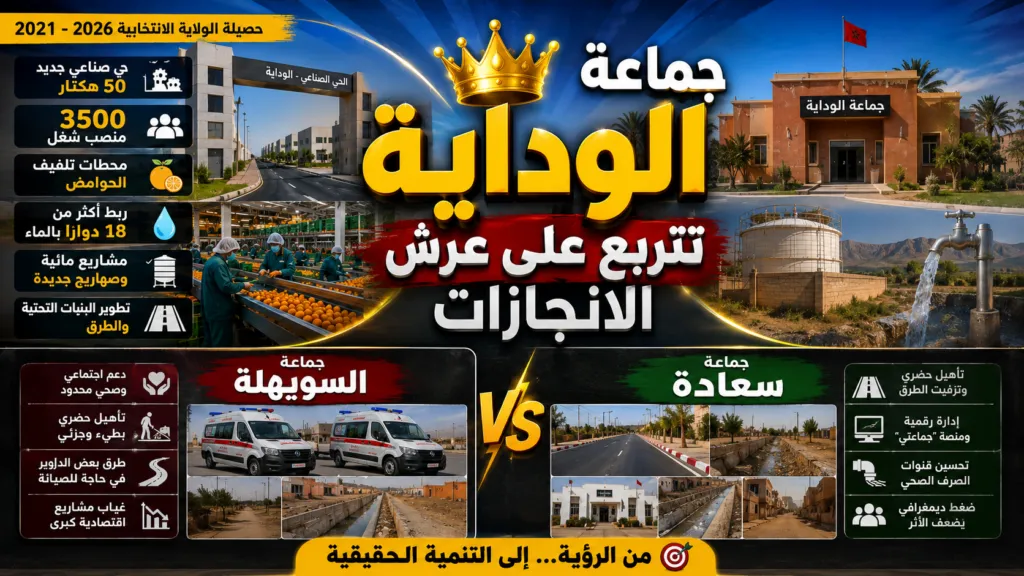
As the current electoral term, spanning from 2021 to 2026, approaches its conclusion, discussions are reigniting regarding the performance of the local councils surrounding Marrakech, particularly focusing on Ouled Ayad, Saada, and Souihla. A preliminary analysis reveals significant disparities in the nature of projects undertaken, as well as the priorities set by these councils in response to the needs of their residents. While Saada has primarily concentrated on managing urban expansion and enhancing digital administration, Souihla has directed its efforts more towards social and health-related initiatives. In stark contrast, Ouled Ayad has prioritized economic, water, and infrastructure projects, positioning itself at the forefront of developmental discussions in the region.
Saada: Urban Rehabilitation Amidst Rapid Expansion
During this electoral period, Saada has faced challenges linked to the swift urban expansion and demographic pressure stemming from the growth of Marrakech into its surrounding areas. Notable initiatives executed or initiated include the rehabilitation of sewage systems and the resurfacing of numerous roads, notably related to the first phase of the Horizons subdivision. Furthermore, Saada has made significant strides in administrative digitization, developing electronic services and modernizing its official website to facilitate access to information and communal services while reducing the necessity for residents to travel to the council's office. However, the most pressing challenge for Saada remains the escalating demographic pressure, which compels the forthcoming council to continue investing in roads, sanitation, lighting, and public facilities to keep pace with the population and urban growth.
Conversely, Souihla has demonstrated a pronounced commitment to social and health-related services, addressing managerial and political challenges that, according to local stakeholders, have affected the pace of certain structural projects. Key initiatives include the enhancement of health transportation services and the acquisition of equipped ambulances, particularly to assist patients requiring transfer from rural areas to healthcare institutions. These projects hold particular significance for residents of rural communities, given the distances separating many villages from healthcare centers and hospitals. Nevertheless, the challenge facing Souihla moving forward will be the transition from social interventions to economic projects capable of generating jobs and stimulating local economic activity.
Ouled Ayad: A Focus on Economic Development, Water Security, and Infrastructure
Ouled Ayad stands out in local discourse as a distinctive model, characterized by the nature of projects proposed during the current electoral term, particularly within the realms of local economic development, water management, and infrastructure. One of the most talked-about initiatives is the establishment of an industrial zone spanning approximately 50 hectares, which, if realized as envisioned, could open new avenues for investment and job creation in the region. Estimates suggest the potential creation of around 3,500 direct and indirect jobs, though this figure is contingent on the project's completion stages and the nature of the final investments involved. Additionally, there is a noticeable trend towards enhancing local agricultural products by promoting investments related to the packaging of citrus fruits and agricultural production chains. Such developments could significantly retain a larger share of added value within the communal territory, while also generating employment opportunities linked to production, packaging, transportation, and logistics services.
Water security has emerged as a critical challenge for Ouled Ayad, especially given the recurring years of drought and declining water resources. Discussions have included the construction of water reservoirs and projects aimed at supplying several villages with potable water, alongside initiatives related to liquid sanitation. These projects are of paramount importance to residents, as access to water is intrinsically linked not only to public service delivery but also to the stability of the population, improved living conditions, and mitigating the impacts of drought.
When comparing the three councils, it becomes clear that the primary differences extend beyond the number of projects and delve into the nature of developmental visions. Saada faces challenges related to urban expansion and infrastructure rehabilitation, Souihla prioritizes social and health services, while Ouled Ayad emphasizes local economic stakes, investment, water security, agricultural enhancement, and infrastructure development. Therefore, a comprehensive evaluation of their achievements should not solely rely on perceptions but rather on precise criteria, including budget size, execution rates, project counts, associated costs, beneficiary numbers, and the actual impact on residents' lives.
In terms of developmental dynamics, preliminary estimates position Ouled Ayad at the forefront, followed by Saada, and then Souihla. However, these percentages remain indicative and should not be regarded as definitive rankings until they are compared with financial documents and official assessments from each council. Civil actors assert that the current phase is marked by a shift from merely demanding essential projects to seeking initiatives capable of creating job opportunities and achieving sustainable added value. Local stakeholders emphasize that the true challenge for the region's youth lies in securing employment and economic stability rather than relying solely on temporary projects with limited impact. In summary, the electoral period from 2021 to 2026 presents three distinct local experiences: Saada is addressing urban expansion challenges, Souihla is focused on enhancing social and economic services, while Ouled Ayad is committed to building a model more closely tied to investment, water security, and local economic growth.
As reported by klamkom.com.