
The Political Dynamics in Nador Ahead of the 2026 Elections
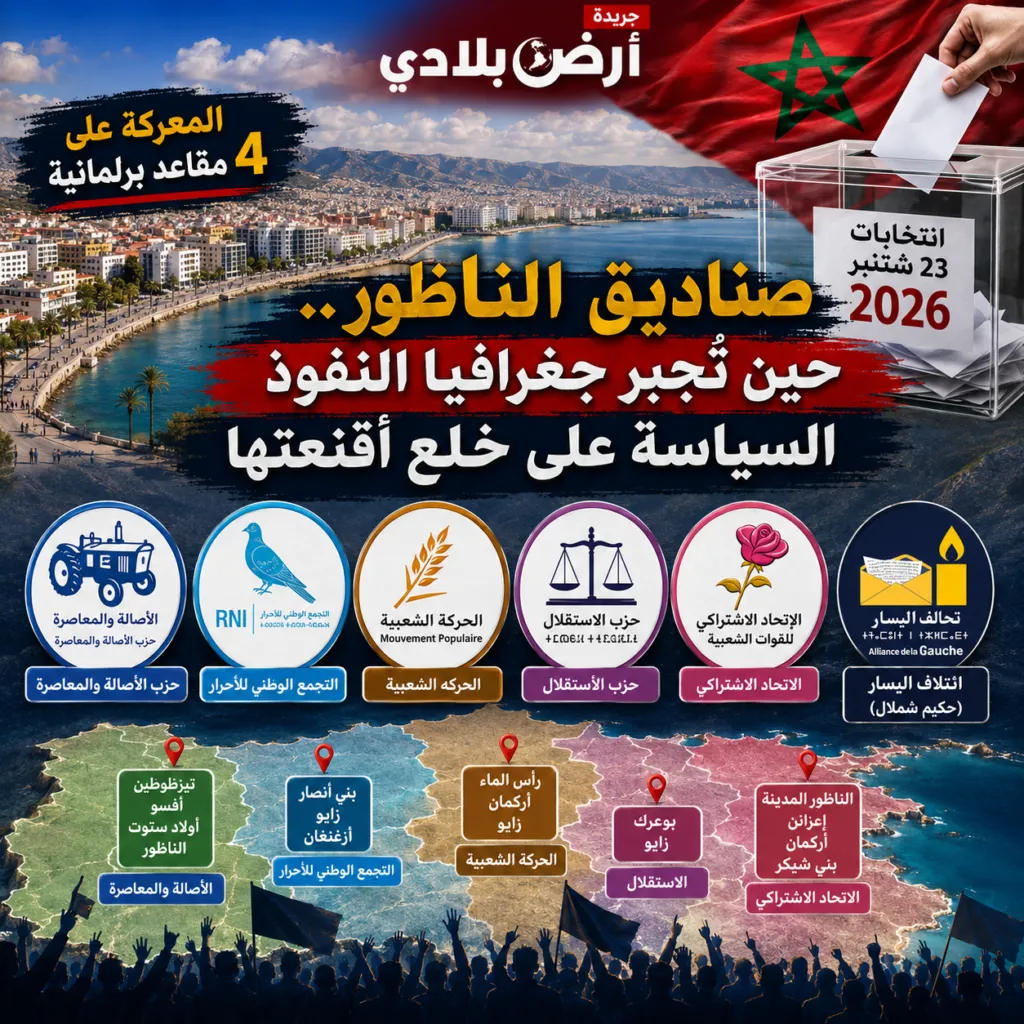
With the official commencement of the nomination process for the upcoming parliamentary seats in the Nador district, set for the elections on September 23, 2026, the local political arena is transitioning from a phase of subtle preparations to an overt and competitive confrontation, measured with precision. This administrative step is not merely a procedural formality; rather, it signifies the beginning of a critical political battle involving names that have amassed substantial electoral experiences, entering the fray with strategically defined maps akin to a chess game.
An analysis of the list of candidates who have submitted their files reveals that the Nador region is not experiencing a renewal in its competitive elite; rather, it is engaged in a "round of Iyad" among the key players. Aside from the entry of Hakim Chamallal representing the leftist coalition, the major parties are backed by figures well-versed in shaping power dynamics. Between Mohamed Moumeni (Parti Authenticité et Modernité), Halim Fotat (National Rally of Independents), Mohamed Boudo (Popular Movement), Mohamadi Touhatouh (Istiqlal), and Mohamed Abrakan (Socialist Union), there is a palpable desire from political entities to secure their positions by nominating "electoral engines" capable of direct mobilization.
Electoral Geography and Power Dynamics
However, the true interpretation of the scenario extends beyond just the names; it lies within the electoral geography that candidates have divided among themselves like a map of influence. While the PAM (Parti Authenticité et Modernité) is banking on its strongholds in Tiztoutine, Afes, and Ouled Stout, alongside the city of Nador, the RNI (Rassemblement National des Indépendants) seeks to encircle the outcome through the triad of Beni Ansar, Zaiou, and Azghenghan. Conversely, the Popular Movement is attempting to secure a solid foothold by relying on the regions of Ras El Ma, Arkamane, and Zaiou, while Istiqlal is placing its decisive bet on the Bouarq and Zaiou blocs, with the Socialist Union reorganizing its strategy in the urban center of Nador, Iznan, Arkamane, and Beni Cheker.
This implicit division of areas of influence raises a fundamental question regarding the limits of field strength and its resilience against the fluctuations of public sentiment. Relying solely on "traditional strongholds" no longer guarantees a definitive outcome in securing the four parliamentary seats. Politics in an intertwined region like Nador has taught us that victory is not achieved merely by amassing guaranteed votes; it hinges on candidates' ability to penetrate rival territories and establish shifting alliances until the very last moments. Amidst the calculations of the candidates and the decisions of the voters, all possibilities remain open on the tables of decision-making.
As reported by ardbladi.com.