
The crisis in Ceuta is gradually evolving into a platform for reshaping political positions within the Spanish political landscape. Recently, left-leaning factions of the Spanish Socialist Workers' Party (PSOE) have begun to adopt a more assertive and aggressive rhetoric towards Morocco. According to a report published by the newspaper "El País" on Tuesday, various political forces including Izquierda Unida, Sumar, Más Madrid, and Podemos are striving to carve out a political space distinct from the PSOE by directly attributing some of the crisis's repercussions in Ceuta to Rabat's actions.
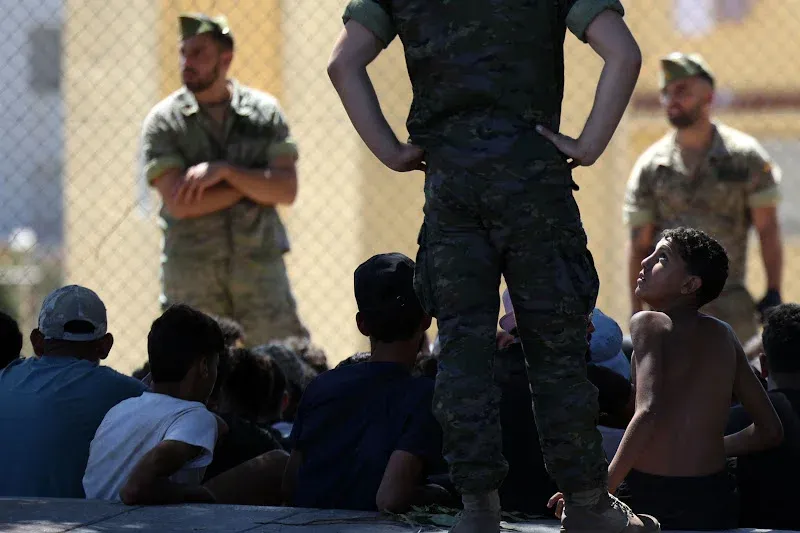
This shift in rhetoric comes at a time when the Spanish Parliament is preparing to discuss the implications of the Ceuta crisis. Prime Minister Pedro Sánchez convened a National Security Council meeting specifically focused on this crisis following a significant influx of migrants into the city. In this context, the left has adopted an approach that combines a humanitarian perspective towards migrants with pointed criticisms aimed directly at Morocco, marking a clear divergence from the PSOE's stance within the government.
The primary focus of their critiques revolves around what they term the "EU's reliance on countries outside its borders to manage migration issues," often referred to in Spanish political discourse as "externalización de fronteras." These parties argue that delegating part of the responsibility for controlling European borders to non-EU countries raises critical concerns regarding democratic standards and human rights. "El País" notes that this objection to the policy of outsourcing border control is one of the two main elements that distinguish this faction's rhetoric from that of the socialists.
The second element involves the transition from criticizing European immigration policies to a direct critique of Morocco. Spanish leftist parties contend that the central government is not sufficiently holding Rabat accountable for the events in Ceuta. Consequently, the debate within the Spanish left has broadened beyond merely how to receive, distribute, or ensure the rights of migrants, now encompassing the nature of political relations with Morocco and the feasibility of continuing to treat it as a reliable partner on issues of borders, migration, and security.
The matter of the 2030 World Cup emerges as one of the most sensitive points in this political escalation, as the crisis has shifted from migration and border issues to a high-stakes sporting and diplomatic event. Some factions within Sumar and Izquierda Unida have previously called for a review of the cooperative organizational structure of the tournament, while Podemos has gone as far as to demand Morocco's exclusion from hosting alongside Spain and Portugal. In contrast, the Spanish government has reaffirmed its commitment to organizing the event under the current framework, despite internal disagreements within the coalition regarding its stance on Morocco.
These demands gain additional significance due to the nature of the parliamentary initiative proposed by Sumar, which does not merely present a general political proposition but demands a review of the joint organizational structure and calls for communication with FIFA, the Spanish Football Federation, and the Portuguese government regarding the need to evaluate the current model. This initiative also includes calls for an independent assessment of human rights risks in the host countries and the submission of the findings to the Spanish Parliament, along with a request for clarification regarding the circumstances surrounding the events at the Ceuta border.
In this particular issue, a rare intersection has emerged between the Spanish left and the far-right. The Vox party has expressed its readiness to support Sumar's initiative aimed at excluding Morocco from organizing the 2030 World Cup. According to "El País," Vox's alignment with this initiative, alongside the support from Sumar and Podemos, could provide the proposal with a coalition of 62 deputies, pending the reactions from other political forces. This reveals that the Ceuta crisis has begun to generate political alignments that transcend the traditional divide between right and left when it comes to relations with Morocco.
The demands do not stop at reviewing Moroccan participation in the World Cup; Podemos has adopted a more aggressive tone regarding bilateral relations, with its Secretary General calling for Morocco’s exclusion from the tournament. "El País" has indicated that the party has even reached the point of advocating for the severance of diplomatic relations with Rabat. Thus, the crisis presents certain components of the Spanish left with a fundamentally different approach from the one adopted by Sánchez's government in recent years, which has focused on maintaining cooperation with Morocco on migration, security, and bilateral relations.
These positions also reflect an effort to establish a political narrative that does not merely compete with PP and Vox on immigration issues but frames the crisis as a test of Spain's foreign policy itself. Rather than focusing solely on the number of arrivals, return procedures, or their distribution among regions, these parties are steering the discussion towards relations with Rabat, the management of European borders outside EU territory, and whether cooperation with Morocco aligns with the standards these factions advocate in terms of human rights. This angle, as observed by "El País," provides the left outside the socialist line with a distinct political space.
Against the backdrop of this escalation, the Spanish government faces a more complex equation: managing the Ceuta crisis while containing its political, humanitarian, and security ramifications amidst rising pressures from within Parliament. Sánchez has decided to establish a unified command to address the crisis, initiating a series of ministerial appearances before Parliament, coinciding with the National Security Council meeting that was dedicated for the first time to this issue, nearly a month after the onset of the crisis.
Thus, the events in Ceuta have transformed from a mere transient migration crisis for the Spanish alternative left into a matter of redefining relations with Morocco within Spanish politics. While the PSOE and the government remain committed to ongoing cooperation and organizing the 2030 World Cup as planned, other leftist forces are advancing demands that range from reviewing Morocco's participation in the tournament to adopting a stricter stance in bilateral relations, culminating in Podemos’s calls for severing ties. In this specific context, these forces are attempting to establish a narrative independent from the socialists, at a moment when Ceuta has become a focal point for discussions on migration, sovereignty, foreign policy, and sports in Spain.
As reported by hespress.com.