
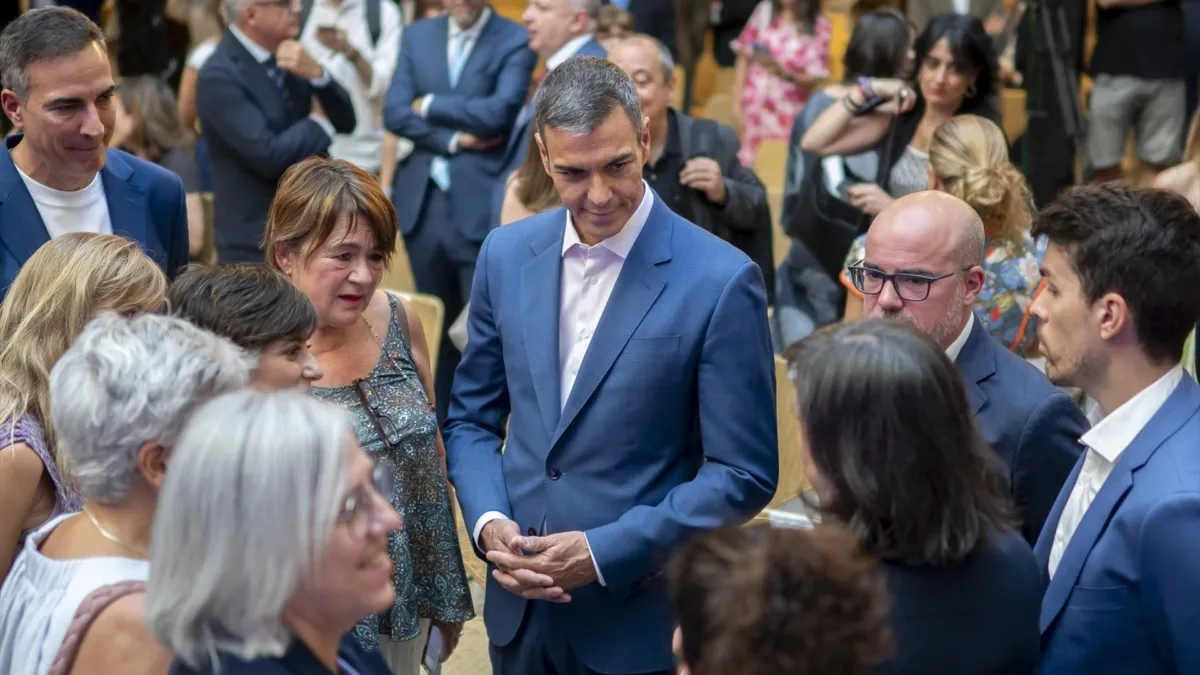

The Struggles of the Sánchez Administration
The return to school for the Spanish government has been far from joyous. This year marks the most challenging start of the academic term for Prime Minister Pedro Sánchez since taking office, and that’s saying a lot considering the difficult summers he has endured in the past. The recent crisis stemming from the assault on the Ceuta border has added yet another layer of strain to an already beleaguered administration, exacerbated by ongoing corruption scandals. This situation has revealed two significant issues that present a cross-political challenge: it has exposed the government's inability to safeguard its southern border and clarified that Sánchez is constrained in his capacity to react decisively towards Morocco.
At the Moncloa Palace, where self-criticism is not the norm, there has been a realization that the insistence from both Sánchez and certain ministers, particularly José Albares and Fernando Grande-Marlaska, to absolve Morocco of any responsibility has proven to be counterproductive. Sánchez's recent tentative shift in stance during a parliamentary session, where he suggested that the government would act if evidence of Moroccan involvement surfaced, did little to quell the mounting discontent.
On Monday, September 7, Sánchez was confronted with a damning poll from 40DB published in _El País_, a newspaper favored by socialist voters. The headline was striking: "90% of Spanish society blames Morocco for the Ceuta crisis." Additionally, a staggering 63% of respondents believe that Sánchez has performed poorly, with nearly half categorizing his handling of the situation as very bad. In any governmental crisis management, there are typically two phases: handling the crisis itself and managing the associated communication. In this instance, both aspects are going poorly, with thousands of immigrants still present in the streets and beaches of Ceuta after 40 days, and no clear timeline for when normalcy will return. This scenario is particularly troubling given that the Foreign Minister had promised on August 11 that all migrants who crossed the border illegally would be immediately returned to Morocco.
Communication Breakdown and Public Perception
With regards to communication, the recent survey from _El País_ serves as a stark indicator of public sentiment. The overwhelming majority of Spaniards believe that Morocco orchestrated the assault and also disapprove of Sánchez’s response. The Prime Minister is typically resistant to criticism and maintains he has managed the situation well, as he stated last week on Cadena Ser. However, as reality continues to contradict him, he has mobilized his team to work on reversing the unfavorable polling data that now places the PSOE at a precarious position with only 100 seats, while the right-wing parties (PP+Vox) surge above 50% in voter intention for the first time.
Consequently, a media offensive is set to begin, starting with an appearance on _Mañaneros 360_ on Televisión Española, a decision that has angered the public broadcaster's news council, who argue that an interview with the Prime Minister should be conducted by in-house professionals rather than those employed by an external production company. Following discussions with Cintora and Esther Palomera, Sánchez will also sit down with El Gran Wyoming. In this context, the risks remain minimal; Sánchez appears to have abandoned the effort to persuade those who do not support him and is instead focused on retaining the confidence of those who are beginning to waver.
Furthermore, the government's media strategy and the declassification of documents aim to achieve two objectives: to deflect responsibility from itself and to exonerate Morocco. However, achieving this aim will prove challenging. The shift in narrative regarding Moroccan responsibility appears more cosmetic than substantive. In fact, Marlaska reiterated on Monday that there is no evidence pointing to Moroccan involvement, and should any evidence exist, he would likely obscure it. The government's announcement to declassify 40 documents serves a dual purpose: on one hand, it seeks to demonstrate that no agency or security body informed them of an impending influx of nearly 80,000 individuals, and on the other hand, it aims to clear Morocco of any doubt regarding its involvement in the border assault.
As such, there will be little more than minor adjustments in rhetoric, such as Albares' warning to Morocco that claims of sovereignty over Ceuta and Melilla are unwelcome. Yet, it remains an impossible task to suggest Moroccan culpability without causing discomfort to King Mohamed VI. Sánchez's narrative surrounding the events, which includes allegations of mafias, Israeli and Russian hackers, and far-right involvement, lacks credibility even among his closest supporters. The situation is further complicated by a judge in the National Court who is determined to investigate the matter thoroughly. A ruling from September 7 meticulously dismantles the president's conspiracy theory, revealing that the invasion was indeed planned from Morocco with assistance from the Moroccan gendarmerie. Attacking María Tardón and the police unit (CENIF) that drafted the most damaging report for the government is not a productive approach to uncovering the truth. The spokesperson for the government, Elma Sáiz, backing the disparagement of Tardón's impartiality by Óscar Puente underscores how concerned the president's team is about this criminal investigation.
Once again, the government is taking aim at the judiciary when judges fulfill their duties, a recurring theme in the president's modus operandi.
As reported by elindependiente.com.
