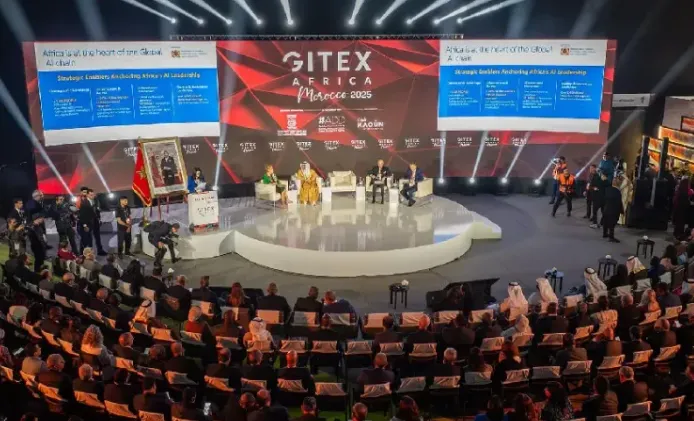

The Evolution of GITEX Africa Morocco 2026
GITEX Africa Morocco 2026 has transcended its status as a mere technology exhibition and has emerged as a genuine indicator of the digital transformation taking place across the African continent. It highlights Morocco's aspirations to establish itself as a regional digital hub. The impressive statistics from this fourth edition underscore the magnitude of this transformation and reveal an unprecedented dynamism in the field of innovation and technology.
This year’s exhibition achieved record-breaking figures that affirm its significance within Africa, showcasing unparalleled participation from countries, companies, institutions, investors, and, importantly, visitors. Noteworthy numbers include over 55,000 attendees from around the globe—some reports even suggest up to 70,000, a significant increase from 45,000 in 2025 and 40,000 in 2024. Additionally, the event hosted more than 1,500 exhibiting companies, over 400 international investors, representatives from 130 nations, and around 650 governmental and institutional delegations, along with approximately 700 international speakers and experts. Such growth is a clear testament to GITEX Africa's increasing prominence as the largest tech exhibition on the continent.
Challenges in Organization amidst Success
Despite this remarkable success, it is essential to address the organizational shortcomings that became evident on the first day of the event. The entry of visitors was perhaps the only significant drawback, as the flow of attendees, including company representatives and guests, was notably chaotic. Given the advanced digital tools available, which could facilitate the entry of thousands in under two minutes—such as displaying a QR code on a digital reader that prints out a badge—it was surprising to witness the disarray that ensued. Attendees had to navigate a considerable distance through traffic and crowds to reach a small entrance, where overwhelmed organizers struggled to manage the situation, resulting in considerable confusion.
This organizational failure suggests a reliance on partial digital solutions, reflecting a bureaucratic mindset that contradicts the principles of digital transformation. Successful digital transitions cannot coexist with an aversion to modern technology and artificial intelligence solutions. Had the organizers considered two critical factors, the reception on the first day could have aligned with the technological advancements showcased at the event. Firstly, the presence of a government delegation led by the Prime Minister, with each minister traveling in individual cars accompanied by numerous vehicles carrying only one or two aides, caused significant congestion. A simple solution would have been for the official delegation to use a single bus to transport all ministers and their assistants, alleviating the parking issues significantly.
The second critical adjustment would involve abandoning bureaucratic attitudes resistant to digital transformation. Instead of forcing visitors to traverse congested areas and contend with vehicular hazards, organizers could have streamlined access by allowing attendees to directly enter the corridor housing the scanning machines, where they could present their QR codes for swift access, as was successfully implemented on the second and third days of the exhibition. This is the essence of digital technology and its most significant advantages.
While these observations are made to enhance future editions of the event, it is crucial to acknowledge the overall success of GITEX Africa Morocco 2026. The country needs to continue hosting such events, as GITEX offers substantial benefits across various domains. For instance, studies indicate that the digital economy in Africa is projected to reach approximately $2.9 trillion by 2030. The AI market on the continent is expected to grow from $4.5 billion to $16.5 billion, while the telecommunications sector is set to surpass $66 billion. These figures contribute to GITEX's role as a strategic platform connecting investors with startups and emerging markets.
Hosting this event in Marrakech embodies Morocco's commitment to investing in Africa and aligns with a strategic vision aimed at establishing Morocco as a digital hub in Africa. The goals include attracting global tech investments, supporting over 300 participating Moroccan startups, and fostering partnerships between governments and the private sector.
However, the significance of GITEX extends beyond mere statistics. The true value lies in the exchange of ideas, the number of partnerships formed, the funding opportunities presented to young Africans, and the transition of the continent from being a consumer of technology to becoming a producer and innovator in the sector.
The fourth edition of GITEX was distinguished by the caliber of speakers and experts in digitalization, artificial intelligence, and the Internet of Things. These three themes dominated discussions throughout the Moroccan African exhibition. Notably, the event showcased the achievements of young Moroccans who have successfully built startups in Morocco and are now expanding into Africa, offering their technological innovations on the continent. This creative youth, eschewing formal protocols associated with ministers and public institution directors—evident in their casual attire and demeanor—awaits governmental recognition to invest in their potential and capabilities for further development in Morocco and expansion into Africa.
Ultimately, GITEX 2026 demonstrated that African youth are poised to embrace the digitalization and artificial intelligence era, transforming their continent from a mere consumer to a producer of AI and digital knowledge. The numbers from GITEX Africa Morocco 2026 confirm that Africa has indeed entered the digital revolution, with Morocco firmly positioning itself at the heart of this transformation. It is not just an exhibition but a strategic platform that outlines the future of the digital economy in Africa, where numbers translate into indicators of strength and ambitions evolve into tangible projects.
As reported by pjd.ma.