
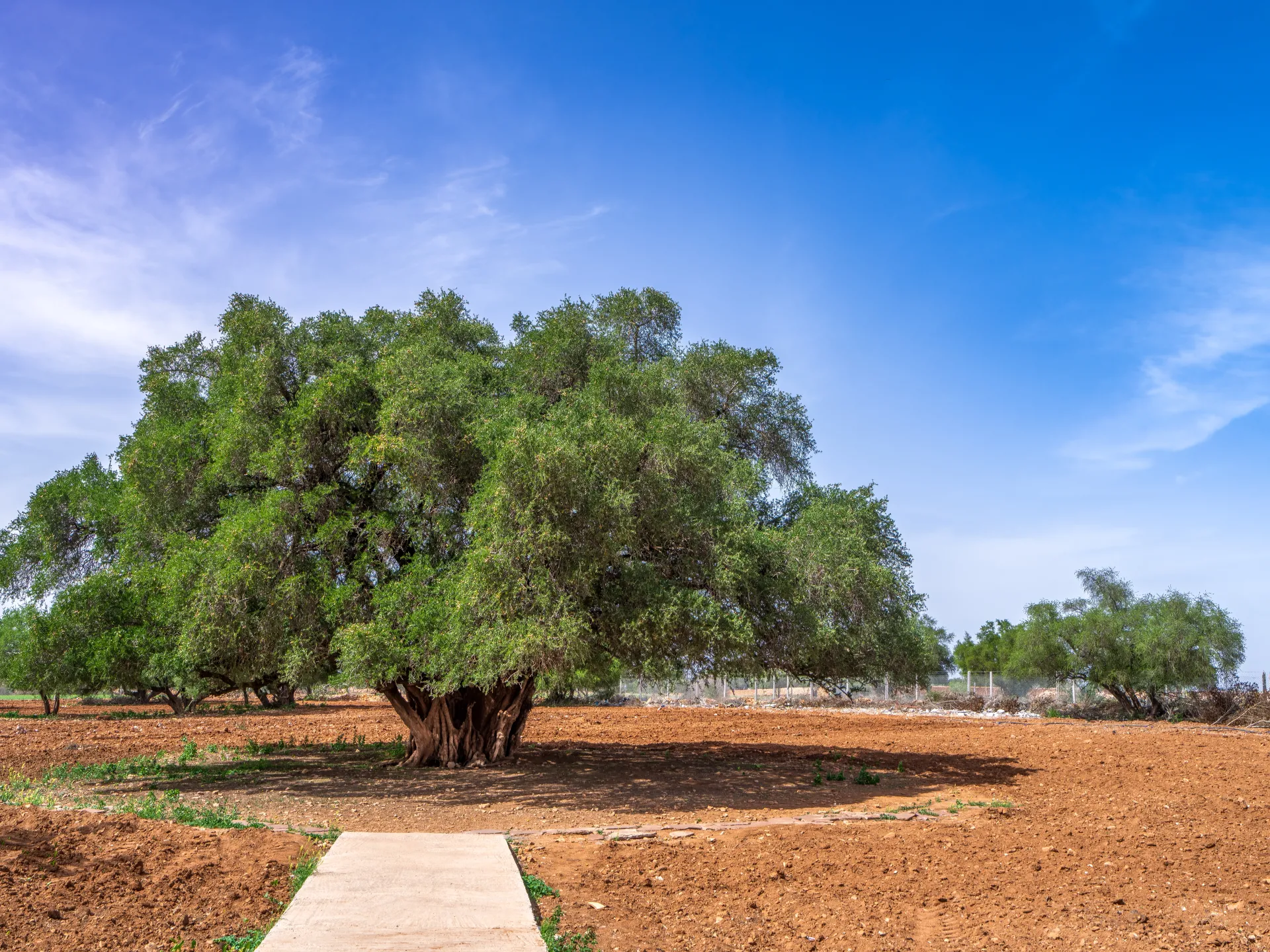

In the southern regions of Morocco, where harsh climate conditions intersect with scarce water resources and expansive drought, the Argan tree emerges as a vital ecological system capable of resisting desertification while safeguarding natural balances. Its deep roots penetrate the arid soil, serving not merely as a biological characteristic but as a testament to an environmental and human memory intertwined with local landscapes and communities for centuries.
Today, the Argan tree transcends its role as a mere source of locally and internationally marketed oil; it has evolved into a significant environmental and climatic symbol that embodies the relationship between development, sustainability, and social justice. However, this natural heritage is increasingly threatened by a series of challenges, including prolonged drought years, rising temperatures, decreased rainfall, and human pressures stemming from overgrazing, urban expansion, and the excessive exploitation of natural resources. Amid environmental warnings and developmental stakes, a pressing question arises: can the Argan tree withstand the rapidly changing climate?

Argan: An Ecosystem Against Drought
The Argan tree predominantly thrives in the Souss and southwestern regions of Morocco, situated within an ecological zone that is particularly sensitive to climate change. This tree represents a complete ecological system that contributes to soil protection from erosion, mitigates desertification, and preserves biodiversity, while also playing a role in maintaining moisture and ecological balances in arid areas. Experts and environmental activists, in statements to Al Jazeera, assert that the Argan tree acts as a natural barrier against climatic changes, especially with the increasing frequency of droughts and global temperature rises. However, this vital role is now under threat due to the degradation of forest areas and the challenges surrounding natural tree regeneration.
Increased Climatic and Human Pressures
Despite the designation of the Argan area as a UNESCO biosphere reserve, environmental degradation indicators have become alarming. Recent years have witnessed a decline in rainfall coupled with rising temperatures, which directly affects tree growth and the sustainability of forest coverage. Additionally, other complicating factors, such as overgrazing, deforestation, urban expansion, and unsustainable exploitation of resources, further weaken the ecosystem's ability to maintain balance. In this context, the Argan Biosphere Reserve Association has emphasized the need to view the Argan tree as a strategic environmental issue rather than just an economic resource. They have highlighted the necessity for revising land policies, accelerating climate change adaptation programs, protecting water resources, and valuing traditional knowledge associated with this region.
Abdullah Ahjam, the regional coordinator of the network in Tiznit, stressed that honoring the Argan tree should extend beyond mere symbolism to include thoughtful consideration of the future of this ecological area amid rapid climate changes. He emphasized that preserving the Argan tree requires a participatory approach that places local populations at the heart of public policies, enhances the role of civil society in awareness and advocacy, and connects scientific research with social innovation. He asserted that the Argan tree is not merely an economic resource but also an environmental and cultural symbol, with the biosphere reserve representing a safeguard for sustainable development.

In rural areas, women are closely linked to the Argan tree, not only as a source of income but as part of a lifestyle that emphasizes harmony with nature. With the expansion of women's cooperatives, the tree has become a model for linking economic empowerment with environmental preservation. In this context, Saida Attar, president of the Argan Alkhair Cooperative in Essaouira (southern Morocco), highlighted that this tree plays a crucial role in combating climate change by protecting soil, reducing desertification, and maintaining biodiversity. She underscored that women form the first line of defense in safeguarding this environmental heritage, calling for enhanced afforestation programs and restrictions on overgrazing to ensure the sustainability of forested areas.
In the face of these challenges, Morocco has launched various programs to protect the Argan tree, including reforestation efforts, support for tree-planting projects, and encouragement of scientific research, alongside backing women's cooperatives within the framework of social and solidarity economy. The National Agency for Water and Forests in Morocco is implementing programs to combat desertification and protect biodiversity, adopting participatory approaches that integrate local communities into conservation efforts. Furthermore, the international recognition of the Argan tree, whether as a biosphere reserve or through the designation of a global day for it, signifies acknowledgment of its environmental importance and its role in addressing climate change.
Dr. Oumima Akhi, an expert in environment and sustainable development, affirmed that the Argan tree is one of the most crucial ecosystems capable of adapting to drought and climatic changes, thanks to its ability to stabilize soil, reduce erosion, and combat desertification. She added that its role extends beyond the economic aspect to include essential environmental functions such as carbon stabilization and biodiversity protection, considering the Argan forest area as an "environmental shield in fragile regions." She called for strengthening scientific research, expanding reforestation programs, and protecting natural regeneration while involving local communities, especially women, in managing this area. The Argan tree now faces a real test amidst rapidly changing climatic conditions; with both human pressures and harsh climate realities, there is an increasing need for a comprehensive developmental vision that makes this environmental heritage part of Morocco's ecological, water, and food security.
The protection of the Argan tree has evolved from being merely an environmental option to a strategic necessity to ensure the continuity of one of the most significant symbols of natural resilience against climate change.
As reported by aljazeera.net.

