
The Struggle of the Sahrawi People
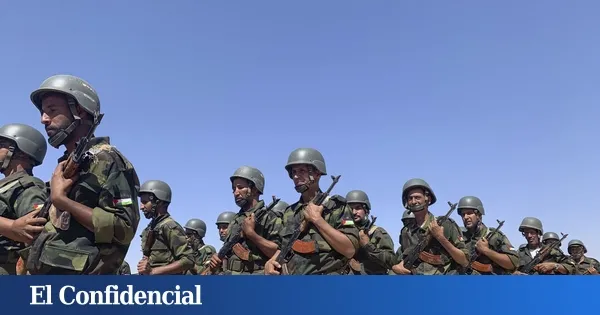
A procession of soldiers marches along an asphalt track amidst the sand, their old Kalashnikovs in hand and without helmets, performing awkward gestures to rally the crowd. This is not a conventional military parade nor an exhibition of professionalism; rather, it serves as a defiant statement. These individuals represent the remnants of resistance in a conflict that has persisted for fifty years between the Polisario Front and Morocco.
On April 8, a significant day for the Sahrawis in the refugee camps of Tinduf, Algeria, the audience—predominantly women—chant names, whistle, and cheer for the fighters, even going so far as to clear the view for better visibility of the procession. However, this year carries a different weight. In the autumn of the previous year, the United States pressured the UN Security Council to shift its long-standing position on the conflict, endorsing Morocco's plan for ‘limited autonomy’ for Western Sahara under Moroccan sovereignty as the only viable “solution” to the ongoing dispute. This abrupt change has sidelined previous UN resolutions that have historically supported the Sahrawis' aspirations for self-determination through a referendum.
A Shift in Negotiation Stances
The Moroccan proposal entails integrating Sahrawi territory under the Alaouite kingdom's sovereignty, allowing for a degree of self-governance, thereby designating it as a southern province of Morocco. The Trump administration adopted this stance early in its term, and France followed suit in 2024, while Spain made a controversial decision in 2022 under Pedro Sánchez. The leader of the Polisario Front, Brahim Ghali, laments, “Spain denies our right to exist,” his voice rising above the cheers of the crowd.
Within the camps, there exists a complex sentiment. The Polisario Front authorities are increasingly advocating for greater openness in negotiations aimed at resolving the conflict, expressing willingness to “discuss any proposal and any scenario that could lead to a solution.” In a media briefing attended by El Confidencial, Foreign Minister Mohamed Yislem Beisat acknowledged that independence “is not the only option” for the Sahrawis. “We cannot force them to choose solely between independence and dependence,” he explained to reporters—words that could potentially redefine the historical Sahrawi claim for a referendum to choose between independence or integration with Morocco.
Beisat emphasized the possibility of discussing autonomy as a viable alternative for the Sahrawi people, although he firmly stated that the Polisario Front would never accept autonomy as a dictated, exclusive solution. Among the marchers, there is a distinctive group. Clad in uniform but wearing civilian shoes, they bear no arms and do not attempt to project a military demeanor. “We dress as soldiers because our soul is to fight,” asserts Mohamed Baba, a worker at the Polisario Front's Interior Ministry, adjusting his camouflage shirt.
This case of civilians “whose soul is to fight” highlights another dimension beyond official and pragmatic diplomacy. Despite the domino effect of international support for the Moroccan plan—now recognized by the UN as the only feasible solution—and the challenges of enforcing international law, which have dampened the expectations of the Polisario leadership, some Sahrawis continue to cling to the fight. “We, as a generation [around our forties], are not at all satisfied with the international peaceful plan,” he states. The acceptance of the mental and legal framework of the Moroccan proposal effectively extinguishes the hope for a referendum with a genuine chance for independence that was initially envisioned following the ceasefire in 1991 between the Polisario and Morocco.
Baba reflects on the nearly three decades since the ceasefire as “29 years of waiting, goodwill, and numerous losses.” This prolonged anticipation culminated in one of the worst outcomes when, on November 13, 2020, in Guerguerat—on the border with Mauritania—“several groups of young Sahrawis blocked the flow of goods to protest the occupation.” Morocco's response was to dispatch troops to restore commercial traffic in the area, crucial for its connections with sub-Saharan Africa, thus igniting a new war.
“The only way to regain our land is through armed struggle,” Baba asserts. Although the ongoing conflict remains of low intensity, it is far from resolved. Yaqouta Moulay, president of the Sahara and Natural Resources and Environmental Protection Observatory, acknowledges the military limitations faced by the Sahrawi people. Yet, for advocates of armed resistance, the nature of conflicts has evolved, potentially offering the Polisario a new opportunity. “Wars are no longer what they used to be; they are now fought with drones as well,” Moulay notes, defending that despite their challenges, they possess some capacity in this realm. El Confidencial has been unable to independently verify whether the Polisario operates military drones, while Morocco has prioritized drone purchases from Israel—at least 300—since the normalization of relations between the two countries in 2020.
It’s not that these Sahrawis embrace war. “We are peaceful; we love peace,” Baba insists, emphasizing their empathy for Moroccan victims, who he believes are also caught in the conflict. However, the prevailing sentiment, as articulated by Moulay, is skepticism regarding a negotiated resolution with Morocco. “I see negotiations as very difficult. Morocco will never accept certain conditions,” she predicts from her makeshift tent. For her, the current international landscape is characterized by the imposition of force. “We are in a moment where force is what speaks,” she asserts.
Baba underscores the ineffectiveness of international law. “If this situation continues, many countries in the future may stop recognizing international agreements,” he insists. “If we end up accepting the Moroccan plan, I won't hesitate to move to Spain,” he declares. “The only way to recover our land is through armed struggle,” he concludes.
Approximately 50 kilometers from the Aussed camp in Rabuni lies the “Museum of Sahrawi Resistance,” where former military personnel proudly display weaponry seized from Morocco during the war. The remnants of a Mirage F-1 fighter jet, clusters of unexploded bombs, South African Eland 20 reconnaissance vehicles, remains of F-5s, and mortars manufactured by Santa Bárbara in Seville stand as symbols of past victories before the watchful eyes of the military personnel guarding this museum.
Mohammed S., a veteran of the Polisario and the museum's director, feels a swell of emotion as he recalls the family he left behind when the conflict erupted. Decades ago, he left the occupied territory to join the fight and has not seen his parents since. A wall stretching 2,700 kilometers separates Morocco from Western Sahara, known as “the wall of shame,” which has indelibly marked his destiny. Adding to this grim reality, military personnel estimate that between eight to ten million unexploded mines remain scattered throughout this desert region. The sirocco winds and the constant shifting of sand have moved these devices, which end up detonating among those least involved in the conflict: nomads still inhabiting the region and even children who mistake them for toys.
Outside this makeshift gallery, Mohammed gazes downward. He knows nothing of the Moroccans—the individuals who, like many other Sahrawis, forced him to separate from his family and enlist for an “unjust war.” “What are the Moroccans like? Have you ever been to Morocco?” he asks. “Have you never seen or spoken to them?” “No. How could I? But I wonder what they are like. What is their personality, what do they think, what do they like? This war has completely separated us, and this,” he says, pointing to the seized military material, “is all that remains. All that we know of them.
As reported by elconfidencial.com.