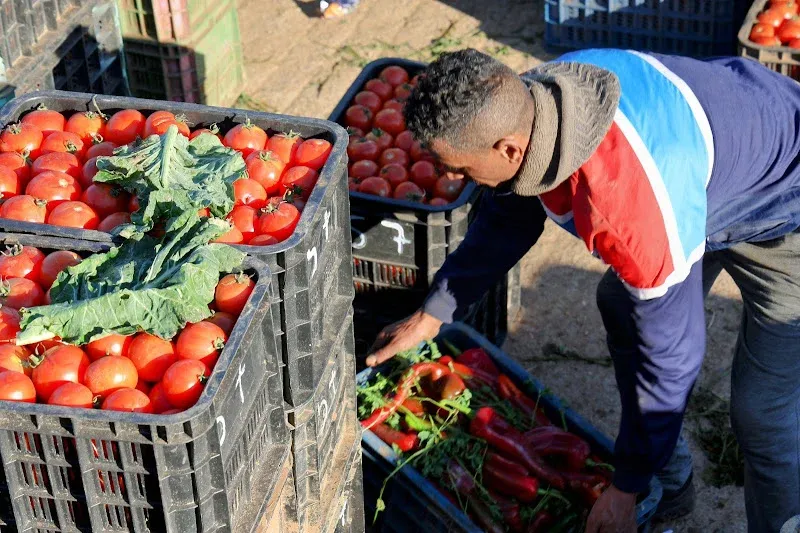

Moroccan Tomatoes: A Growing Economic Discuss in Europe
In the fresh produce markets across Europe, particularly in Spain and France, Moroccan tomatoes have transitioned from being just another consumer product to a focal point of economic and, at times, political discourse. This shift is largely attributed to the remarkable success of Moroccan tomatoes, along with other products from the fertile plains of Souss, Saïs, and Loukos, in establishing a significant presence in European markets. Their rise can be credited to a combination of superior quality, the advantageous geographic position of Morocco, and trade agreements linking Rabat to Brussels and several other countries outside the European Union. According to data from Eurostat, Morocco is projected to account for approximately 70.6% of tomato imports by European countries from non-EU nations until the end of 2025. Moreover, from 2014 to 2023, the volume of tomatoes imported from Morocco by EU member states surged by over 42%.
Quality Commitment and European Response
The increasing presence of Moroccan tomatoes on supermarket shelves from Madrid to Paris and even London is not coincidental; it is a testament to the commitment of Moroccan producers and exporters to adhere to stringent quality standards that align with relevant European operational protocols. Agricultural expert Ryad Ouhtita emphasizes that the strong reputation of Moroccan agriculture and the geographical proximity of the kingdom to Europe provide it with a crucial competitive edge against various international competitors. This advantage has enabled Moroccan products, particularly tomatoes, to penetrate non-traditional markets such as the British and Scandinavian markets. Ouhtita further noted that Morocco has firmly established its place in the European vegetable market, despite the emergence of competing agricultural powers in Africa, such as Mauritania and Senegal, which have their sights set on the European market. He insists that the continuity of Moroccan leadership in this sector hinges on the development of export monitoring systems, modernization of supply chain tracking mechanisms, and conducting in-depth studies on local consumption patterns.
Many observers of the agricultural sector in Europe agree that the key to the competitiveness of Moroccan tomatoes, which are often preferred by European consumers over local products, lies primarily in the lower production costs in Morocco and the availability of a less expensive labor force compared to their European counterparts. This economic dynamic allows Moroccan tomatoes to be marketed at attractive prices without compromising the required quality standards. However, this perspective is contested by agricultural investor Sarhan Lahrech, CEO of the Agida agricultural group, who argues that claims made by some European stakeholders about the lower production costs in Morocco are misleading. He points out that Moroccan farmers today, like their counterparts worldwide, are heavily influenced by global market fluctuations in securing production inputs. Lahrech emphasizes that this narrative overlooks the substantial investments made by Moroccan producers in agricultural technology, modern irrigation systems, and digitalization to ensure production continuity amidst climate change challenges.
He also stresses that the quality superiority of Moroccan vegetables and fruits, particularly tomatoes, in both EU and non-EU markets is not based on cheaper prices but rather on quality and strict adherence to health and environmental standards. In today's market, survival is no longer guaranteed to those who produce at lower costs, but rather to those who maintain higher quality and sustainability—an equation that Moroccan agriculture has successfully decoded.
The success of Moroccan tomatoes, however, has not come without controversy, as it has sparked significant backlash from European farmers, particularly in France and Spain. These farmers have voiced their concerns regarding rising production costs and labor expenses, decrying what they perceive as "unfair competition" from Moroccan tomatoes. This tension has led to protests advocating for a revision of import conditions from Morocco, including incidents where trucks carrying Moroccan tomatoes were obstructed, their loads offloaded, and drivers assaulted on European roads, as seen in early February 2024 along the route linking the Spanish cities of Seville and Cádiz. The Spanish farmers' association COAG has spearheaded the campaign against Moroccan tomatoes, asserting that they undermine local production and fail to meet European health safety standards.
In response to these challenges, professional associations in Spain and France have urged Brussels to restrict Moroccan tomatoes' access to European markets and to revisit the trade agreements established with Morocco. Furthermore, these "trade harassments" have extended beyond protests and statements to media campaigns highlighting claims that Moroccan-sourced tomatoes are "not safe". Despite these claims, the Moroccan National Office for Food Safety has continuously affirmed the safety of the production and export processes of Moroccan tomatoes and the rigorous nature of the national monitoring system.
Official data from the Spanish Ministry of Economy revealed that Madrid imported over 65,000 tons of Moroccan tomatoes between January and October last year, marking an annual increase of nearly 54%. During the 2024-2025 agricultural season, Spain's total imports surpassed 522,000 tons, positioning Morocco among the top tomato exporters to Spain, coinciding with a decline in imports from competing countries like the Netherlands.
In France, citizens consume over 700,000 tons of tomatoes annually, while local production hovers around 480,000 tons, justifying the need for imports, especially of cherry tomatoes, which accounted for 40% of France's tomato purchases in the past two years. The French Ministry of Agriculture and Food Sovereignty has acknowledged in response to inquiries regarding the impact of Moroccan tomatoes on local producers that insufficient domestic production to meet internal consumption necessitates imports. They highlighted that the 2012 agreement between the EU and Morocco, concerning mutual trade liberalization, excludes a range of sensitive products, including tomatoes, from complete trade liberalization.
Despite these tensions, the European Commission has reiterated the importance of maintaining a favorable production environment for Moroccan producers, allowing them to offer competitive prices in the European market, even during the French production season in summer. In a political turn, the discussion surrounding Moroccan tomatoes resurfaced in Europe after Rabat and Brussels signed amended correspondence regarding the agricultural agreement in October, ensuring that agricultural products from the southern regions of Morocco receive the same preferential access to the European market enjoyed by goods from other areas of the kingdom. This new agreement has been leveraged by professional bodies in Europe to intensify criticism surrounding the entry of vegetables and fruits, particularly tomatoes, into European markets, with the Spanish Federation of Associations of Producers and Exporters of Fruits and Vegetables (Fepex) arguing that the agreement fosters a lack of competitiveness and places Spanish agricultural products at a disadvantage.
As reported by hespress.com.