
Following a month-long tournament held across the United States, Canada, and Mexico, culminating in the triumph of La Roja, attention now shifts to the upcoming 2030 World Cup, which will be co-hosted by Morocco, Spain, and Portugal. With just four years until the tournament, the framework for this historic World Cup is gradually taking shape. Behind the scenes, FIFA and the organizing committees from the three nations are already tackling the numerous challenges posed by this unprecedented event, which will span two continents, marking a significant shift in international sporting events.
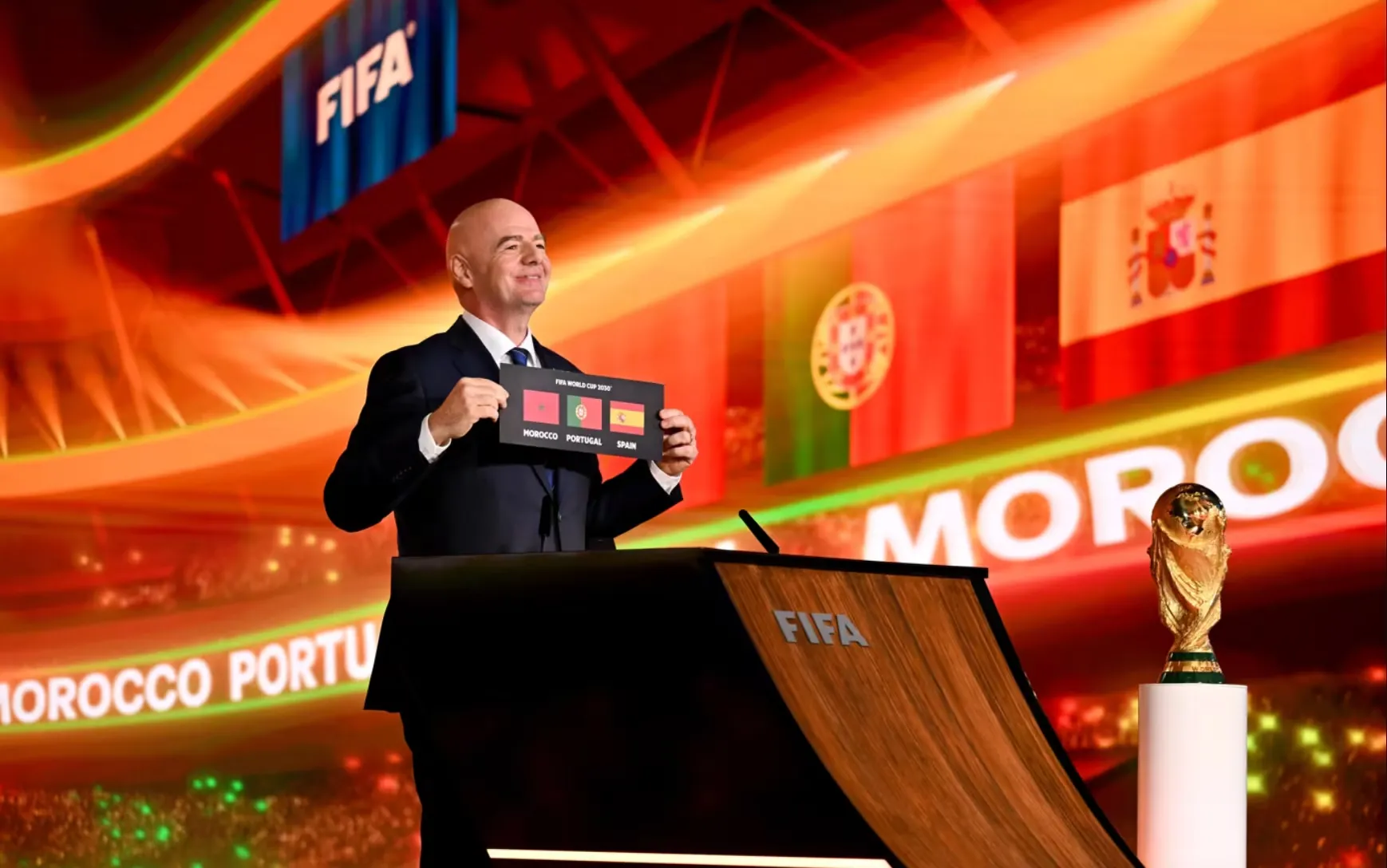
Key considerations such as host cities, stadiums, scheduling, and match distribution are already coming to the forefront as the three countries prepare for this monumental occasion. The formal announcement of Morocco, Spain, and Portugal as the official hosts was made during the 74th FIFA Congress in 2023. After evaluating multiple bids, FIFA, under the leadership of Gianni Infantino, awarded the tournament to these nations, marking a first in World Cup history with an event shared across two continents.
This 2030 edition will also have a special symbolic significance, as three inaugural matches will take place in South America—in Uruguay, Argentina, and Paraguay—to commemorate the centenary of the first World Cup, which was held in 1930 in Montevideo.
After various meetings, the distribution of venues has been outlined, featuring 17 cities: 11 stadiums in Spain spread across 9 cities, 6 stadiums in Morocco in 6 cities, and 3 stadiums in Portugal across 2 cities. The tournament is expected to kick off in mid-June and conclude on July 19, 2030. FIFA meticulously assessed various criteria before finalizing the venues, including stadium capacity, surrounding infrastructure, transportation, security, and hospitality options.
The organization is planned with precision, particularly as FIFA is contemplating an expansion of the tournament to include 64 teams, up from 48 in 2026. This ambition aligns with the collaborative project championed by the three nations under the slogan “Yalla Vamos 2030.”
The 2030 Final: A Crucial Topic
While the “Yalla Vamos 2030” bid emphasizes unity among the three nations, with ongoing coordination and necessary compromises, certain issues remain particularly contentious. Among the most debated is the location of the 2030 final—the most anticipated and viewed match of the entire tournament. Currently, three stadiums are at the center of discussions: the Grand Stade Hassan II in Casablanca, the Santiago Bernabéu in Madrid, and Camp Nou in Barcelona.
The two Spanish venues hold immense symbolic value, primarily due to their association with global football giants, Real Madrid and FC Barcelona. In contrast, the Grand Stade Hassan II, which is being constructed specifically for this event, aims to establish itself as a legendary venue for international football. All three stadiums present compelling arguments for hosting the World Cup final.
Ultimately, it will be FIFA and its president, Gianni Infantino, who will make the final decision on the location of the 2030 World Cup final. This decision will be made in continuous consultation with the three host nations, but the final say will rest with FIFA. After reviewing the various proposals, engaging with all parties, and evaluating the criteria, FIFA will designate the stadium for the tournament's most prestigious match. This decision is expected to be announced as the tournament date approaches.
The Grand Stade Hassan II: Morocco's Crown Jewel
The Grand Stade Hassan II, expected to be completed by late 2027, is poised to become one of the most iconic venues in global football thanks to its size and ambition. Located in Benslimane, within the Casablanca-Settat region, an entire ecosystem is being developed to ensure the stadium becomes an international reference point. It stands as the main competitor to the Santiago Bernabéu, which is backed by the Spanish Federation in the bid to host the grand final.
Meeting FIFA's evolving expectations, the Moroccan stadium offers an additional advantage over its Spanish counterparts: superior VIP hosting capabilities. When comparing the facilities for premium clients, the Grand Stade Hassan II boasts a significantly larger VVIP area (2,228 m² compared to 1,297 m² at Santiago Bernabéu). Similarly, the Grand Stade will feature 2,533 luxury boxes, outpacing the 2,371 available at the Madrid venue. However, the Real Madrid stronghold retains a slight edge in overall VIP space, with 6,123 m² against 6,091 m² at the Moroccan stadium.
On other fronts, particularly regarding accessibility, the Moroccan venue is leading the way. The Grand Stade Hassan II will include 99 accessible restroom facilities, compared to just 20 at its Madrid counterpart. The stadium is also designed to withstand potential climatic challenges during the tournament, a stark contrast to the Santiago Bernabéu, which has faced issues with water ingress during heavy rains.
While the final decision rests with FIFA and its president Gianni Infantino, the discourse surrounding the 2030 final has increasingly absorbed Spain's attention. Spanish representatives have actively voiced their desire for the final to be held in Madrid rather than Casablanca. Concerns have been raised by officials, such as Rafael Louzán, president of the Spanish Football Federation (RFEF), who expressed frustration over the ongoing doubts regarding Spain's role in hosting the centenary World Cup.
As various Spanish cities, including Bilbao, have begun to express reservations about hosting matches, the political implications of the final's location are becoming increasingly apparent. Alberto Núñez Feijóo, president of the Popular Party, has stressed the importance of tradition and logistics, urging the Spanish government to secure the final for Spain.
Ultimately, the debate over the final's location transcends sports, tapping into broader political discussions. The Moroccan bid champions the notion that Africa deserves a second World Cup final, given that the continent has only hosted one, in 2010 in South Africa. Offering the final to Morocco would align with FIFA's vision of expanding football's global reach.
Regardless of the outcome, the final location of the 2030 World Cup will continue to generate significant discourse, with FIFA's decision remaining the ultimate authority. As the tournament nears, the focus and discussions surrounding the final will intensify, reflecting the passion and stakes involved in hosting such a monumental event.
As reported by sport.le360.ma.