
A Transformative Moment in Moroccan Architecture
There are pivotal moments in a nation's history when transformation occurs quietly, without grand proclamations, driven solely by the power of vision. Such was the case with the international Tangier Med competition, a foundational event for Morocco that illuminated the understanding that architecture transcends mere form; it embodies political language, serves as a projection tool, and acts as a manifestation of sovereignty. The project leaders, Saïd El Hadi and the late Michel Titecat, tasked me with a dual mission: to identify international agencies capable of conceptualizing the complete design of the future port complex and to assemble a high-caliber jury to select the winner. This initiative resonated with the national vision advocated by His Majesty King Mohammed VI, who envisioned Tangier Med as more than just a port; it was a catalyst for territorial transformation, an economic engine, a symbol of openness, and a strategic gesture with long-lasting implications.
A Fusion of Creativity and Royal Vision
To this end, four prominent figures in global architecture were invited: Rem Koolhaas, Zaha Hadid, Jean Nouvel, and Ricardo Bofill. Each architect brought distinct philosophies and approaches to spatial thinking, embodying a rare ambition to engage Morocco in dialogue with international avant-garde movements—not as mere imitators, but as equal interlocutors. The international jury I established was chaired by the late Abdelaziz Meziane Belfqih, a counselor to His Majesty the King, with me serving as vice-president. This gathering was marked by an extraordinary intensity: a confluence of creative audacity from the world's leading architects and the royal vision of a reinvented Morocco. Through these exchanges and debates, a new way of conceiving territory began to emerge—not merely as a backdrop for infrastructures, but as a cultural and symbolic space for projection.
Zaha Hadid, a Pritzker Prize laureate, presented an extraordinarily powerful design characterized by fluid, almost liquid architecture that sought to redefine the very landscape. However, despite its captivating nature, her proposal was hampered by structural complexities and an inaccurately estimated budget, ultimately failing to secure the competition's top prize. Nevertheless, something within her vision—a sense of freedom, a unique manipulation of space, and a dynamic engagement with materials—suggested an alternative destiny.
I then proposed to His Majesty's Counselor an alternative stage, a new horizon: the opportunity to create a postmodern monument in a significant Moroccan city, where Hadid's artistic language could flourish without constraints. This intuition crystallized a few months later, resulting in the Royal Theater of Rabat. This relocation, from Tangier to Rabat, was not merely a project transfer; it signified the recognition that an architectural idea can find its true expression in a different context and narrative.
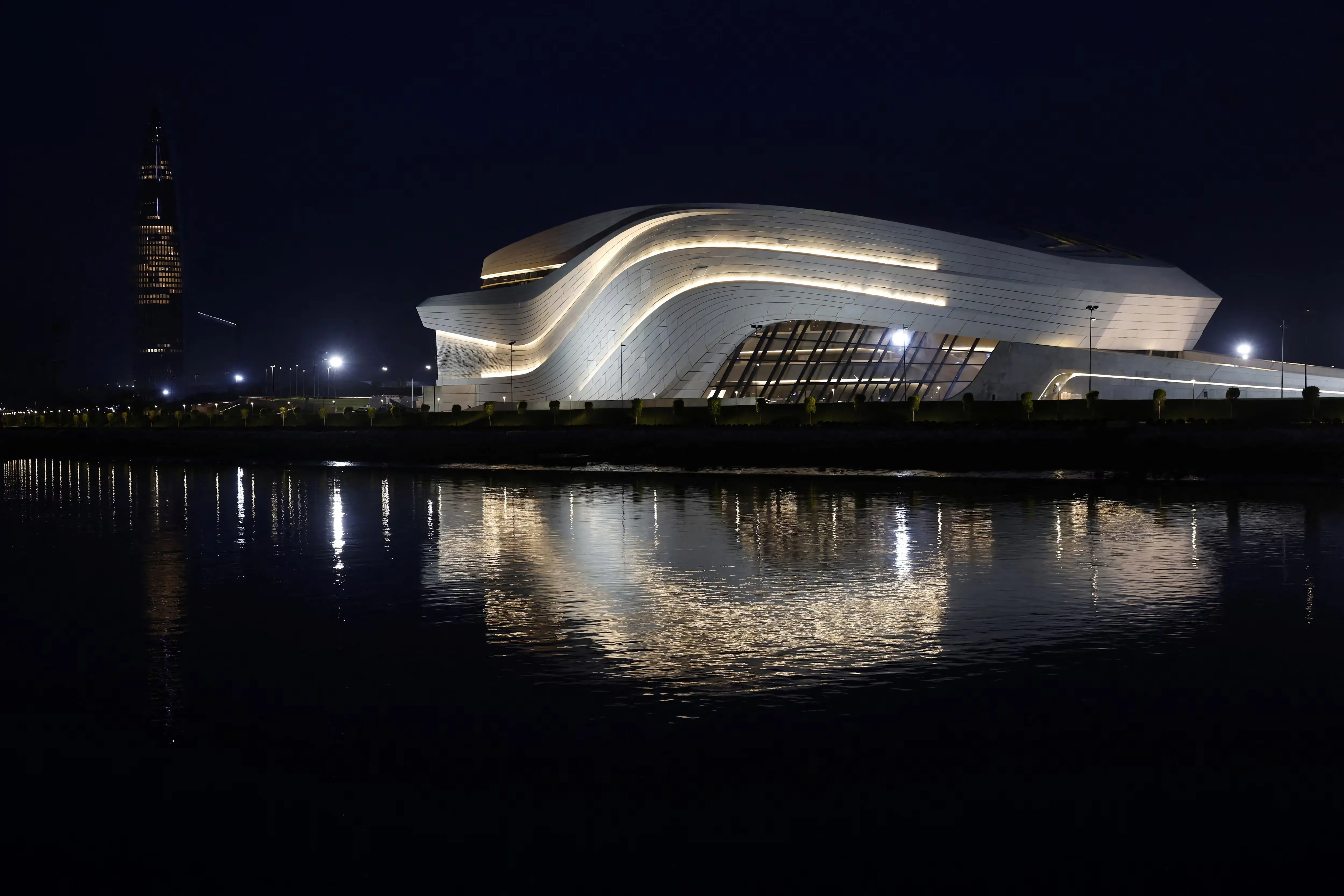
The Royal Theater is not a standalone building; it represents a cornerstone of a broader vision articulated by His Majesty King Mohammed VI, who has positioned culture as a strategic axis of national development. This vision is not ornamental; it is foundational, asserting that Moroccan modernity is forged not solely through infrastructure but also through symbols and meaningful places where a nation narrates its identity and projects its future. Within this framework, the Royal Theater transcends being just another cultural facility; it serves as a civilizational marker that signals to the world that 21st-century Morocco embraces ambition, creativity, and contemporary relevance. It is part of a larger ensemble around the Bouregreg River, where the Mohammed VI Tower, the tallest building in Africa, and other projects redefine the silhouette of the capital.
The theater interacts with these new forms, harmonizing with the Hassan Tower, the Kasbah of the Oudayas, the river, and the light. It serves as a balance between heritage and future, where memory and innovation cease to be opposing forces and instead become complementary. Zaha Hadid's architecture does not merely occupy a site; it extends, reveals, and transforms it. The Royal Theater appears to emerge from the ground as a dynamic material, a wave caught in motion. Its taut curves and lines unfold like forces, while volumes intersect without collision, creating an interior landscape where space becomes an experiential journey. The main auditorium, with a capacity of 1,800 seats, is designed to host opera, symphonic music, and large-scale choreographic works.
In summary, while the inaugural performance showcased the vibrant vitality of various Moroccan musical expressions, it remains to be seen what the theater's future orientation will be. No specific specialization has been announced—whether in opera, dance, theater, world music, or contemporary creations—leaving the theater's artistic direction still largely undefined. The inauguration celebrates a place; however, it does not yet articulate the overarching project that will define it. It would have benefitted from an initial programmatic gesture, such as announcing a season, outlining artistic orientations, revealing upcoming collaborations, and articulating connections with other cultural institutions in the country, and perhaps international stages capable of providing a network for circulation and visibility.
Ultimately, the Royal Theater of Rabat is not just an architectural marvel; it embodies a remarkable political and cultural gesture: a Morocco that rejects aesthetic modesty, embraces ambition, and situates its identity firmly within the global modern context while honoring its roots. It is also a testament to continuity; the creative audacity experienced during the Tangier Med competition—the intersection of architectural boldness and royal vision—has manifested in this architecture that now belongs to everyone. In a world where nations tell their stories through symbolic places, this theater communicates something essential: that Morocco is no longer merely a crossroads but is evolving into a major cultural player, a nation that creates, welcomes, and shines. It signifies a newfound confidence: a country unafraid to measure itself against the great stages of the world.
In conclusion, the Royal Theater of Rabat, through its form, location, and ambition, carries a promise: that of a country that thinks long-term, projects itself into the future, and recognizes that culture is not a luxury but an essential architecture of the interior. This monument stands not only as a tribute to Zaha Hadid but as an homage to what Morocco can achieve when it dares to dream. It invites us to imagine, create, and dream, placing culture at the heart of collective life. Lastly, it calls for the artistic depth this architectural gesture deserves, ensuring that its form finds its breath and that Morocco discovers, in this space, an opportunity for reinvention.
As reported by fr.le360.ma.