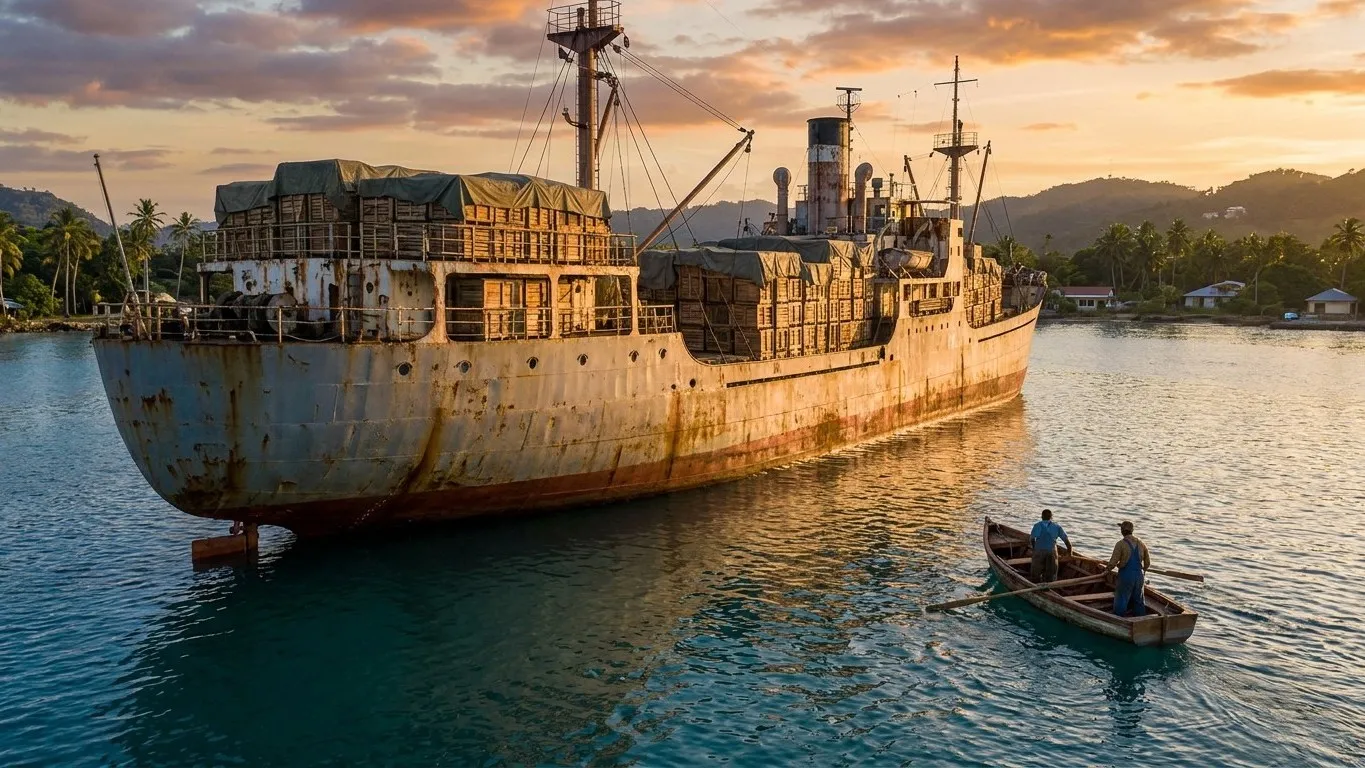

The Displacement of 2,500 Tons of Gold
On June 18, 1940, five ships departed from the port of Brest, escorted by two destroyers, carrying several hundred tons of gold bullion. Officially, their destination was Casablanca; however, they ultimately made their way to Dakar, where a portion of their gold was buried 70 kilometers inland in present-day Mali. This clandestine operation was not part of the original plan when the Banque de France began emptying its Parisian vaults as early as fall 1939.
With the declaration of war, France found itself in possession of one of the largest gold reserves in the world, holding 2,500 tons, which represented 20% of the global gold reserves of banks and was the second-largest stockpile globally, following the United States. This treasure was deemed too vulnerable in Paris, located just a few hundred kilometers from the German border. To safeguard this precious asset, Finance Minister Lucien Lamoureux took decisive action in September 1939, identifying three evacuation ports: Toulon, Le Verdon, and Brest. The first convoys were organized promptly, and between September 1939 and April 1940, the French Navy successfully transported 400 tons of gold to the United States via Halifax, Canada, utilizing eleven ships. In March 1940, a larger shipment of 150 tons, consisting of 3,000 crates valued at approximately 7 billion francs in gold, was dispatched from Toulon by “Force X,” which included four battleships and cruisers. Each standard gold bar weighed around 12.5 kilograms, making it a compact and easy-to-stack load, but handling thousands of crates proved to be a considerable challenge.
The Largest Gold Fleet Ever Assembled
The real turning point occurred with the collapse of the front. In June 1940 alone, 1,700 tons of gold managed to leave French ports bound for Africa and Martinique, marking what historians describe as the largest “gold fleet” ever to sail the seas. The scale of the endeavor is underscored by the sheer number of crates involved: at Brest, the Portzic fort alone housed 750 tons of gold, equivalent to 16,200 crates and bags of bullion, which had to be transported to the port within a tight timeframe. However, the operation was not without its hurdles. On May 28, customs officials in Le Verdon attempted to block an embarkation due to missing paperwork but were subdued by sailors, allowing 200 tons to be loaded onto the passenger ship “Ville d’Oran” for Casablanca. The cruiser Émile Bertin, nicknamed the “Greyhound of the Seas,” played a crucial role in this race against time, receiving orders to evacuate part of the gold from the Banque de France and making two crossings from Brest to Halifax on May 21 and June 10, 1940. Finally, on June 18 at 6:45 PM, the last five ships departed Brest, escorted by the destroyers Épervier and Milan, coinciding with the remaining fleet still present in the port.
However, the narrative took an unexpected turn when the convoy, initially destined for Casablanca, arrived there on June 21 and was joined two days later by another convoy from Lorient. Yet, the announcement of the armistice on June 22 dramatically altered the diplomatic landscape. On June 24, 1940, the six ships carrying the gold, escorted by the Épervier and the Milan, set sail for Dakar, joined on June 27 by the battleship Richelieu, ultimately arriving in Dakar on June 28, 1940, with 1,120 tons of gold—the planned stop in Casablanca had merely been a waypoint.
Even in Dakar, the gold did not remain securely locked in local vaults. Following the British attack on Mers el-Kebir in early July, the cargo was deemed too vulnerable in the port area and was relocated inland to Kayes, a small town in present-day Mali, several hundred kilometers from the coast. Meanwhile, the Émile Bertin, which had arrived in Halifax with its cargo, received radically different orders than initially planned, directing it to Martinique instead of Canada. It reached Fort-de-France on June 24, where the gold would be safeguarded by the Army at Fort Desaix for the remainder of the conflict. Ultimately, the distribution of gold in July 1940 bore little resemblance to the plans made the previous autumn: the gold was divided between New York (1,145 tons), Fort-de-France (250 tons), and Dakar (1,100 tons, which included Belgian and Polish gold entrusted to France). The entire operation concluded on July 7, 1940, just four months after the first significant shipments in March and a mere three weeks after the armistice.
Contrary to popular belief, the gold did not return to mainland France immediately after liberation. Instead, it wasn't until the end of active hostilities and the logistical organization of repatriation that the ship Île d’Oléron departed from Saint-Nazaire on September 12, 1945, making a stop in Casablanca before arriving in Dakar on September 22, where it loaded approximately 6,000 crates of gold, nearly 400 tons. After another stop in Casablanca and then in Algiers, the ship docked in Marseille on October 10 and 11, 1945. Over five years after leaving Brest or Le Verdon, part of the treasure finally returned to French soil. Although the gold had no immediate utility during the war, its return was timely for post-war France, which was in dire need of recovery. The repatriated gold would facilitate the reconstruction of France, allowing it to bridge the gap for over two years until the Marshall Plan was implemented in 1948. Yet, one lingering question remains, as few archives have shed light on it: how long exactly did the gold that remained in Kayes take to return to the Senegalese coast before its final journey to Marseille? On this specific point, the available records remain surprisingly silent.
As reported by sciencepost.fr.