
It is with great concern that I observe the inconsistent arguments often constructed by Spain regarding the contentious issue of Ceuta and Melilla. Morocco persistently asserts its claim over these cities, frequently employing the term "recover"—a term that is particularly significant. The word is not innocuous; to recover implies "to take back or acquire what was previously held." This presupposes prior ownership, and therein lies the crux of the debate.
Before accepting the term "recovery," it is essential to demonstrate what the word inherently assumes: that Ceuta and Melilla were once part of the Moroccan state, of which the current Kingdom of Morocco claims to be a successor, and that they were subsequently taken away. However, the reality is significantly more complex and cannot be reduced to such simplistic formulations.
Ceuta was captured by Portugal in 1415 and remained linked to the Portuguese crown for over two centuries. After Portugal separated from the Spanish monarchy in 1640, it chose to remain loyal to Philip IV. Ultimately, the Treaty of Lisbon in 1668 formally recognized its continued sovereignty under Spain. Thus, to reduce centuries of history to the claim that Morocco seeks to "recover" a city currently occupied by Spain is, at the very least, an extraordinary oversimplification of a historically intricate reality.
Revisiting the Wad-Ras Treaty
Another frequent argument arises from geography: Ceuta and Melilla are situated on the African continent and, therefore, should belong to Morocco. However, geography alone does not dictate sovereignty. If territorial continuity or shared continental affiliation were sufficient legal titles, we would need to reconsider much of the world's political map. Portugal does not belong to Spain merely because they share the Iberian Peninsula, nor does geographic proximity automatically transform a territory of one state into part of a neighboring state.
Boundaries are not established merely by geometry; they are determined by history, treaties, international law, and the effective exercise of sovereignty. This is precisely where a document, surprisingly absent from the public debate in Spain, comes into play: the Treaty of Wad-Ras of 1860.
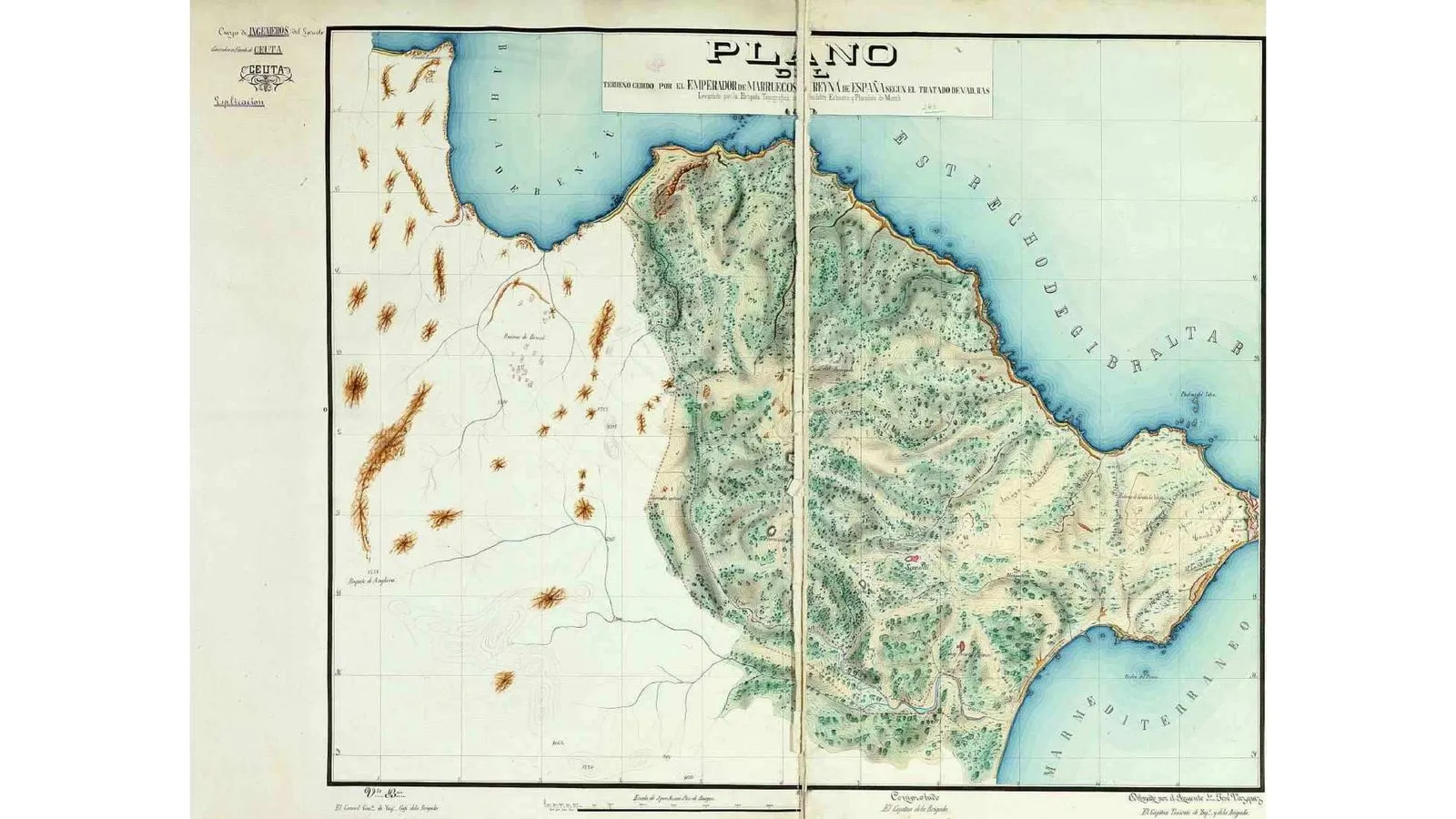
The so-called Treaty of Wad-Ras, officially known as the Treaty of Peace and Friendship between Spain and Morocco, was signed in Tétouan on April 26, 1860, and ended the African War. Its content is extraordinarily significant for understanding the territorial configuration of Ceuta. Article II establishes that the Sultan of Morocco agrees to extend the jurisdictional territory of the Spanish enclave of Ceuta "to the most convenient places for the complete security and protection of its garrison." However, it is Article III that deserves special attention. In it, the Moroccan monarch explicitly grants the Queen of Spain certain territories surrounding Ceuta with the legally robust phrase: "in full domain and sovereignty." This wording is crucial; it does not refer to mere permission for use, provisional administration, passage rights, or temporary occupation. It speaks of **dominion and sovereignty**.
Additionally, Article IV provides for the creation of a commission of Spanish and Moroccan engineers tasked with marking the agreed-upon boundaries on the ground with posts and signs. Yet it adds something even more significant: it was unnecessary to wait for the conclusion of that demarcation for Spanish authorities to exercise their jurisdiction, as the ceded territories would be considered under the sovereignty of the Queen of Spain "from the day of the signing of the treaty." Furthermore, Article VII obliges the King of Morocco to ensure that his subjects respect the territories that, according to the treaty, fall under Spanish sovereignty, allowing Spain to adopt necessary defensive measures without opposition from Moroccan authorities. Few formulations could be more explicit.
The Implications of the Wad-Ras Treaty
It is crucial to emphasize the importance of the argument without exaggerating it. It would be historically incorrect to claim: "Ceuta belongs to Spain because Morocco ceded it in the Treaty of Wad-Ras." This is not the case. Ceuta was already under Spanish sovereignty long before 1860. In 1580, when Philip II assumed the Portuguese crown, Ceuta came to share sovereignty with other territories within the Spanish monarchy. When Portugal regained its independence in 1640, Ceuta remained loyal to Philip IV, and in 1668, the Treaty of Lisbon definitively recognized Spanish sovereignty over the city. Therefore, Wad-Ras does not transfer Ceuta to Spain; rather, it expands the territory of a town that the treaty itself designates as Spanish and establishes an explicit territorial cession made by the Sultan of Morocco in terms of full dominion and sovereignty.
This distinction does not weaken the Spanish argument; instead, it makes it historically more precise and thus much stronger. There are also consequences that should not go unnoticed. Article V of the treaty reaffirmed the 1859 agreement concerning Melilla and confirmed the territorial cessions made in favor of Spain. In other words, Wad-Ras is not only a relevant document for Ceuta but is part of a series of international Hispano-Moroccan agreements related to the territorial delimitation of Spanish enclaves in North Africa.
One of the most striking questions is why the Treaty of Wad-Ras is discussed so little. The current controversy over Ceuta and Melilla cannot be resolved by a single historical document. It would be naive to think so. Morocco builds its claim through historical, geographical, and political arguments. Spain, on the other hand, maintains that Ceuta and Melilla are integral parts of its national territory and rejects their characterization as colonies pending decolonization. Yet, given the complexity of the debate, Spain should more clearly utilize all the historical and legal elements at its disposal, and Wad-Ras is one of them.
This treaty is not merely an archival curiosity or an irrelevant document from the 19th century. The Congress of Deputies has continued to reference the Treaty of Peace and Friendship of April 26, 1860, among the international instruments related to the delimitation of Ceuta, alongside other prior and subsequent agreements. Therefore, its limited presence in public discourse is surprising.
The Treaty of Wad-Ras has a fundamental virtue: it is written. It does not depend on sentimental interpretations, contemporary political rhetoric, or retrospective reconstructions. There exists a text signed between Spain and Morocco. This text refers to a "Spanish enclave of Ceuta"; it records a territorial cession made by the Moroccan monarch; it explicitly uses the terms "full dominion and sovereignty"; it determines the exercise of Spanish jurisdiction from the signing of the agreement; and it obliges the Moroccan sovereign to respect the territories subjected to that sovereignty.
This does not mean that Wad-Ras resolves any contemporary controversy surrounding Ceuta and Melilla on its own. It does not do so, but it is also unreasonable to act as if the treaty does not exist. The Spanish position should be based on a continuous, rigorous, and comprehensible historical explanation for both national and international public opinion. It is not enough to react each time the Moroccan claim makes headlines. Spain should articulate the history of Ceuta from 1415, its evolution from Portuguese sovereignty to its definitive integration into the Spanish monarchy, the Treaty of Lisbon of 1668, the successive agreements signed with Morocco, and, of course, Wad-Ras. Because territorial claims are best countered with documents rather than slogans.
However, an even more intriguing question remains. One thing is to demonstrate the historical significance of the Treaty of Wad-Ras, and another is to determine its **legal value in contemporary international law**. This is a legal, historical, and political debate of enormous interest that cannot be resolved with a simple word like "recover." Because before recovering something, one must demonstrate that it was ever lost. And when discussing sovereignty, words matter; yet documents matter even more.
As reported by europasur.es.