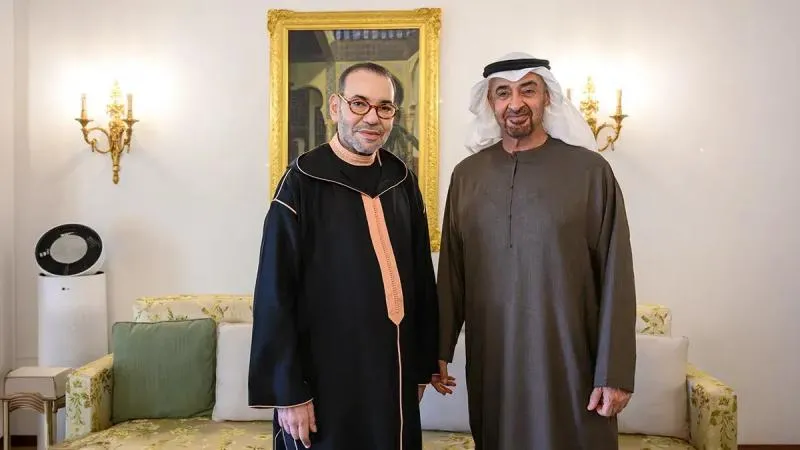

In the realm of international politics, while some meetings are merely routine diplomatic exchanges, others possess significant implications that reveal the strategic calculations, shared aspirations, and emerging alliances influencing regional and global dynamics. A prime example of the latter is the recent meeting held in Rabat between King Mohammed VI of Morocco and Sheikh Mohamed bin Zayed Al Nahyan, the President of the United Arab Emirates. This event transcended mere ceremonial engagement, marking a pivotal moment in the evolution of Moroccan-Emirati relations, which have developed into one of the Arab world's most resilient and influential strategic partnerships.
Amidst a backdrop of uncertainty, fragmentation, and shifting geopolitical landscapes that characterize much of the Middle East and North Africa, the relationship between Rabat and Abu Dhabi stands out as a beacon of stability, continuity, and foresighted strategic thinking. The importance of this partnership extends beyond mere political symbolism; it reflects an adaptability to an increasingly complex global environment where traditional alliances are being tested. The global order is undergoing significant change, characterized by intensifying geopolitical competition, the reconfiguration of economic corridors, evolving energy markets, and security challenges that stretch across the Middle East to the Sahel and beyond. In this context, successful alliances are now assessed not simply by historical ties or diplomatic niceties but by their capacity to generate strategic value, coordinate responses to crises, and promote a shared vision for the future.
Over the past decade, Morocco and the UAE have meticulously crafted this type of relationship, transitioning from a conventional partnership between two fraternal nations to a comprehensive strategic alliance rooted in mutual trust, political alignment, and a shared commitment to regional stability. Both countries have consistently shown an ability to synchronize their positions on critical regional matters while simultaneously broadening their cooperation across various sectors, including investment, infrastructure, renewable energy, security, and development initiatives.
This alignment is not merely coincidental; it signifies the rise of two nations pursuing ambitious modernization agendas while ensuring institutional stability and strategic independence. Morocco has effectively positioned itself as a vital conduit linking Europe, Africa, and the Arab world, evolving into an increasingly influential regional player with a growing diplomatic and economic footprint. Concurrently, the UAE has emerged as a global epicenter for investment, innovation, logistics, and diplomacy, exerting influence that extends far beyond the Gulf region.
Together, these nations represent a partnership between two development-oriented powers that prioritize pragmatism over ideology and long-term planning over immediate political gains. The timing of the Rabat meeting is particularly noteworthy; as instability lingers across various regions and geopolitical tensions reshape international relations, the dialogue between the Moroccan and Emirati leadership underscores a collective understanding that the Arab world necessitates more effective mechanisms for cooperation and strategic alignment. This meeting also indicates a growing inclination towards practical solutions founded on economic integration, security collaboration, and sustainable development, rather than the divisive politics that have frequently obstructed regional advancement.
Furthermore, this meeting signals the gradual establishment of a pragmatic Arab axis dedicated to stability, moderation, and constructive engagement. This emerging framework rejects the dichotomy of passivity versus confrontation, instead advocating for enhanced regional resilience through investment, connectivity, collective security, and strategic partnerships that can yield tangible benefits for their populations.
In many ways, the Moroccan-Emirati relationship serves as a case study on how political trust can be transformed into geopolitical influence. It illustrates that enduring alliances are forged not only on shared interests but also on shared visions. Both nations have demonstrated an impressive ability to maintain consistent strategic alignment amidst a rapidly evolving international landscape, thereby enhancing their partnership as a crucial pillar of regional equilibrium.
The overarching message emerging from Rabat is unmistakable: the Morocco-UAE partnership has transcended its initial bilateral success, evolving into a strategic asset for the broader Arab world. It exemplifies how effective leadership, confidence, and a long-term vision can transform historical bonds of brotherhood into a significant source of geopolitical strength and regional influence.
At a time when numerous alliances globally are being tested by uncertainty and competing interests, the Moroccan-Emirati model imparts a vital lesson: that trust, when paired with strategic foresight and shared ambitions, remains one of the most potent currencies in international relations.
As reported by thearabweekly.com.