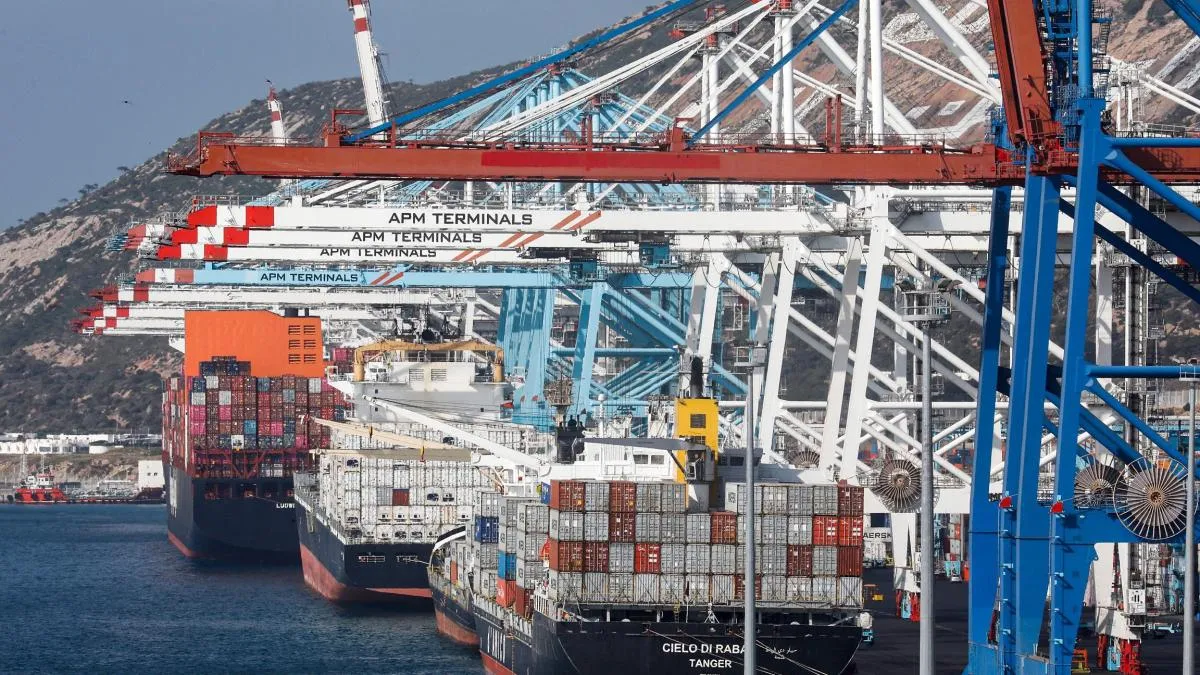

The sea serves purposes far beyond recreation, acting as the conduit for 85% of global commercial traffic. This cruciality was highlighted when the Strait of Hormuz faced an economic catastrophe due to its closure. In a show of solidarity with Gaza, the Houthi forces previously disrupted activity in the Bab el Mandeb Strait, a vital access point to the Red Sea, which has adversely affected Egypt's Suez Canal as well as the ports in Piraeus and Italy. Meanwhile, ports in Algeciras, Valencia, and Barcelona have seen significant growth during these years of conflict in the biblical East. However, the Tanger Med port, located near Ceuta, is rapidly catching up, and by the end of the year, the ultramodern and automated Nador West Med port, adjacent to Melilla, is set to open. This represents a monumental leap in maritime capabilities. The emergence of the Tanger and Nador ports casts a shadow over the future of Spanish ports, threatening to suffocate the economies of Ceuta and Melilla, a strategy that Morocco can execute without the need for military invasion.
Historically, empires have been maritime powers— a fact established during Roman times, where control over oceanic trade routes was vital for dominance. This context makes the current impotence of the United States in the Strait of Hormuz particularly significant, as it encourages the rise of new players in the geopolitical arena. Turkey has begun collecting tolls in the Bosporus and Dardanelles, while Iran and Oman are expected to impose fees in Hormuz, stirring considerable activity in the Indo-Pacific region. Morocco is positioning itself to play a pivotal role in the Strait of Gibraltar.
U.S. Strategy: Seeking Corsair States for Controversial Affairs
To fully understand the recent assault on Ceuta, it is essential to consider Morocco's primary objective: to unapologetically reclaim the former Spanish Sahara. The United States is assisting Morocco in this endeavor by proposing an autonomous region, supplying armaments, and providing cutting-edge technology, including Israeli tech. Morocco is also developing a drone aimed at counter-terrorism, as controlling the Sahel remains a significant concern for the U.S. Given that the United States cannot be everywhere at once and may not want to directly engage in ethically questionable matters, it seeks to subcontract these responsibilities to what are termed 'corsair states.' Morocco is emerging as one such state. By aligning itself with U.S. interests, Morocco has significantly strengthened its position against Spain.
Morocco's strategy is clear: to assert control in the Strait, solidify its claims over the Sahara, establish itself as a North African Atlantic power, suffocate the economies of Ceuta and Melilla, leverage migration as a bargaining chip for EU aid and compensations, and bolster its own economy through the Moroccan diaspora in Europe. In light of these developments and the emotional responses surrounding the assault on Ceuta, one must ask: what is Spain's strategy moving forward?
As reported by lavanguardia.com.