
The classical military doctrine emphasizes three essential principles for victory: the will to win, freedom of action, and the means to achieve it. Spain aspires to maintain good neighborly relations with Morocco, similar to those it has with France, Italy, or Portugal. However, if Morocco's ambition to assert itself as a hegemonic power in Africa leads it to challenge Spain, decisive measures will need to be taken.
Allies, much like stock market traders, can "sense" whether an executive is determined to win or is inclined to abandon their goals. The situation envisioned by Morocco does not inspire optimism regarding Spain's position. In a context of escalation, Rabat could leverage ambiguity to evade a full NATO response, given that Article 5 does not explicitly cover the Spanish enclaves of Ceuta and Melilla. The NATO defensive umbrella is not solely defined by the well-known Article 5 but also by the strict geographical limits imposed by Article 6 of the Washington Treaty, which specifies that collective defense will be activated in response to attacks on the territories of member states in Europe, North America, Turkey, and "the islands under the jurisdiction of any of the Parties in the North Atlantic region north of the Tropic of Cancer." Since the Canary Islands are geographically located in the Atlantic and north of this line, their legal protection is equivalent to that of Madrid or Paris, while Ceuta and Melilla are not explicitly covered. Being autonomous cities situated on the African continent places them outside the geographical delineation of the 1949 Treaty.
The EU's Protection of Ceuta and Melilla
In contrast to NATO, the European Union (EU) does not geographically discriminate against its member states. Ceuta, Melilla, and the Canary Islands are integral parts of Spain's sovereign territory and, by extension, the EU, as recently recognized explicitly by the European Parliament. In the event of a hybrid or armed aggression from Morocco, Spain can immediately activate two fundamental clauses of the EU Treaties: Article 42.7 and Article 222.
Understanding the Potential Escalation of Conflict
Article 42.7 of the Treaty on European Union serves as the European equivalent to NATO's Article 5 but is articulated in even stricter terms. It states, "If a member state is the object of an armed aggression on its territory, the other member states shall provide it with help and assistance by all means in their power." Notably, this includes France. The text explicitly states "on its territory" without limitations regarding continents or borders. Any military incursion in the autonomous cities triggers the legal obligation for assistance from the other 26 EU countries.
Article 222, designed specifically for gray zone scenarios, obliges member states to act collectively if a partner suffers a terrorist attack, natural disaster, or extreme emergency that exceeds its capabilities. In the context of hybrid warfare—such as a massive cyberattack affecting hospitals or the Spanish power grid, coupled with an orchestrated migratory wave—Spain could invoke Article 222 to mobilize EU police, economic, and cyber defense resources without the need to declare conventional war.
Experts consulted suggest three potential phases under the umbrella of the Anti-Access/Area Denial (A2/AD) bubble provided by France and the U.S., Spain's allies. The first phase could involve Morocco unilaterally declaring exclusion zones around the Canary Islands, claiming exploratory or military exercises while closing airspace over the Strait, backed by missile and drone batteries. The initial signs of conflict would be invisible, directly impacting Spain's rear with critical infrastructure failures, including power grids and civilian airport navigation systems.
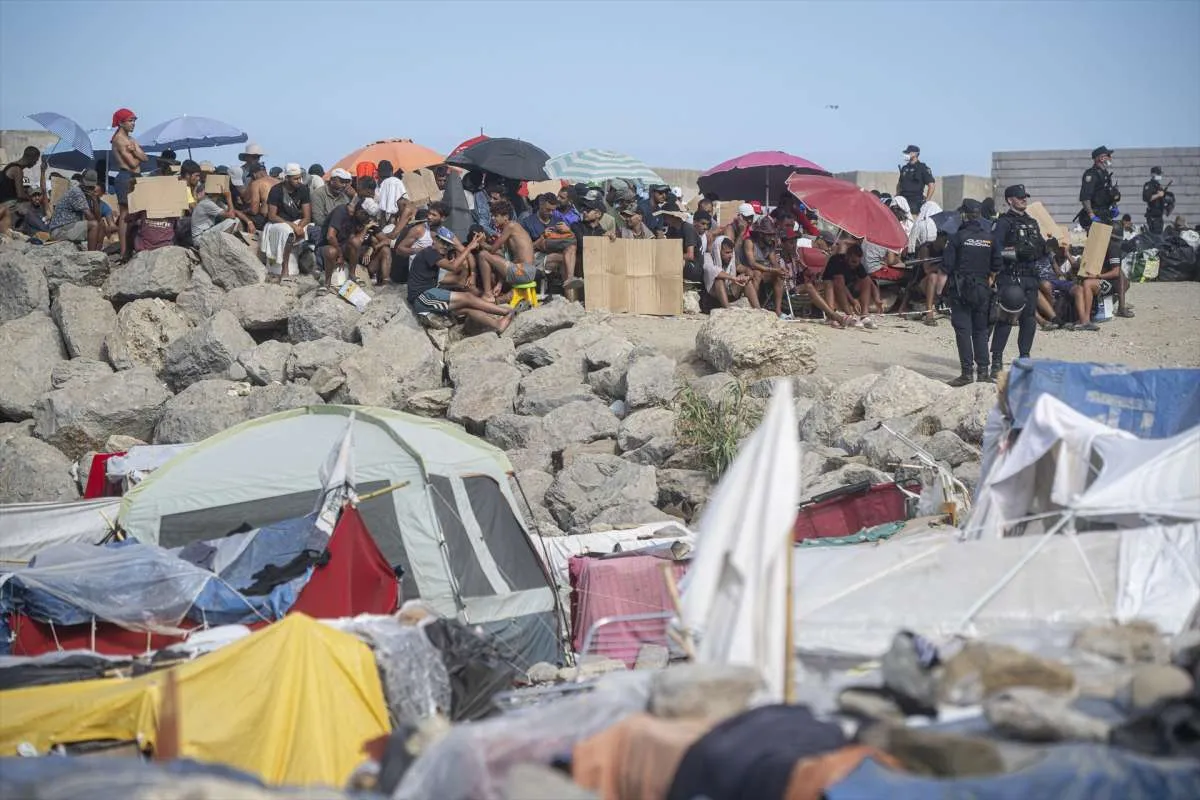
Such a scenario would also trigger a migratory offensive, with the simultaneous and coordinated opening of the borders at Ceuta and Melilla, leading to a massive influx of boats towards the Canary Islands, overwhelming Spain's law enforcement agencies. In addition, campaigns of misinformation and hacking could paralyze government decision-making.
In this complex geopolitical environment, Morocco appears to be pursuing a strategy that is primarily political and psychological, aiming for what is termed "deterrence by denial." By leveraging its defense industrial agreements, Morocco seeks to make the military, economic, and social costs of defending Ceuta, Melilla, or the Canary Islands so disproportionately high that Spain opts for diplomatic solutions instead of risking a collapse of its security framework.
As reported by escudodigital.com.