
The Dawn of a Significant Day in Auserd
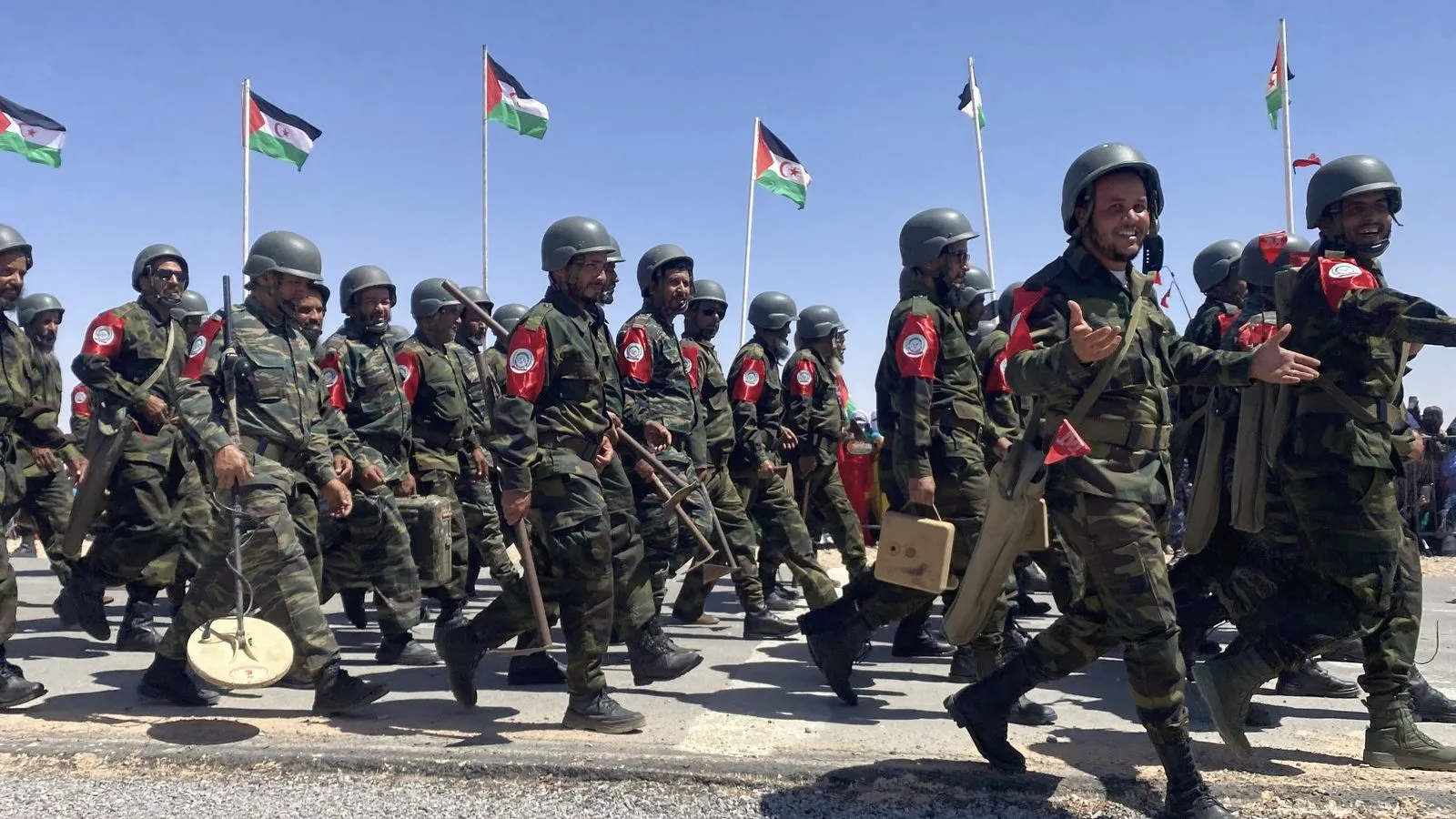
As the first rays of dawn break over the arid landscape of the Algerian desert, the tranquil morning air is pierced by the call to prayer. Despite being situated in the heart of the Sahara, a chill hangs in the air, signaling the arrival of a day of profound significance for the Sahrawi people. The welcoming family lays out a hearty breakfast comprising dates, yogurt, and bread, preparing for what promises to be a historic day. In just a few hours, a parade will commence, potentially marking a pivotal moment in the ongoing struggle and history of the Sahrawi people.
Children are putting the finishing touches on their flags, meandering through the streets of Auserd, one of the six Sahrawi refugee camps in Algeria that is home to nearly 200,000 individuals. While the camp boasts supermarkets, pizzerias, workshops, and hospitals, it remains a stark representation of the occupation by Rabat of what was once the 53rd province of Spain. The actual Auserd lies nearly 1,000 kilometers away, and the streets are patrolled by police from the Moroccan monarchy.
Commemorating 50 Years of the Sahrawi Arab Democratic Republic
As we make our way to the military parade organized by the Polisario Front, the political and military entity that has led the Sahrawi movement since the 1970s, the reality of a diaspora becomes painfully apparent. Few homes are under construction; those that remain standing often feature appliances, solar panels, and doors purchased with remittances from the tens of thousands who work in Europe and parts of Africa. Others have crumbled, perhaps abandoned as families moved further away from the occupied territory or lost their lives in the shifting sands of the Sahara.
Today marks the 50th anniversary of the establishment of the Sahrawi Arab Democratic Republic (RASD), an entity that, while not a member of the United Nations, is part of the African Union. This commemoration occurs amidst ongoing negotiations and a diplomatic race with Morocco. The Moroccan influence extends to several Sahel countries (Niger, Mali, and Burkina Faso), as it seeks to provide them with maritime access following the refusal of the Economic Community of West African States to utilize its ports after political upheavals and its ties with Russia.
As the armored vehicles roll through the parade, the crowd cheers and waves Sahrawi flags, seemingly unaware that at the same time, Mali has announced its recognition of Morocco's autonomy plan, a diplomatic victory for King Mohammed VI. Additionally, the European Union has finalized a technological agreement with Morocco, further solidifying its diplomatic gains. The situation is complex, as it involves not only diplomacy but also arms, violence, and casualties.
Currently, the Sahara is a divided territory, with 80% occupied and the remaining territory under the control of the Polisario Front. A militarized wall — the longest in the world after the Great Wall of China — stands as a testament to the ongoing conflict, constructed with the assistance of Israel. Following the cessation of a ceasefire, the Moroccan army killed the head of the Polisario National Guard in a liberated zone using Israeli drones. This military relationship is further evidenced by joint maneuvers involving the Golani Brigade, which trains Moroccan troops for combat in tunnels and has been implicated in atrocities against medical personnel in Gaza.
The atmosphere is electric as a throng of journalists, primarily Algerian and Sahrawi, rushes to capture images of Brahím Gali, the leader of the Polisario for the past decade and Morocco's principal adversary. He has been at the center of a significant diplomatic crisis between Madrid and Rabat after receiving COVID-19 treatment in Spain. Following his recovery, the Moroccan government responded by instigating a migration crisis in Ceuta and Melilla.
In his speech, Gali emphasizes the RASD's commitment to strengthening ties with countries worldwide, particularly in its regional context, including Morocco, asserting that the Sahrawi people aim to be partners in peace and cooperation rather than sources of threat. He also recalls Spain's historical shift in 2022, which endorsed Morocco's stance on Western Sahara, reminding Spain of its legal responsibilities regarding the decolonization process of the territory.
Shortly after delivering these words, this newspaper is the only Spanish media outlet accompanying Gali to review his troops. The display of anti-aircraft missiles, armored vehicles, and artillery reflects the support the RASD received in past years from Algeria, the former USSR, and Muammar Gaddafi's Libya. Following the military parade, we meet with Mohamed Uleida, the Director of Information and Political Orientation of the Sahrawi Army, who invites us to his car as we head towards Rabuni, the administrative capital of the refugee camps in Tinduf.
Our first stop is the National Museum of Resistance, which features the remnants of a downed Moroccan Dassault Mirage F1 fighter jet. Uleida takes us into a room filled with Cetme rifles and rocket launchers sold by Spain to Morocco, captured during a war that resumed in 2020 after three decades of ceasefire, resulting in over 10,000 casualties. He notes that all Spanish governments have supported Morocco in its conflict, lamenting that Prime Minister Sánchez has endorsed Morocco's claim over Western Sahara. He highlights the hypocrisy of former Socialist President Felipe González, who once visited the camps in casual attire but altered his stance upon taking office.
As we delve deeper into the issues, Uleida expresses skepticism about the U.S.-led negotiations involving the RASD and Morocco, especially after Washington backed Rabat's position on Western Sahara. He questions the efficacy of international law, citing Palestine's struggles despite having legal support. Behind closed doors, we discover a stockpile of 20th-century European military assets sold to Morocco, including tanks and artillery, underscoring the ongoing arms trade. He highlights a particular 106 mm cannon manufactured in Seville and displays a NATO-marked artillery piece. Outside the room, remnants of cluster bombs used by Morocco to target fleeing refugee caravans serve as haunting reminders of the violence that has plagued this region.
As night descends over Auserd, we are welcomed by Mohamed Yeslem Beisat, the Minister of Foreign Affairs. He asserts that while autonomy may be discussed as an option for the Sahrawi people, they will never accept it as a mandated and singular solution, as it undermines their inalienable right to self-determination. He emphasizes the need for dialogue rooted in legality and expresses a willingness to engage in negotiations, indicating that despite Sánchez's political shift, channels of communication remain open. The RASD has participated in three negotiation rounds with Morocco, two in Washington and one at the U.S. embassy in Madrid, where he acknowledges efforts made by the Trump administration toward resolutions supported by the UN and international legality.
As darkness envelops the refugee camps, there is no public lighting, and journalists walk to a nearby tent where women prepare henna, a natural dye used in celebrations believed to attract good fortune. The process of brewing traditional tea is mesmerizing, each cup flowing seamlessly into another, with sugar and mint amounts differing based on the number of servings. There is a saying: the first cup is bitter like life, the second is sweet like love, and the third is gentle like death.
During the parade, we meet a Sahrawi woman living in the Balearic Islands who introduces us to her family member for an interview. We travel to another camp where Abderramán shares his story of fleeing with his family in the 1970s, arriving with nothing and facing harsh conditions. He recounts being injured during bombing raids, stating emphatically, 'I don’t want to go to Spain or have all the resources. I want to return to the place from which Morocco expelled me half a century ago.'
Arriving in Smara, another camp several kilometers away, we are accompanied due to security concerns as jihadist groups sometimes target aid workers. We are welcomed by Sidi Lebsir, one of the founders of the Polisario and a living embodiment of African history. Now 81, blind, and struggling to speak, he carries the weight of the Sahara's history. Reflecting on Spain's repression against the Polisario during colonial rule, he expresses a desire for practical relations with Spain, especially in education and healthcare, lamenting the decision to align with Morocco instead.
Lebsir recounts the Spanish repression faced by the Polisario as they fought against colonial authorities. He notes that today's youth lack the fervor to fight as previous generations did. His 27-year-old niece, Aichatau Lehbib, a Sahrawi journalist, expresses hope for a 'free Sahara' within the next decade. The family shares documents from the Spanish colonial era, highlighting the loss of identity as the Spanish government has excluded Sahrawis from mass regularization efforts.
The youth play a crucial role in Sahrawi society, often studying abroad and returning. Two young women studying English philology at the University of Granada share their love for Spain and the sea, while also noting the claims of Moroccan students regarding Western Sahara. In the camps, children's affection and enthusiasm for football are evident, as is their exposure to the Spanish language during summer visits to Spain. However, many adults express concern over the gradual loss of the language. Thousands of children have temporarily traveled to Spain for summer vacations, often witnessing airplanes, the sea, or forests for the first time.
While some children engage with mobile devices, a psychologist at the camps warns that excessive screen time can be detrimental to mental health. Adala Lbhuhali runs an autism center where several women care for nearly 40 children, noting that while some parents are gradually recognizing the importance of mental health, it remains a taboo subject. The center employs animal therapy and has a garden, but medical assistance is scarce, particularly in accessing epilepsy medication. The recent cuts to U.S. international aid compound the challenges, alongside ongoing conflicts and crises in Spain that hinder support from families and institutions.
As the night deepens, the setting sun casts a unique signature over the camp, where vintage Mercedes-Benz cars from the 80s and 90s stand as relics of the past, having been rejected in European capitals due to environmental policies. When they cease to function, every part is salvaged. Children play among the remnants of what was once a Land Rover, while darkness envelops the camp, marking another day in a territory facing critical moments. Many Sahrawis dream of witnessing a sunset on the Atlantic shores of Western Sahara, now under Moroccan occupation.
As reported by europasur.es.