
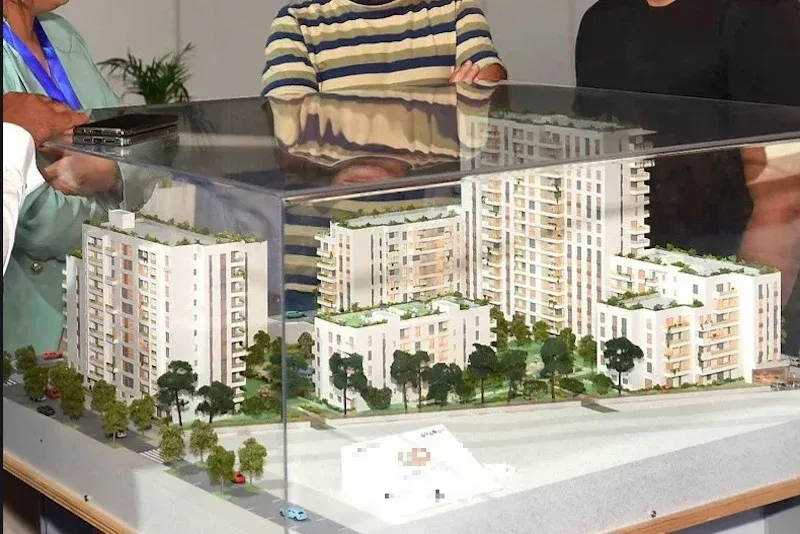

The Increasing Burden of Homeownership for Morocco's Middle Class
In Morocco, the aspiration to own a primary residence has transformed into an ongoing struggle for the middle class, primarily due to the limited options available and the relentless rise in housing prices, which have surged at alarming rates. This situation has been exacerbated by economic pressures that have negatively impacted the purchasing power of many families in recent years. The challenges are particularly pronounced for families living in major cities, where the costs and interest rates associated with bank loans place an additional burden on prospective homeowners. Compounding this issue is the stark imbalance between the limited supply of housing and the increasing demand, making it increasingly difficult for individuals to secure adequate housing close to their workplaces and essential urban amenities.
Market Dynamics and Government Support
The Moroccan real estate market presents a perplexing scenario. Despite a reported decline of over 40% in real estate transactions during the first quarter of the current year, prices have continued to escalate to record levels, as indicated by data from Bank Al-Maghrib and the National Agency for Land Conservation, Cadastre and Cartography. In response to this growing crisis, the Moroccan government has introduced a direct support system for housing purchases, offering financial assistance of approximately 100,000 dirhams for apartments priced below 300,000 dirhams, and 70,000 dirhams for those under 700,000 dirhams. This new system replaces the previous framework that provided apartments at a fixed price of 250,000 dirhams, as part of efforts to ensure affordable housing.
In this murky reality, many Moroccan families cling to the hope of finding housing that aligns with their financial capabilities, particularly when the purchase necessitates securing a bank loan. This increases the stakes significantly, as interest rates on mortgage loans currently range from 4.10% to 5.20%, excluding taxes and insurance costs, with only a few segments benefitting from interest-free loans from social enterprise institutions. According to expert Amin Mernissi, the real estate sector in Morocco is grappling with soaring prices driven by the high cost of inputs, particularly land parcels. Although the current housing support program has provided a lifeline for citizens, the available real estate products remain insufficient to meet demand, especially in larger cities where economic conditions deter developers from undertaking unprofitable projects.
Mernissi further elucidated the difficulty in providing the necessary quantity of real estate products without coordinated efforts between the state and the private sector. The demand for housing support has reportedly exceeded 200,000 requests, yet only about 105,000 have been addressed. He emphasized that securing adequate housing in major urban centers such as Casablanca and Rabat with a financing ceiling of 300,000 dirhams is exceedingly challenging, if not impossible, while apartments priced between 300,000 and 700,000 dirhams are available in varying quantities in other cities.
While it is increasingly difficult for the middle class in Morocco to find housing that fits their budget, Mernissi pointed out that most real estate developers prefer investing in luxury properties, which offer higher profit margins and stronger demand. In light of this, he suggested that "second-hand" properties emerge as a rational option for many families, particularly those located in neighborhoods equipped with essential services, rather than seeking apartments in the outskirts of cities. He noted that the Moroccan real estate sector has only witnessed genuine dynamism in the past thirty years, shifting from individual entrepreneurship to large, organized real estate companies responsible for developing extensive housing projects, with the economic housing program also playing a pivotal role in energizing the sector.
In 2025 and 2026, residential property prices in Rabat ranged from 8,500 to 25,000 dirhams per square meter for apartments, and between 16,000 and 32,000 dirhams for villas, with commercial spaces falling between 9,000 and 18,000 dirhams per square meter. According to the specialized site "Masaaken", the average price for apartments in Rabat hovers between 12,000 and 14,500 dirhams per square meter, varying by neighborhood and finishing quality. Areas such as Agdal, Hay Riad, and Souissi are among the most expensive, while neighborhoods like Yaacoub Al-Mansour and Taqaddum offer more affordable options.
Other major cities such as Casablanca, Tangier, Marrakech, and Agadir are experiencing similar trends, with a significant demand for private apartments amid a shortage of supply and a rising interest in studio apartments intended for daily rental purposes (such as through Airbnb). A source from the National Federation of Real Estate Developers (FNIP) acknowledged that the sector is facing a compounded and deep crisis attributed to a confluence of economic, social, and administrative factors that have contributed to a mismatch between supply and demand. The source stated that many Moroccans' salaries have stagnated for years, leading to a drastic decline in their purchasing power and ability to save for real estate acquisitions. Additionally, the final sale prices of residential apartments constructed by developers have been heavily influenced by a wave of inflation in recent years, as the prices of land parcels, construction materials (such as cement, steel, and aluminum), and labor costs have all increased without any sign of improvement since the COVID-19 pandemic.
Furthermore, the source noted that prices for middle-income apartments in some cities start at around 700,000 dirhams (equivalent to 70 million centimes or more), indicating that the middle class is increasingly looking to the suburbs for more affordable prices. Within the cities, the situation has been dire for some time now. The source also explained to Hespress that real estate developers face complicated and lengthy administrative processes from urban agencies and local municipalities, as various institutions are involved in issuing permits, which slows down the pace of project completion.
As reported by hespress.com.
