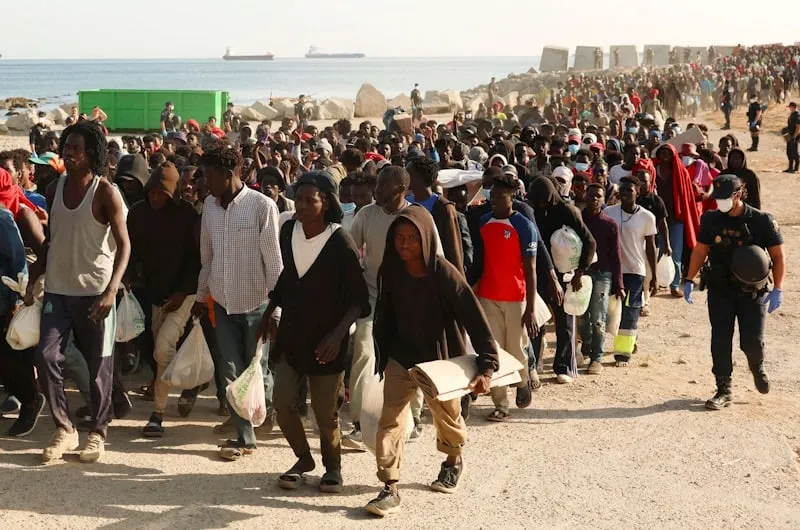

In a recent article by the French magazine Jeune Afrique, it was reported that the ongoing migration crisis in Ceuta has led to heightened tensions between Madrid and Rabat. This complex situation reveals that Spain holds a significant leverage point over Morocco, as it serves as a crucial supplier of gas, oil, and electricity to its neighbor. The pressing question is, to what extent can Madrid utilize this leverage in future negotiations?
Following three weeks of escalating migration issues in Ceuta, the diplomatic strain between Morocco and Spain appears to be easing, at least on the surface. While the Spanish government continues to publicly commend its partnership with Morocco, labeling it as "reliable" and even "exemplary," there are indications that the Spanish authorities are contemplating potential pressure tactics to implement should a new crisis arise.
Spanish public broadcaster TVE recently disclosed in its program _Mañaneros 360_ that Prime Minister Pedro Sánchez has requested major energy companies, including Red Eléctrica and Enagás, to provide him with data concerning trade relations with Morocco in the sectors of gas, oil, and electricity. According to the report, this initiative aims to transform energy into a diplomatic instrument to compel Rabat to tighten its monitoring of migrant flows towards Ceuta and Melilla.
Energy Dependence and Diplomatic Maneuvering
This information has garnered considerable media attention in Morocco, prompting Spanish governmental sources to deny the reports circulated by local media. The economic publication Capital Madrid clarified that the Prime Minister's office emphasized that this was merely an update to an existing plan, rather than the preparation of a new report.
Nevertheless, the information serves as a reminder to Rabat of its substantial dependence on Madrid in the energy sector. According to statistics from the Spanish Strategic Reserves Agency for Oil Products (Cores), Morocco has imported nearly 4,000 GWh of natural gas since the beginning of the year, making it the second-largest destination for Spanish gas exports after France. Furthermore, oil exchanges with Morocco accounted for 14% of Spain's total oil exports in the first half of the year. Similarly, Morocco continues to depend on Spain for electricity, with Spanish exports to Morocco reaching 827 MW between August 1 and August 19.
Mutual Economic Interests Mitigate Energy as a Weapon
So far, no official responses have emerged from Moroccan authorities regarding these developments, and the office of the Minister of Energy Transition and Sustainable Development, Leila Benali, has not responded to requests for an interview with Jeune Afrique. However, several Moroccan governmental sources have underscored the importance of contextualizing Spain's capacity to exert pressure. A senior official stated, "The strategic partnership between our two countries is very strong. I do not believe Madrid would consider reducing energy supplies to Morocco, as it would not be in its interest, in addition to the robustness of our relations."
Another Moroccan official involved in bilateral cooperation dismissed the likelihood of Spain resorting to retaliatory actions, while acknowledging that the "electricity weapon" operates in both directions. He explained, "When Spain experienced a widespread power outage in 2025, Morocco, alongside France, assisted Madrid in restoring its electrical system. Energy exchanges flow both ways." Moreover, a former director of the National Office for Electricity and Drinking Water (ONEE) highlighted on LinkedIn that the Moroccan institution is the first non-European company to buy and sell blocks of electricity directly on the European electricity market, specifically in the Spanish market, asserting that "countries that respect the law and the future do not cut energy infrastructure for political reasons."
Despite the recent events in Ceuta creating tensions between the two neighboring countries, there are currently no indications that trade exchanges between them have been adversely affected. The volume of trade between Morocco and Spain surpassed €22 billion in 2025, solidifying Morocco’s position as Spain's primary trading partner. This commercial activity is also supported by the numerous contracts awarded to Spanish companies in Morocco recently. Noteworthy examples include Acciona, which, along with Afriquia Gaz and Green of Africa, secured a contract valued at €800 million to construct a desalination plant in Casablanca. Additionally, CAF received a contract worth €600 million to supply 30 trains to the National Rail Office (ONCF) in preparation for the 2030 World Cup, which will be jointly hosted by Morocco, Spain, and Portugal.
As reported by alquds.co.uk.