
The Revolutionary Impact of the Train in Morocco
The terms “train,” “Babor al-Barr,” “machina,” and “Tangy Fes” are just a few of the expressions that Moroccans have used to refer to a singular invention that would dramatically alter travel, commerce, and the interconnectedness of cities in the country: the train. The arrival of the railway in Morocco was not merely the introduction of a new mode of transportation; it signified a profound transformation that took place at the end of the 19th century and the beginning of the 20th century. Railways came with promises of modernization, speed, and urban connectivity, yet they were also deeply intertwined with European competition for influence in Morocco and the military and economic agendas of colonial powers.
Initially, Moroccans viewed the train, or "machina," not simply as a novel machine gliding along iron tracks, but as a symbol of a rapidly advancing European world and an expanding foreign influence within the nation. The discourse surrounding the train was inherently political from its inception, raising pressing questions: Who would construct the railway? For what purpose? And who would control the paths it would traverse?
Fears and Controversies Surrounding the Train
Before the train became a reality in Morocco, its proposed implementation sparked significant debate. In the late 19th century, as European powers vied to extend their dominance in Morocco, modern communication methods—such as telegraphs and railways—were perceived by some officials and scholars as instruments of this expansion. Moroccan historian Ahmed Ben Khalid Naciri, author of "Al-Istiqsa," illustrated this apprehension by recounting European delegations' discussions with the Sultan regarding "Babor al-Barr and the telegraph," remarking that what was presented as a benefit for both Muslims and Christians could, in his view, be "a source of harm." This rejection was not a dismissal of technology itself, but rather a manifestation of fear regarding its potential use as a tool for foreign infiltration and control.
Such fears were not unfounded, as the railways that would later spread throughout Morocco primarily facilitated the movement of troops and transport of military supplies before gradually evolving into a network for the transit of goods and passengers. One of the most telling chapters in the history of Moroccan railways, revealing the connection between rail transport and colonial expansion, occurred in Casablanca in 1907. During the construction of the Casablanca port, a narrow gauge railway was established to transport stones from quarries to the port works, with its path running adjacent to the Sidi Belyout cemetery, inciting widespread outrage among local residents. On July 30, 1907, a "Decauville" train was attacked, resulting in the deaths of nine European workers involved in the project. This incident was used as a pretext for French military intervention, leading to a violent naval bombardment of Casablanca in August of the same year, followed by the landing of troops and subsequent occupation of the city. Thus, one of the earliest railway scenes in Morocco became linked with one of the bloodiest moments in colonial history.
The significance of this event transcends the incident itself; the railway was part of a broader economic project related to the port, which served as a gateway for European influence. The city was rapidly transforming into a strategic economic hub.
As Casablanca embraced the train in the context of port construction, Marrakech would soon experience a different yet equally military and strategic context. Reaching the Red City meant traversing the vast distance south of Casablanca towards Tadla, the Rhamna region, and Marrakech— a substantial logistical challenge in an era reliant on animals, caravans, and carts for transportation. In this context, the train advanced southward through a narrow gauge network.
By 1919, the Casablanca-Marrakech line was nearing completion, having reached Ben Guerir in September of that year, before finally extending to Marrakech in 1920. The arrival of the first train from Casablanca to Marrakech on May 20, 1920, marked a significant moment in the city’s history.
Imagine Marrakech, accustomed to the sounds of animals and caravans, hearing the chugging of a steam locomotive for the first time. A massive iron machine moving along tracks, billowing smoke and noise, cutting through the space that had traditionally been traversed on horseback. Historical sources indicate that the train arrived at Marrakech’s narrow gauge station at the foot of the Jelliz mountain, which was not the station that later became known to locals, but rather a different facility that preceded the well-known station.
While these narrow-gauge trains were not fast by today's standards, with speeds averaging between 15 and 20 kilometers per hour, their significance lay not only in their speed but in their ability to reduce travel time drastically. What once took hours or an entire day via animals was now achievable in a fraction of the time, enabling larger quantities of goods to reach their destinations and connecting military and administrative centers in ways that had previously been impossible.
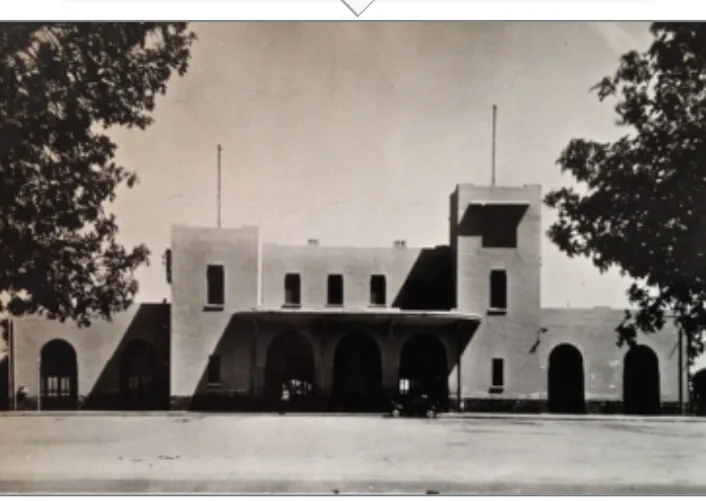
This encapsulates the true significance of the train in its early days in Morocco—it was not merely a means of travel but a tool for reorganizing spatial dynamics. The arrival of the train coincided with the transformation of Jelliz into a new area outside the ancient city walls. Historical accounts suggest that the first train station in Marrakech was constructed in 1923, situated near the location of the later station in the Jelliz area.
Jelliz itself gradually transitioned from a marginal space to a new urban and economic center, as the train did not just enter Marrakech; it contributed to the city’s reconfiguration around a new axis outside the old walls. By November 1928, Marrakech entered a new phase. After years of operating the narrow gauge network, standard gauge railway lines reached the city, linking Marrakech to the broader national railway network.
Historical documents reveal that the official inauguration of the Casablanca-Marrakech line took place in November 1928, with passenger services gradually commencing, marking the end of the narrow gauge line between the Tunisian leader and Marrakech. This marked a distinct shift from a "military train reaching Marrakech" to a "civilian train integrating Marrakech into a national network." The train was no longer solely for transporting equipment; it became a means for moving people and goods, expanding the scope of trade and population movement.
The railway reshaped the map of Marrakech, creating new routes within the city, connecting the station to industrial areas, warehouses, and sites of material extraction. Branch lines served the industrial area southwest of Jelliz, while some routes were dedicated to transporting stones extracted from the Jelliz mountain— the very mountain that supplied construction materials for the new city. As it traversed the urban landscape, the railway approached areas that would later become some of the most famous spots in Marrakech, passing through the vicinity of Jelliz, then following various paths near streets that are now part of the modern city network, before edging closer to the Harathi district and the famous Jemaa el-Fnaa square.
Thus, the sound of the train, at one point, became an integral part of Marrakech's daily life—not only outside the city but also within its urban fabric. One of the most overlooked aspects of contemporary Marrakech’s memory is that the train was not always confined to the current station. The old tracks once penetrated portions of the area known today by different names, housing facilities and warehouses linked to freight transportation. In the vicinity of Jelliz, the railway was associated with factories and storage, while other lines facilitated the transport of construction materials.
Eventually, the train’s path drew closer to the Harathi area, moving toward the city before nearing the Jemaa el-Fnaa vicinity. Here, the railway transformed from mere "infrastructure" to an urban relic; the streets of today conceal within their memory the tracks of a train that once passed through before the rails disappeared, and the roads and buildings evolved into the landscape we know today.
The name "Tangy Fes," meanwhile, was linked to the **Tangier-Fes** line, which was a separate project from the initial military Marrakeck-Casablanca network. The French-Spanish railway company responsible for the Tangier-Fes line was established in 1916, and the connection was gradually completed throughout the 1920s. This route appears in official documents from that era as a project managed by a French-Spanish company. Therefore, "Tangy Fes" was not a generic name for all Moroccan trains but rather a colloquial term for a specific route that became prominent in Moroccan imagination.
When the first train arrived in Marrakech in 1920, no one could have anticipated that this machine would leave an impact that extended beyond its arrival point. However, the train played a crucial role in the emergence of a new Marrakech— one whose economic appeal expanded towards Jelliz, becoming more connected with Casablanca and northern cities, where an outsider's arrival became linked with the station rather than a caravan. Nearly a century later, locomotives have changed, the narrow gauge lines have vanished, stations have evolved, and the new modern station opened in 2008 has become a part of the contemporary cityscape. The previous station, according to preserved architectural records, dates back to 1923 and remained operational until the inauguration of the new station. Yet beneath the asphalt, buildings, and streets lies another Marrakech— the Marrakech that once resonated with the sounds of trains.
As reported by almarrakchia.net.