
The Strategic Partnership Between the U.S. and Morocco
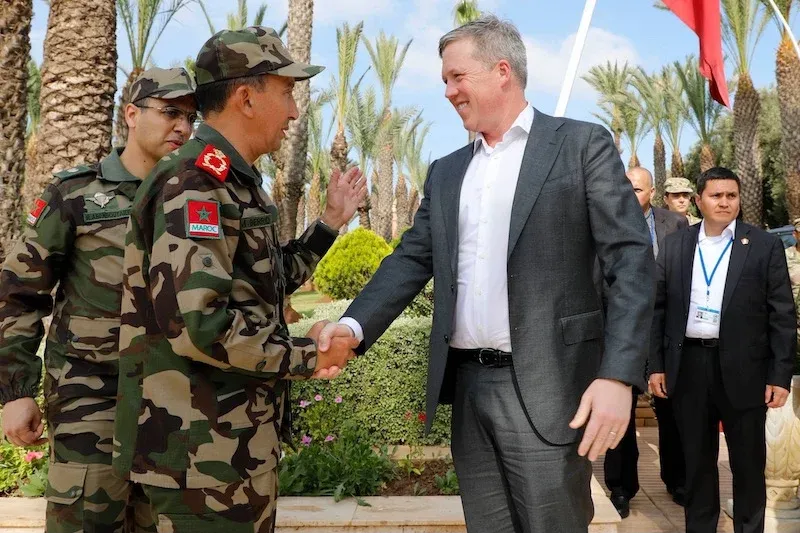
The recent visit by U.S. Army Secretary Daniel Driscoll to the headquarters of the Royal Armed Forces' Southern Command in Agadir marks a significant step in the burgeoning military cooperation between Morocco and the United States. This partnership has reached unprecedented levels, particularly in the context of the ongoing "African Lion 2026" military exercises. The meeting transcends typical diplomatic protocols, underscoring Morocco's emergence as a central partner in shaping regional security through high-level military coordination. This collaboration includes modernizing defense capabilities with Pentagon approval and enhancing operational capacities to address growing challenges in the Sahel and Sahara regions, solidifying Morocco's role as a pillar of stability and reliability on the African continent.
Analysts observing the dynamics of this deepening relationship highlight that the current military coordination aims to incorporate emerging and complex warfare technologies. This includes adapting to technological advancements such as the use of drones and artificial intelligence to safeguard national borders. This partnership reflects a political and operational acknowledgment of Morocco as a trustworthy ally in countering international terrorism, especially in light of the increasing alliances between extremist groups and separatist movements, thus reinforcing the nation's position as a guardian of national security in its vital region.
Record Levels of Military Cooperation
According to Ihsan Al-Hafidi, a professor at the Faculty of Law and Political Science and an expert in security sciences, U.S.-Moroccan military cooperation has reached "record levels." This is evident from the frequency of high-level visits between military officials from both nations. The close security coordination between Moroccan security institutions, particularly the Directorate General for Territorial Surveillance, and American intelligence agencies is also noteworthy. Al-Hafidi points out that arms deals have significantly increased in the past three years, focusing on renewing, modernizing, and rebuilding the Royal Armed Forces' military arsenal in collaboration with leading American companies, with prior approvals from the Pentagon.
Moreover, this cooperation is operationalized through exercises such as "African Lion," which has expanded to include participation from over 40 nations, along with observer states. The expert emphasizes that this development comes at a crucial time amidst evolving regional security challenges, particularly in Morocco's strategic Sahel and Sahara region. The relentless threat posed by extremist groups and their alliances with separatist movements has led the United States to view Morocco as a credible and reliable partner in combatting international terrorism, marking this alliance as an extension of the political rapprochement that culminated in U.S. recognition of Morocco's sovereignty over Western Sahara.
Dr. Mohammed Issam Al-Arousi, Director General of the Perspectives Center for Geopolitical Studies in Rabat, underscores the strategic implications of Driscoll's visit. He interprets the trip as a testament to the ongoing military cooperation between the two countries on three levels: armament, operations, and organization. Al-Arousi also notes the geopolitical dimension related to the precarious conditions in the Sahel region, which faces terrorist campaigns and alliances between extremists and separatist movements that threaten state unity. He insists that this transformation necessitates close coordination between the U.S. and Morocco to unify positions and foster peace and security in this troubled area.
Operationally, Al-Arousi clarifies that the meeting aims to coordinate the "African Lion 2026" exercises, which have become an annual event allowing Morocco to benefit from U.S. expertise in emerging warfare and what is known as hybrid and complex warfare. He concludes that Morocco seeks through this cooperation to adapt to technological advancements, including the use of drones, advanced radar systems, and artificial intelligence for national surveillance, ultimately reinforcing Morocco's pivotal role in Africa and renewing confidence in its capacity to enhance the security-development equation on the continent.
As reported by hespress.com.