
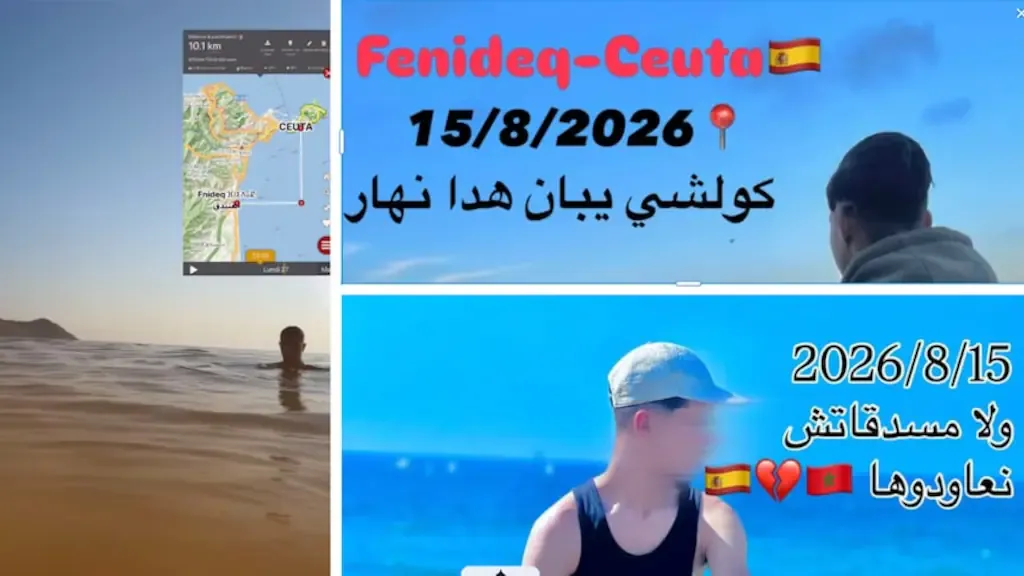

A striking video depicting a young man immersed up to his neck in water, with a map tracing a sea route from Fnideq, Morocco, to Ceuta, a Spanish enclave in North Africa, has recently gone viral across platforms like Instagram and TikTok. This visual, among others, has played a significant role in mobilizing at least two substantial waves of irregular migration from Morocco to Ceuta, one of which took place on August 15 and resulted in numerous arrests. The original poster of the video later claimed in response to comments, "we've arrived," hinting at the growing trend of using social media to fuel migration narratives.
The accounts behind these viral posts belong to various online communities that are part of a broader digital ecosystem focused on migration culture, including music, memes, and compelling imagery. Many of these accounts exploit the desperation of primarily African and Middle Eastern youth who are in search of better opportunities abroad, effectively profiting from their plight. Amid ongoing discussions, governments and organizations are divided on whether a singular entity orchestrated the events in Ceuta or if migration has been weaponized for geopolitical purposes. Nonetheless, it is evident that misinformation, propagated by numerous online communities, significantly contributed to the influx of migrants this summer.
The Role of Misinformation in Recent Crossings
The CBC's visual investigations team, assisted by Sebastian Vandermeersch from the investigative collective Bellingcat, identified numerous active social media accounts, particularly on Instagram, leading up to the first wave of migration on July 30. The increase in posts was initially sparked by false information indicating that a Spanish court ruling would no longer permit the rejection of migrants arriving by sea. This misinformation was rapidly disseminated, with anonymous accounts promoting the idea that crossing was feasible, using similar language and imagery that resonated with desperate individuals. As a result, more than 72,000 people crossed the border on July 30, overwhelming Ceuta's authorities and triggering a political crisis across Europe.
While most of those who crossed have since returned to Morocco, around 5,000 remain in Ceuta, many relying on charity while living on the beach. Tragically, nearly 100 individuals lost their lives attempting the crossing. The situation starkly illustrates how misinformation, when amplified across social media platforms, can lead to real-world consequences, especially for those in dire circumstances, as stated by Moustafa Ayad, the executive director for Africa, the Middle East, and Asia at the Institute for Strategic Dialogue. His team has been closely monitoring the surge in social media activity linked to migration.
Some social media accounts directed followers to WhatsApp chats where users exchanged plans and tips for crossing into Ceuta. Others provided direct advice through their posts. A notable Instagram video, titled "The Shortest Distance," has attracted over 320,000 views and showcases a reinforced fence adorned with barbed wire, clearly indicating the Spanish and Moroccan sides. The video suggests a particular section of the fence as the optimal crossing point, marked by large arrows in the colors of the Spanish flag. Some accounts even engaged in direct messaging with potential migrants, offering guidance on entering Ceuta for a fee of around $750.
The Ongoing Challenge of Misinformation and Migration
In response to the alarming events following the July 30 crossing, Meta and TikTok agreed to implement fact-checking measures to curb the spread of misinformation and prevent criminal organizations from exploiting vulnerable migrants. However, the surge of posts resumed in anticipation of another crossing on August 15, with some accounts re-emerging alongside newly created ones just days before the event. Posts circulated with messages like "15/08/2026. Everything will become clear on this day," leading to reports from Morocco indicating that hundreds gathered at the border on that date. This time, authorities in both Morocco and Spain were prepared, deploying thousands of police to manage the situation and arresting nearly 300 migrants that day.
One major factor contributing to the online surge was the increasing number of migrants who had successfully reached Ceuta prior to the Spanish court ruling, making it a popular entry point into Spain. According to the International Organization for Migration, more than 2,200 individuals entered Ceuta by land by the end of May, tripling the numbers from the previous year. Researchers suggest that this success, coupled with stricter patrols on other migration routes, may have fueled the misinformation circulating on social media. However, it is crucial to note that social media did not create the desire to migrate; rather, it amplified an existing aspiration among those seeking better lives.
Many of the accounts identified by CBC reflect a deep sense of disillusionment among young people in North Africa, utilizing aspirational imagery and language to promote migration. This dynamic underscores the profound desperation felt by these individuals, particularly in regions like Morocco, where youth unemployment rates can reach as high as 40%. With limited political representation and respect for their rights, the messaging surrounding migration often resonates as an urgent call to action.
In conclusion, the recent waves of migration from Morocco to Ceuta reveal how social media can serve as a double-edged sword, amplifying both hope and despair. While it offers a platform for connection and information, it also raises significant ethical concerns regarding the dissemination of misinformation and its real-world implications. The situation remains fluid, and as authorities continue to monitor and respond to these developments, the role of social media in shaping migration narratives will undoubtedly remain a contentious issue moving forward.
As reported by ici.radio-canada.ca.
