
Challenges and Progress in Post-Earthquake Morocco
Three years following the devastating earthquake that struck Morocco, significant strides have been made in reconstruction efforts. However, many survivors continue to live in tents, raising concerns about the adequacy of government assistance. On September 8, 2023, a catastrophic earthquake rattled the Al Haouz region, claiming over 2,900 lives and injuring more than 5,500 individuals. The destruction was extensive and left many communities in disarray.
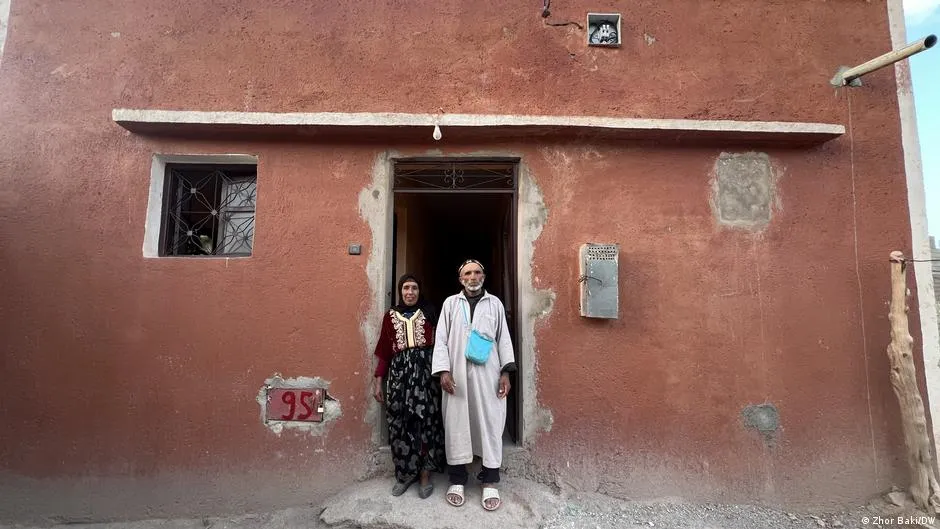
In the village of Ighermane, located about 50 kilometers southwest of Marrakech, 72-year-old Mohamed Ait Belaid reflects on his situation with a sense of satisfaction. Initially living in a tent after the earthquake, he has now moved into a newly constructed home, albeit smaller than his previous residence. "I received partial government support of 80,000 Dirhams, approximately 7,300 Euros, for the reconstruction," he shared. "Additionally, I paid out of pocket for another 100,000 Dirhams, roughly 9,110 Euros. Thankfully, I like my new home, and I feel comfortable in it. I am relieved that my wife, children, and I are healthy, and I have not lost anyone from my family."
In stark contrast, Larbi Ait Jelloulat, also 72, sits amidst the ruins of what was once his home in Azgour, a village severely affected by the earthquake. "I want to know where my rights have gone," he states angrily. "Who took away what is rightfully mine? For three years, I have gone from one government office to another, filing complaints and petitions, just to get an answer. Why have I been excluded? Am I not a citizen of Morocco?" Ait Jelloulat, a former municipal employee, had saved for years to build his large house, which was destroyed in 2023. Now, due to bureaucratic requirements, he must prove his residency in the region.
"My only dream was to spend the rest of my life in my own house and to rest there after all those years of service," he explained. "Now they say I am not a resident here. Where is the logic in that?" In Ighermane, reconstruction appears to be progressing more swiftly, with approximately 90 percent of the village reportedly rebuilt, and life for most residents has returned to a sense of normalcy, according to Omar Saeed from the Development and Solidarity Association in Ighermane. Out of about 150 families, 114 received government assistance, although most had to invest their own money as well.
Azgour, however, was the hardest-hit area. Ait Jelloulat mentions that only around 76 families have received assistance for reconstruction, while another 56 are still awaiting help. He adds that those 76 families who have rebuilt their homes elsewhere are facing issues with water and electricity connections. According to the High Atlas Development Agency (ADHA), 54,425 houses have been rebuilt or repaired so far, with over 3,000 more still under construction. The agency was established in October 2023 to coordinate aid efforts in the affected regions.
As of a statement made in March, the government has disbursed over 7.2 billion Dirhams, approximately 656 million Euros, to affected families. This amount includes reconstruction aid and monthly emergency assistance payments. Architect Mohamed Belmejjad, based in Marrakech, assesses the pace of reconstruction positively. "Given the circumstances, I believe the progress made so far is commendable," he remarked. He noted that many affected areas, particularly remote mountain villages, were difficult to access after the earthquake, delaying progress. Additionally, debris removal was a priority before reconstruction could begin, compounded by the challenge of transporting building materials to and from areas lacking paved roads. Water and electricity supply remains another significant hurdle.
Due to risks such as landslides, entire villages and construction sites may need to be relocated. At the same time, it is crucial to respect local building traditions and utilize stable, durable materials. Belmejjad pointed out the lack of necessary expertise in the region, whether among architects, planning firms, construction companies, or the labor force required for the rebuilding process. Despite these challenges, he suggests that the reconstruction efforts might even be ahead of schedule.
Nevertheless, the National Coordination Office for the Victims of the Al Haouz Earthquake reports having received complaints from over 3,000 families who have not received any government support. Montasser Itri, a member of the organization, explains that some families have been excluded because they moved to other parts of the country for work. Consequently, their identity cards reflect addresses that were not impacted by the earthquake. "The government is trying to reduce us, the victims of the Al Haouz earthquake, to mere statistics regarding the progress of construction and the dismantling of tents," Itri told DW, "instead of treating us as humans with dignity." The Coordination Office is therefore calling for an independent and transparent investigation into how local authorities have handled aid payments. During demonstrations outside Parliament in Rabat, victims demanded compensation and new housing, while accusing local officials of failing to fulfill their promises.
Some survivors are now pinning their hopes on the parliamentary elections scheduled for September 23. "Prime Minister Aziz Akhannouch promised us a solution to the problem, and God knows we are waiting for it," said Fawzia Aliban, whose home in Amizmiz was damaged in the earthquake. "We hope the issues will be resolved, as I was denied assistance even though my house is on the verge of collapse." Mohamed Belkaid, who still lives in a tent in Amizmiz with his four children, expressed his frustration, stating, "Three years have passed, and no one has thought of us. But recently, some politicians have appeared and promised to solve the problem." He received no support for reconstruction as he is registered as a tenant rather than a homeowner. He is skeptical that this will change. "They promised to review our cases and asked us to trust them and vote for them," he lamented. "If they truly wanted to resolve the issue, they would have done so long before the elections. Where have they been all these years?"
As reported by amp.dw.com.