
After discovering bouldering in Paris, Sami and Mamoun returned to their hometown with a vision: to establish a climbing gym in Casablanca. With Tla3, their goal is to foster a more localized, accessible climbing community that resonates with Moroccan climbers. They aim to create a space that not only provides climbing walls but also promotes social interaction among climbers, making the sport more approachable for everyone.
Over six months, they explored approximately 15 to 20 potential locations, facing the challenging equation of finding sufficient height for bouldering walls, a central location in a sprawling city, adequate parking, and a rent that aligns with a nascent climbing scene in Casablanca. Eventually, they secured 400 square meters of space with a ceiling height of 5.5 meters, close to offices and residential neighborhoods, allowing them to envision their dream facility. About 300 square meters will be dedicated to climbing, featuring 66 linear meters of walls, complemented by a café and a small yoga studio, with plans for opening by the end of 2026. "Honestly, we couldn’t have dreamed of a better location," Sami reflects. To understand why these two Casablanca natives are deeply invested in this venture, one must first consider their journey back to Paris.
Returning to Roots
Sami grew up in Casablanca, born to a Moroccan mother and a French father. After completing his education at Lycée Lyautey, he moved to Paris for higher studies and later worked in the tech industry as a product manager. Initially, sports played a minimal role in his life. Although he had dabbled in climbing during high school, it wasn’t until a visit to Arkose Nation with a friend that he experienced a transformative moment. "It was as if a new world had opened up before me," he recalls. This newfound passion for bouldering quickly transcended mere physical activity; it became a social outlet for him. Sami found joy in meeting people, engaging in conversations, and simply having fun. Reflecting on Casablanca, he realized that such a space was sorely missing for young people there. His vision extended beyond just constructing walls; he wanted to create a community hub where friends could gather, share drinks, and host local cultural initiatives.
The idea could have remained a fantasy, but Sami decided to pursue the craft seriously. He left the tech sector and gained practical experience working at Climbing District and Climb Up in the Île-de-France region for two years to understand the economics and operations of climbing gyms before returning to Morocco. It was also in Paris that he met Mamoun, another Casablanca native, and together they nurtured a shared ambition: "to develop climbing in the place where we grew up." The focus on bouldering was both a personal preference and a practical choice, as it demands less height, equipment, and safety measures, offering a more immediate and accessible introduction to the sport.
Climbing for All in Casablanca
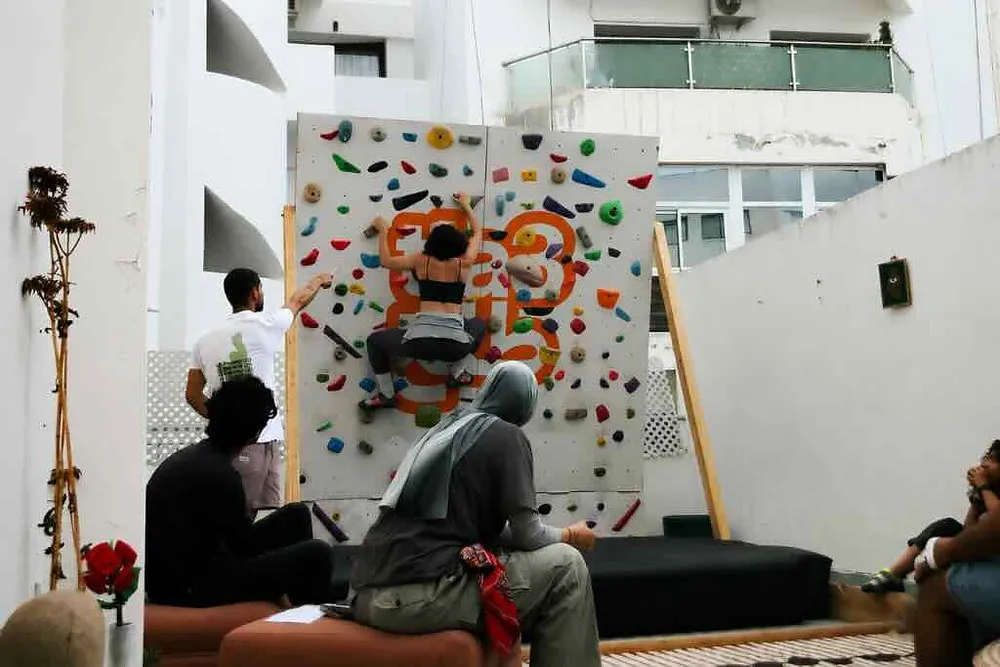
While Casablanca has the historic climbing wall of the French Alpine Club, which is primarily geared towards roped climbing and a small bouldering area, it lacks a modern facility dedicated entirely to bouldering. Marrakech had set a precedent with Atlas Elevation, merging bouldering and difficulty climbing. For Sami, Casablanca was the obvious choice, being his hometown and the economic heart of Morocco. Before securing a location, Sami and Mamoun wanted to ensure there was a sufficient audience for their venture. They constructed a spray wall and began organizing climbing sessions, attracting around 230 participants, many of whom were Moroccan climbers, but also newcomers unsure of what to expect. They aim to challenge the prevailing misconceptions that climbing is solely for children.
Tla3 is particularly focused on reaching out to this untapped demographic. Sami explains, "Our target audience is really young adults seeking a third space to enjoy their time." The future grading system will reflect this intent, emphasizing accessible and intermediate-level routes over extreme challenges. Their commitment to inclusivity is evident in their approach to the gym environment, where they’ve seen a higher ratio of women climbers during their sessions. Sami acknowledges the need for gender diversity, stating, "We are two men and don’t necessarily share the perspective or experience that a woman might have." They plan to implement a code of conduct and consider scheduling women-only climbing sessions.
However, pricing poses a challenge to their ambition of making climbing accessible. Currently, they anticipate a full-price entry fee of around 140 dirhams (approximately 13 euros), with discounts for students. Comparatively, the median monthly salary in Morocco was just 3,173 dirhams (about 295 euros) in 2024, meaning a single session could account for over 4% of that income. For regular participation, they aim for a monthly fee between 40 and 50 euros (about 430 to 540 dirhams), representing 14 to 17% of the median salary. Despite their commitment to accessibility, such costs may remain prohibitive for a significant portion of the population. Sami insists, "The goal is not to offer elitist pricing," adding that Tla3 plans to host free days and continue taking their wall to schools and community organizations, providing opportunities for those who might not otherwise have access to climbing.
Tla3’s walls will be manufactured abroad, drawing on the founders’ extensive experience from French climbing gyms. They aim to model their bouldering gym as a third place, a concept that has gained traction in many Western cities. Sami and Mamoun do not shy away from this influence; instead, they aim to avoid creating a Parisian replica in Casablanca. The name Tla3, written in phonetic Darija with the number ‘3’ representing the Arabic letter ع, translates to "climb" or "go up". It's a widely used expression in casual conversation, embodying local culture. Their logo combines phonetic writing and Arabic scripts, while the café, events, and collaborations will prioritize local actors and initiatives. Casablanca itself becomes an integral part of this project, described by Sami as a "melting pot," where a single sentence might weave together Darija, French, and English. "We wanted to reclaim this concept locally," he explains.
This idea of reappropriation extends beyond the gym itself. Morocco is a renowned climbing destination in the Mediterranean region, with areas like Taghia, Todgha, Tafraoute, and the High Atlas Mountains attracting climbers from Europe and North America. Local guides have worked in these mountain ranges for decades. However, a significant part of the recent sporting history of these cliffs has been narrated from an outsider’s perspective, with those exploring routes, establishing climbs, and producing guidebooks often being foreign climbers. Sami recognized this dynamic while climbing outdoors and realized that the routes lack names that resonate with Moroccan climbers, primarily bearing English or French names. This observation aligns with the work of anthropologist Thomas Fouquet, whose research has shed light on the colonial history of Moroccan sports, revealing how national sporting narratives have been shaped externally.
Sami acknowledges the contributions of foreign climbers in opening, equipping, and promoting these sites but emphasizes the need for a shift. "I would like to see a kind of reappropriation of this nature by Moroccans," he states, not to exclude others—"everyone is welcome"—but to ensure that those living close to the rocks are not merely spectators of a sport that draws on their local resources for sun, stone, and adventure.
Tla3 aspires, in its own way, to contribute to this movement. Sami and Mamoun have already engaged with several local guides and proposed outdoor experiences. For them, indoor climbing is just a gateway to the outdoor experience. "I know that climbing is a portal to the outdoor world," Sami explains. Yet, before they can envision the future on the rock, they must complete the construction, navigate administrative delays, and finally open their doors, a timeline that has already faced several setbacks. Their immediate goal is straightforward: to encourage Casablanca residents who have never climbed before to step through the door. The rest may unfold naturally, potentially leading them to the cliffs—and perhaps to the next routes named in Darija.
As reported by vertigemedia.fr.