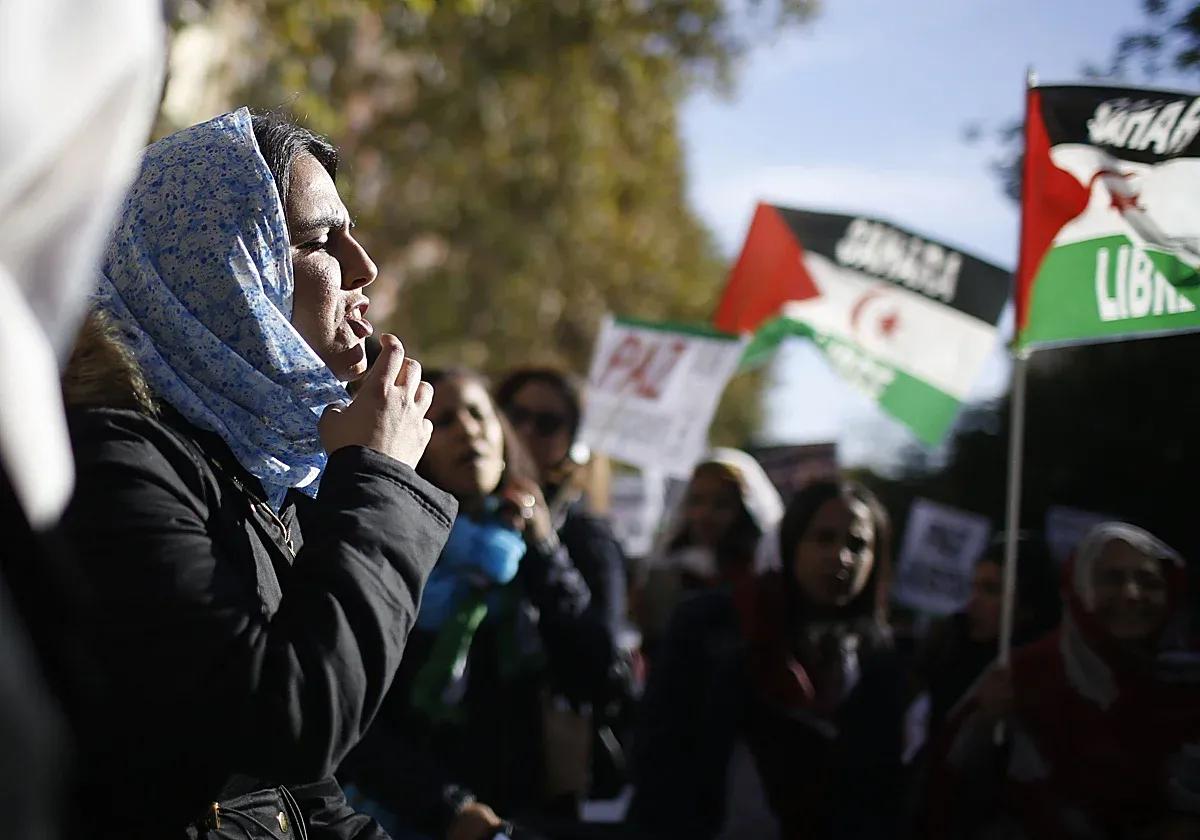
The Polisario Front has suffered a significant loss with the death of Lahbib M. Abdelaziz, a prominent figure poised to become its future leader. The 37-year-old, who was the son of the historical Sahrawi leader Mohamed Abdelaziz, was killed in a Moroccan drone strike on Sunday in Western Sahara, an incident that also claimed the lives of two other unknown members of the independence movement. The Moroccan government has yet to comment on this incident, which complicates the potential return to dialogue between the two parties following a breakdown in negotiations in May.
These discussions, which had been facilitated by the United States, were halted after an artillery attack by the Polisario Front on a Moroccan military base in Esmara, located in northern Western Sahara, which drew international condemnation. The president of the self-proclaimed Sahrawi Arab Democratic Republic (RASD), Brahim Ghali, recently defended the attack as an act of legitimate self-defense against Morocco. He communicated this viewpoint in a letter sent last month to UN Secretary-General António Guterres, who subsequently dispatched his envoy for Western Sahara, Staffan de Mistura, to the region in an effort to de-escalate the situation. Coincidentally, de Mistura arrived in the refugee camps of Tinduf, southwestern Algeria, on the same day that Abdelaziz and his two companions lost their lives.
The drone attack occurred near the wall erected in Western Sahara, which divides the territory between Morocco, controlling 80%, and the independence movement, which holds the remaining 20%. In response to the tragedy, the RASD declared three days of mourning. The loss of Abdelaziz, who was married and the father of three, represents a significant blow to the Polisario Front. He had been rising through the ranks of the organization, gaining a prominent position in recent times. Born and raised in the refugee camps in Algeria, Abdelaziz was adept at navigating these areas where tens of thousands of Sahrawi refugees reside, and he understood how to maintain control over them. His influential position garnered support from both political and military leaders within the movement, who viewed him as the best candidate to carry on his father's legacy.
Indeed, Ghali, who succeeded Abdelaziz as the head of the Polisario in 2016 after his father’s death, appointed him commander of the reserve brigade a couple of years ago, underscoring his growing power within the movement. Abdelaziz had been involved with the Polisario since he was 22 years old and was part of its General Secretariat as well as the Defense Commission, one of its key bodies. His death in the Moroccan drone strike extinguishes hopes for the continuity of his father’s legacy. The historical Sahrawi leader led the Polisario for four decades after taking power in 1976, the year Spanish troops withdrew from Western Sahara, igniting a conflict with Morocco and Mauritania.
This incident coincided with the diplomatic tour of the UN special envoy aimed at reviving dialogue between Rabat and the independence movement. The conflict with Morocco was ostensibly resolved in 1991 with a ceasefire that many believed would lead to a referendum on self-determination, but that referendum was never held. The ceasefire was broken in 2020, and since then, the Sahrawi independence movement has faced a series of diplomatic setbacks. Morocco’s plan for the former Spanish colony, which designates Western Sahara as an autonomous territory within Morocco, has garnered support over recent years, including backing from Spain and France, among other nations. The most recent blow came from the UN Security Council, which endorsed the Moroccan proposal last autumn.
The diplomatic mission of the UN special envoy for Western Sahara, Staffan de Mistura, aimed to rejuvenate discussions between Rabat and the independence movement to alleviate rising tensions. However, the recent deaths of the three Polisario members have severely undermined this objective.
As reported by elcorreo.com.