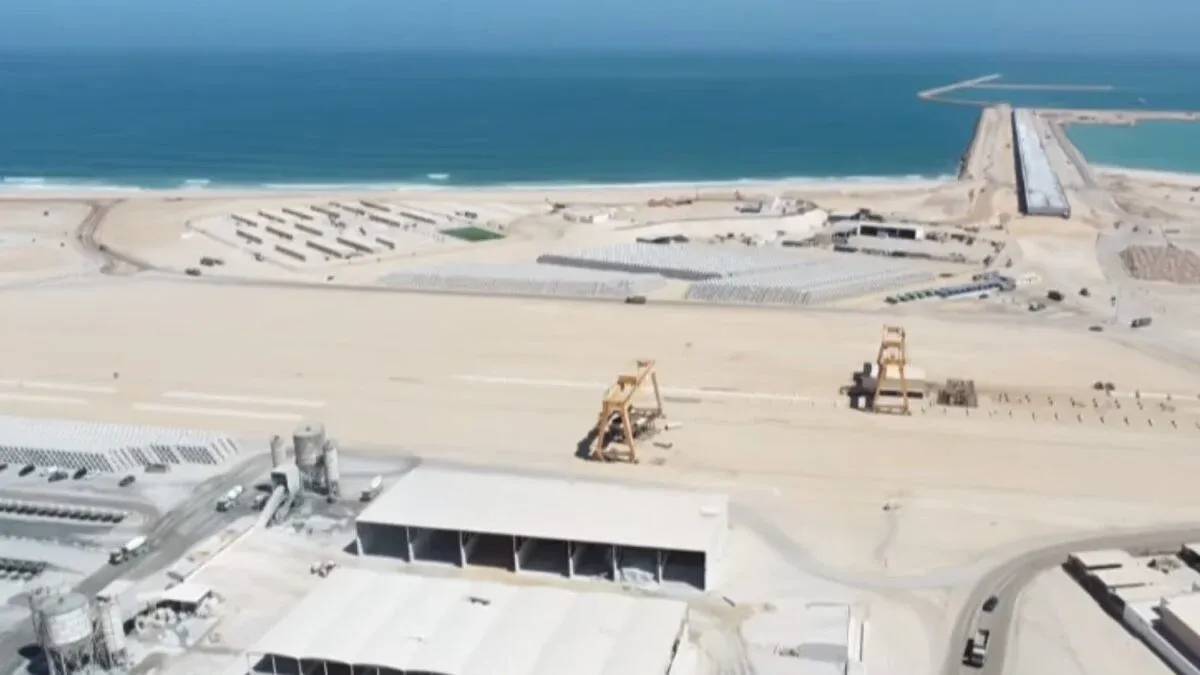

In various regions around the world, agriculture relies on different water sources: some depend on rainfall, others on large rivers, and some on underground reserves. However, there exists a unique region where none of these options suffices. Surprisingly, the ocean lies just a few kilometers away and could potentially be the key to transforming thousands of hectares of arid land into fertile agricultural fields.
The project that Morocco has been developing for years presents a concept that is straightforward yet complex in execution: to extract water from the Atlantic Ocean, desalinate it, and use it to cultivate food in one of the driest areas of the country. The scale of this initiative is beginning to draw significant attention.
The Ocean as a Water Source for the Desert
Bir Anzarane has been chosen as the site for this ambitious project, located within the Dakhla-Oued Dahab region in southern Morocco. The objective is to utilize approximately 5,196.56 hectares to develop agricultural operations. The primary challenge is abundantly clear: water. The area experiences particularly arid conditions, and the underground reserves do not provide an unlimited solution. Therefore, significantly increasing the cultivated area using only these resources could place increasing pressure on the aquifers.
This is why the project relies on a seemingly inexhaustible resource: the Atlantic Ocean. The first step involves capturing seawater, which will undergo a desalination process to make it suitable for agricultural use.
The initiative began to take a more concrete form last year when Morocco's Agricultural Development Agency launched a call for proposals to award 35 agricultural production projects. Collectively, these operations would occupy around 1,090 hectares situated in Bir Anzarane. However, this initial area represents only a fraction of the broader plan, which aims to extend agricultural activities to exceed 5,000 hectares.
A Massive Water Supply for Food Production
The figures involved illustrate the scale of the infrastructure needed for this project. According to the Agricultural Development Agency of Morocco, the system is designed to utilize approximately 100,000 cubic meters of water each day. The annual forecast amounts to about 37 billion liters, of which around 30 billion liters would be allocated for crop irrigation, while the remaining 7 billion liters would provide drinking water for Dakhla.
Additionally, the project incorporates another essential element: the energy required to operate the desalination process. The proposal suggests harnessing electricity from a wind farm, capitalizing on the region’s favorable conditions for renewable energy generation. This combination is particularly significant because desalinating water necessitates considerable energy. Integrating the system with a renewable energy source would allow for a cohesive strategy that combines agricultural production and electricity generation.
The ultimate goal is not merely to create an infrastructure for transporting water to the desert but to establish a new agricultural activity capable of continuously producing food in an area where natural conditions greatly hinder such development.
Among the expected crops are round tomatoes and onions, although the project also includes other agricultural and ecological crops. This initiative does not start from scratch; the Dakhla region already has experience with certain crops, including melons and blueberries. However, expanding production necessitates a water supply that underground reserves alone can hardly guarantee on a large scale. This is where the Atlantic Ocean plays an unexpected role. Instead of searching for new freshwater reserves underground, the strategy involves utilizing an external source, subjecting it to the necessary treatment, and subsequently transporting it to the agricultural operations.
The challenge will be to maintain a balance between the vast amount of resources required and the resulting production. The construction and operation of the water capture and desalination facilities, alongside the distribution infrastructure and agricultural systems, would transform this project into one of the most distinctive initiatives in the region. If developed as planned, thousands of hectares that currently present unfavorable conditions for agriculture could eventually become part of a new productive area. While the desert will not disappear, a segment of its landscape could change dramatically due to technology that allows ocean water to be converted into an agricultural resource.
Morocco's endeavor thus reflects an increasingly prevalent trend in water-stressed regions: when freshwater becomes scarce, the sea can evolve from just a geographical boundary into a strategic resource. In Dakhla, this concept is set to be tested on an extraordinary scale.
As reported by es.gizmodo.com.