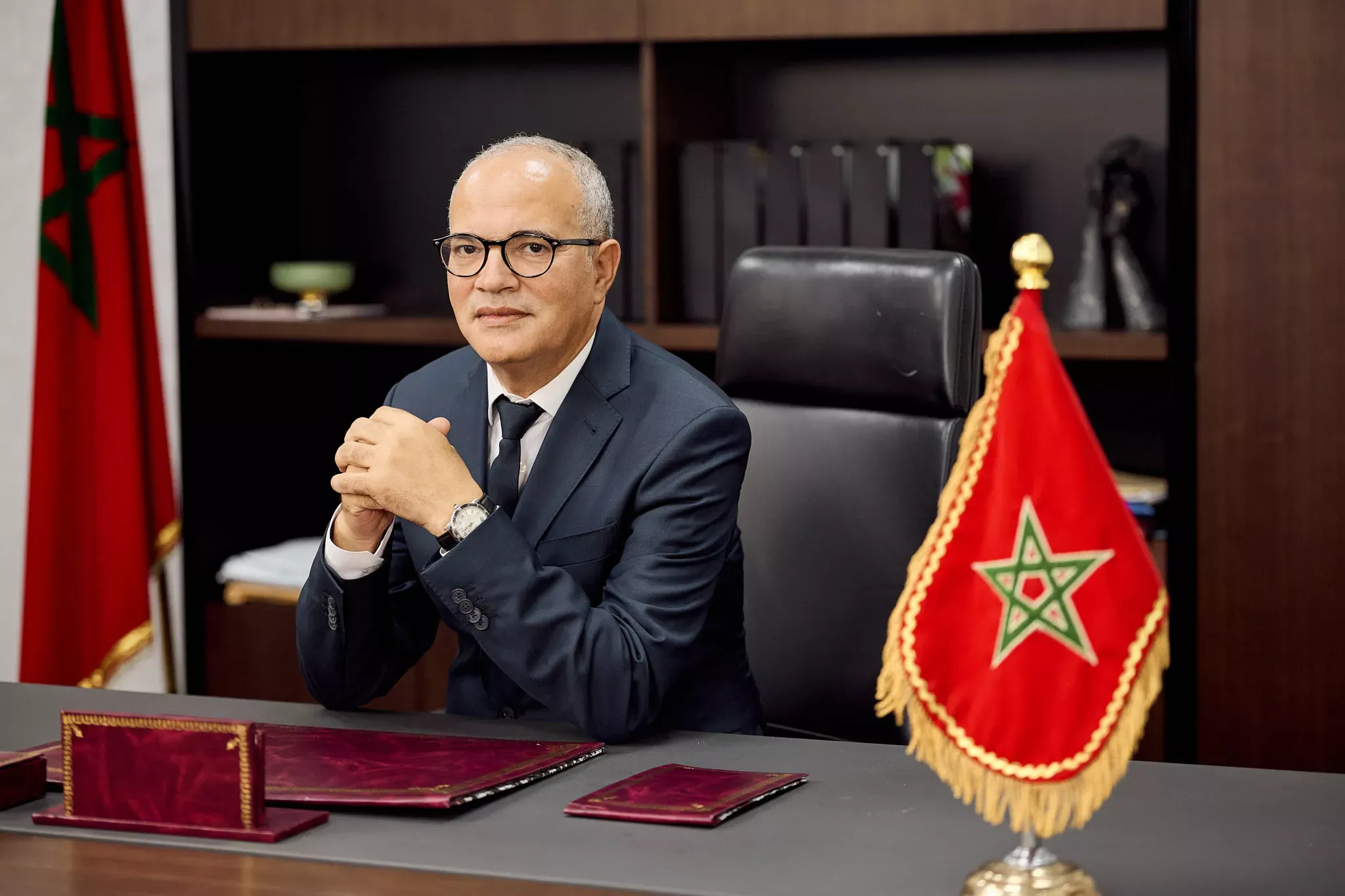

In his office at the headquarters of the Rabat-Salé-Kénitra Territorial Health Group (GST-RSK), located just a stone's throw from the mega-hospital Ibn Sina, Professor Brahim Lekehal exudes a unique presence. With a reserved demeanor and a serious expression that reflects the discipline of both a surgeon and an academic, he weighs his words carefully. There is something profoundly surgical about his approach to management: actions must be precise, preparations meticulous, and schedules adhered to strictly.
This discipline is not merely a facade but encapsulates the journey and methods of a man entrusted with one of the most complex tasks in healthcare reform: establishing the GST Rabat-Salé-Kénitra, a new public entity aimed at transforming healthcare organization in one of the most populated and diverse regions of the Kingdom.
As a professor of vascular surgery at the Faculty of Medicine and Pharmacy in Rabat, where he also served as dean, Brahim Lekehal belongs to a generation of practitioners who view care, education, and governance as interconnected responsibilities. Additionally, he presides over the Advisory Council for Human Organ and Tissue Transplantation and was elected a member of the National Academy of Surgery in France in 2026, further solidifying the academic dimension of his career.
From Operating Room to Governance
Appointed as the General Director of GST-RSK in April 2026, the surgeon scales new heights without altering his method. His discourse remains that of a practitioner: diagnosing issues, prioritizing urgencies, ensuring smooth transitions, and intervening without ever losing sight of the patient. However, the reform he is tasked with leading is not merely an administrative reshuffle. It involves uniting the university hospital with all the former decentralized structures of the Ministry of Health, including primary healthcare facilities, local hospitals, provincial hospitals, and regional structures.
This merger represents an institutional operation of rare complexity. It necessitated a thorough review of human resources, contracts, assets, legal disputes, and financial circuits of the previous entities, all while maintaining the continuity of public service. Brahim Lekehal recounts this transition through very concrete questions: just before the shift, where should the incoming funds be directed? How can we prevent shortages of medications, health products, or blood? How can we ensure that every leader has a clearly defined role and responsibilities from day one?
This attention to detail reveals a pragmatic conception of governance. For the General Director, reform cannot be reduced to the texts that establish it. It must translate into decision-making processes, the working conditions of teams, and, most importantly, the daily experiences of patients. His emphasis on chief nurses, whom he refers to as the backbone of the system, is particularly telling. Before addressing larger frameworks, it is essential to consolidate field responsibilities, recognize the functions performed, and ensure that professionals receive the compensation they deserve.
Financial Autonomy as a Goal
Brahim Lekehal also offers a clear-eyed perspective on the economics of public health services. He carefully distinguishes between management autonomy, now enshrined in the new institutional framework, and financial autonomy, which he describes as "a horizon that must be built." The former should enable the pursuit of greater performance, quality, and efficiency. The latter requires a reevaluation of pricing, billing, and collection mechanisms.
In his view, the widespread implementation of mandatory health insurance (AMO) significantly alters the terms of the debate. Once patients are covered, the services provided by public institutions must be adequately compensated. He highlights the gap between the human and technological resources utilized by major public hospitals and the reimbursements they receive.
This discussion does not undermine the protective role of the state. On the contrary, the General Director advocates for a balanced approach: insured individuals should participate in financing pathways managed by insurance organizations, while those unable to pay must continue to receive care. The pursuit of revenue should not replace the social mission of public service; rather, it should empower it to fulfill its duties more effectively.
Brahim Lekehal's vision encompasses a commitment to align economic efficiency with collective protection. The GST must become a tool for better coordination of care and a more equitable redistribution of resources. The region, in fact, comprises deeply varied realities. The coastal corridor, from Témara to Kénitra, including Rabat and Salé, already enjoys a relatively developed healthcare offer, whereas the hinterlands around Tiflet, Sidi Kacem, and Sidi Slimane face more significant deficits.
To bridge these gaps, Brahim Lekehal relies on team mobility, the rehabilitation of facilities, the strengthening of local competencies, and the redefinition of care pathways. Patients should no longer have to restart their journey each time they transfer between a provincial hospital, a regional facility, and the university hospital. Care pathways must be clear, responsibilities identified, and directions organized at the territorial level.
This territorial logic encapsulates the ambition he assigns to the GST: to dismantle the silos of long-juxtaposed structures and create a cohesive system. Behind the budgetary, administrative, and technical challenges, Brahim Lekehal consistently returns to a singular requirement: trust. Trust from professionals in the institution, trust from partners in the regularity of its commitments, and trust from citizens in the public service's ability to welcome, guide, and care for them. The professor turned leader does not shy away from acknowledging the scale of the challenges or the time needed for transformation. Yet, his message is driven by a belief: health can become a common good around which the state, caregivers, partners, and the population converge. At the helm of GST Rabat-Salé-Kénitra, it is now his responsibility to convert this ambition into tangible results, with the precision of a surgeon, the broad perspective of an academic, and the patience of an institutional builder.
As reported by mobile.telquel.ma.