
Challenges Facing U.S. Military Strategy in Iran
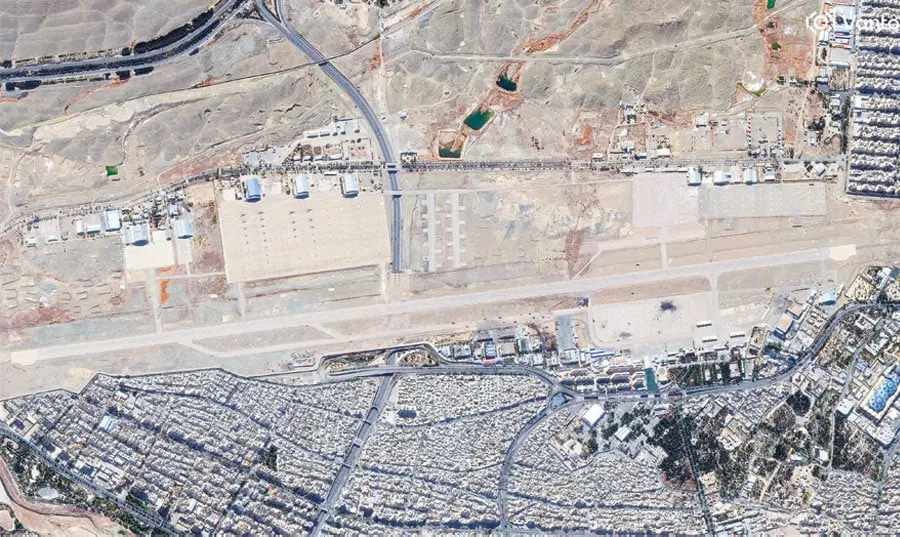
As the geopolitical landscape becomes increasingly complex, U.S. President Donald Trump continues to signal a potential military strike on the fortified site known as "Mountain of the Axe" in Iran. Recent satellite imagery indicates ongoing construction and fortification activities at this facility, believed to be designed for uranium enrichment and situated deep within the mountain. This location, approximately 100 to 145 meters below the surface, is shielded by thick granite layers, complicating the feasibility of targeting it with American bunker-busting bombs, as reported by the Wall Street Journal.
During a Republican party conference in Dallas, Trump remarked on noticing "some activity" at the Mountain of the Axe, warning Iran against "foolishness" and asserting that the U.S. would deliver a "severe blow" if necessary. The satellite images reviewed by the Center for Strategic and International Studies (CSIS) reveal a significant uptick in construction activity throughout 2026, transitioning from excavation to what appears to be interior construction and preparations. Although work on tunnels and access routes continues, there is no concrete evidence yet that the site has commenced operation of centrifuges or uranium enrichment. Rafael Grossi, the Director General of the International Atomic Energy Agency, confirmed signs of "movement" around the facility.
Iran began its activities at the Mountain of the Axe following a sabotage incident targeting a centrifuge assembly facility in 2020. At that time, Iranian officials indicated their intention to relocate their facilities "within tunnels, inside the mountain" for protection against potential attacks. Trump had previously threatened in July to target the site, stating, "We will strike that area soon," insisting that Iran "will not be able to do anything about it." However, no strike has yet occurred, and reports suggest that Washington is working on developing munitions capable of breaching the fortifications surrounding the site.
Military Assessments and Concerns
In light of the challenges associated with completely destroying the facility, experts suggest that Washington may consider alternative strategies, including targeting the entrances to the tunnels to disrupt access. Andrea Stricker, a non-proliferation expert at the Foundation for Defense of Democracies, noted that if the site cannot be obliterated, the U.S. might "prevent access to it," proposing the use of Tomahawk missiles to target tunnel entrances.
Amid ongoing warfare and associated pressures, Trump expressed that he has no regrets about his decisions concerning Iran. In an interview with Fox News, he responded to inquiries about potential regrets regarding the conflict as the midterm elections approach, stating, "I do not believe in the word regret." He added, "You can always second-guess yourself a little. Some people have asked me about it. If I had the chance to do it all over again, I would do exactly what I did." According to Axios, Trump's comments come as the conflict with Iran has become a central topic of discussion among Republicans as they approach the midterm elections, especially concerning the implications of the war on fuel prices, inflation, and political approval ratings.
Simultaneously, The New York Times revealed an unusual move by Vice President J.D. Vance, who has engaged directly with American military leaders in the Middle East, Europe, and Asia to obtain personal and candid assessments regarding the war. Vance, who has opposed the conflict since its inception, was tasked by Trump to help conclude the hostilities. He sought to hear directly from military leaders before integrating their insights into a consolidated assessment for the Pentagon.
The discussions encompassed war objectives, tactics, casualty estimates, Iran's potential actions in the Strait of Hormuz, its adaptability to the evolving conflict, and the extent of pressures the Iranian government can withstand. Vance also requested detailed accounts of remaining U.S. weapons and munitions stocks and the impact of transferring additional arms to the Middle East on the U.S.'s capability to deter threats from China, Russia, and North Korea.
Military leaders expressed candid concerns about the extent of depletion within U.S. arsenals, particularly emphasizing low inventories of Patriot interceptor missiles, which are crucial to American air defense systems. By late spring, one military region reported having fewer than 100 Patriot missiles available. The conflict has also exhausted stocks of ATACMS systems with a range of approximately 190 miles, alongside Precision Strike missiles intended as their replacements. Reports indicate that certain vital munitions have reached their lowest levels ever recorded.
According to individuals who spoke with Vance, he emerged from some discussions with profound concerns regarding the overall strategy of the war and its prospects for success. The assessments he received indicated that the Iranian government is prepared to endure significant suffering in its struggle for survival, while the U.S. faces limitations in its defensive weapon stockpiles needed to counter Iranian retaliatory strikes or manage threats elsewhere in the world. Vance communicated these conclusions in private discussions with Trump and his inner circle.
Concurrently, Trump has been receiving increasingly detailed briefings from General Mark Milley, Chairman of the Joint Chiefs of Staff, regarding the pressures on U.S. weapon stocks and the resilience of Iranian forces—information that initially proved difficult for Trump to accept. This situation presents the Trump administration with two parallel narratives: publicly, the president remains steadfast in his commitment to the war, asserting he would make the same decisions again, while behind closed doors, the assessments received by Vance highlight apprehensions about U.S. stock depletion, Iran's capacity to withstand strikes, and the attainability of war objectives. As it stands, the Mountain of the Axe remains one of the most significant military tests for Washington, as Iran continues its operations at this heavily fortified underground site, while the United States grapples with increasing constraints on its arsenal of necessary weapons and munitions to sustain operations in Iran or maintain its deterrent capabilities in other parts of the world.
As reported by alquds.co.uk.