
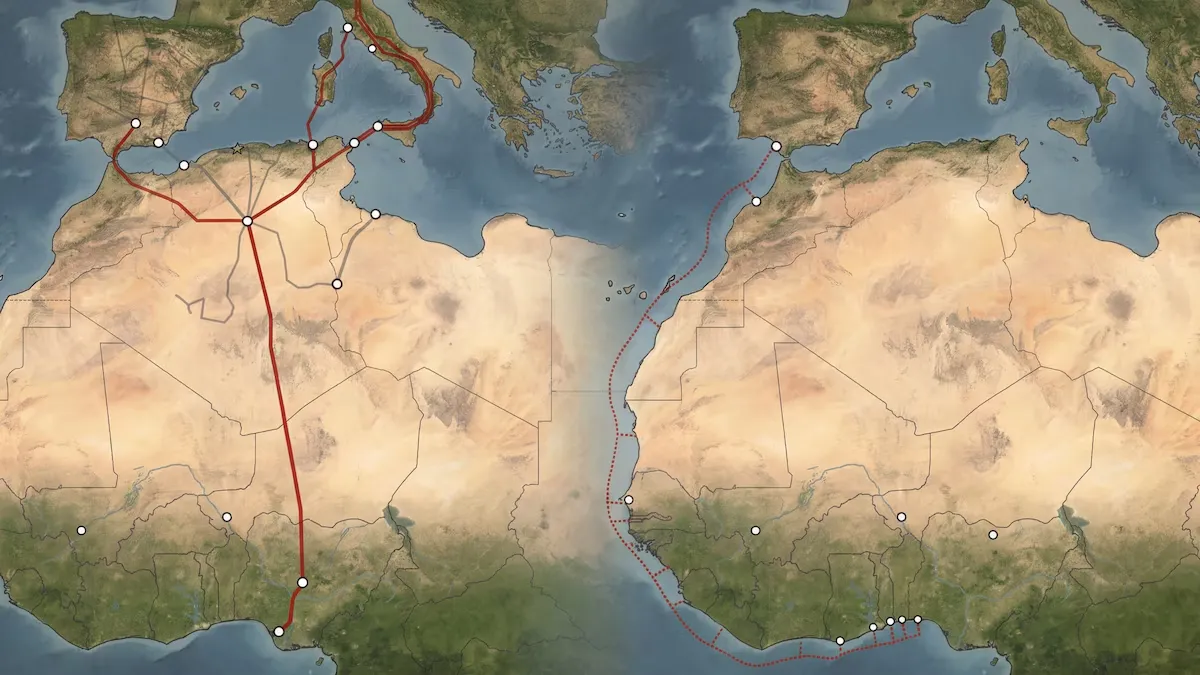

Competing Routes for Nigerian Gas: The Trans-Saharan Gas Pipeline and the African Atlantic Pipeline
In June of this year, Algeria commenced construction on its segment of the Trans-Saharan Gas Pipeline (TSGP), a project that was first envisioned in the 1970s and has gained renewed momentum amid the ongoing European energy crisis. This new route, stretching over 4,128 kilometers, aims to connect gas reserves in Nigeria with Algeria via Niger, as reported by Pipeline Journal. The project is spearheaded by Algeria's state-owned oil company, Sonatrach, in collaboration with the Nigerian National Petroleum Corporation (NNPC) and the Niger Petroleum Products Company (Sonidep). According to project officials, the pipeline will link to the existing network near Aoulef in southwestern Algeria, extending to Mediterranean export terminals, including those that supply the European market through Italy and Spain.
In 2025, Algeria exported approximately 40 billion cubic meters of gas to the European Union, accounting for around 14% of the total European imports, as noted by Euronews. The country operates two major pipelines that connect directly to the continent: the Trans-Mediterranean pipeline (TransMed), reaching Italy, and Medgaz, which heads to Spain, in addition to supplementary exports via liquefied natural gas (LNG) vessels. Notably, Algeria has been the largest supplier of natural gas to Spain for three consecutive years.
Algeria’s domestic gas consumption also continues to rise steadily, with over 53 billion cubic meters recorded in 2025, according to Arab News. This combination of export capabilities and internal demand underscores Algeria's interest in enhancing its role as a transit country while seeking new gas sources, such as those that would be provided by the TSGP.
The Rivalry Between Algeria and Morocco
The idea of connecting Nigerian gas to North Africa through Niger was first proposed in the 1970s but remained stagnant for decades due to funding issues and regional instability, particularly in Niger and northern Nigeria, as documented by the U.S. International Trade Administration. In 2009, Algeria, Niger, and Nigeria signed an initial intergovernmental agreement aiming to have the pipeline operational by 2015, a date that has since been postponed repeatedly. The project was revived in 2022 with a memorandum of understanding signed in Algiers, but it faced another setback in 2023 following a military coup in Niger and the subsequent diplomatic rift with Algeria. However, relations between the two countries began to improve in the same year, marked by the reinstatement of ambassadors and the signing of over twenty cooperation agreements, including the reactivation of the TSGP.
Meanwhile, the African Atlantic Pipeline, also known as the Nigeria-Morocco pipeline, is progressing as an alternative route for transporting Nigerian gas to Europe. This pipeline envisions a route of about 6,900 kilometers along the Atlantic coast of West Africa, eventually connecting to the Moroccan network and, subsequently, to the Maghreb-Europe pipeline linking to Spain. In April, Amina Benkhadra, the head of Morocco's National Office of Hydrocarbons and Mines, announced that an intergovernmental agreement for the project, valued at $25 billion, would be signed in 2026, with feasibility studies and preliminary designs already completed. This initiative anticipates a maximum capacity of 30 billion cubic meters per year, slightly more than half of what the now-defunct Nord Stream pipeline used to supply to Europe.
As Morocco is a country with limited fossil resources, the project would not only secure gas supply but also strengthen its geopolitical ties with sub-Saharan Africa, particularly in light of Algeria's dominant energy position in the Sahel region, which would face significant challenges if the Atlantic corridor comes to fruition. The connection with the Maghreb-Europe pipeline would further reinforce Rabat's role as a bridge state between Europe and Africa. For Nigeria, this project provides an additional export pathway, as the country stands as the fifteenth-largest gas producer globally and the second in Africa after Algeria, seeking to reduce its dependence on dwindling Western markets and expand its influence in Francophone West Africa.
The 69th summit of the Economic Community of West African States (ECOWAS) held on July 19 in Sierra Leone saw the heads of state and government from twelve member countries greenlight the construction of the pipeline that will link Nigeria to Morocco, traversing thirteen African countries along the Atlantic coast. Beyond its energy dimension, the project embodies the shared ambition of Africa to build a more integrated, industrialized, and prosperous continent, as stated by Benkhadra. She added that the infrastructure would enhance energy security, stimulate industrial development, create new economic opportunities, and contribute to sustainable and inclusive growth for future generations.
The project was initially proposed ten years ago by King Mohammed VI of Morocco, but a definitive decision on its execution had not been reached at that time. The ongoing conflict in Iran and the resulting tensions in the global gas market have prompted ECOWAS to expedite timelines: construction is expected to commence in 2028, with the first deliveries projected for 2031. The agreement between the two governments was signed in July, but the project has yet to secure the final investment decision necessary to initiate construction. A specific company will be established in Morocco to oversee the works, while the management bodies of the pipeline will be based in Abuja, Nigeria.
With an estimated cost of $25 billion, the African Atlantic Pipeline is among the major energy projects planned in Africa. This budget could increase due to inflation and the complexities associated with an infrastructure spanning nearly 6,900 kilometers, including maritime and terrestrial sections. Following the signing of the intergovernmental agreement in July 2026, funding, the final investment decision, and the establishment of the executing bodies will remain pending. The protection of the infrastructure and the political stability of the participating states are two critical factors influencing its development. The planned route largely avoids the most unstable areas of the Sahel, although it crosses regions still exposed to threats such as piracy in the Gulf of Guinea, attacks on energy infrastructure, and the activities of armed groups in several West African countries.
In fact, a report by North Africa Risk Consulting (NARCO), which specializes in political and security risks in North Africa, raises questions about the project's economic viability. The study estimates that the investment could take up to 288 years to break even, suggesting that after meeting the needs of transit countries and Moroccan internal consumption, the gas available for export to Europe could amount to around 12 billion cubic meters annually. NARCO also projects the potential cost of the project to reach $38 billion and highlights a significant decline in Nigeria's gas production over the past two decades.
The timing of these projects aligns with the European Union's efforts to reduce energy imports from Russia and diversify suppliers following the Russian invasion of Ukraine. The European Commission has included this diversification in the REPowerEU initiative, aimed at reducing dependence on Russian fossil fuels and accelerating the ecological transition, although it has not specifically linked this pipeline to its strategy. The official timeline places the final investment decision as the next milestone for the African Atlantic Pipeline, a step that will determine the effective start of construction projected for 2028. Meanwhile, the TSGP is already underway with physical works on its Algerian segment, while Nigeria and Niger plan to commence theirs in 2027.
Both projects will continue to rely on negotiations between the involved governments and the stability of the regions they traverse in the coming years. Only then will it become clear which of the two routes, if any, will succeed in establishing itself as the new gas corridor between Africa and Europe.
As reported by infobae.com.

