
Reassessing Morocco's Position in Africa
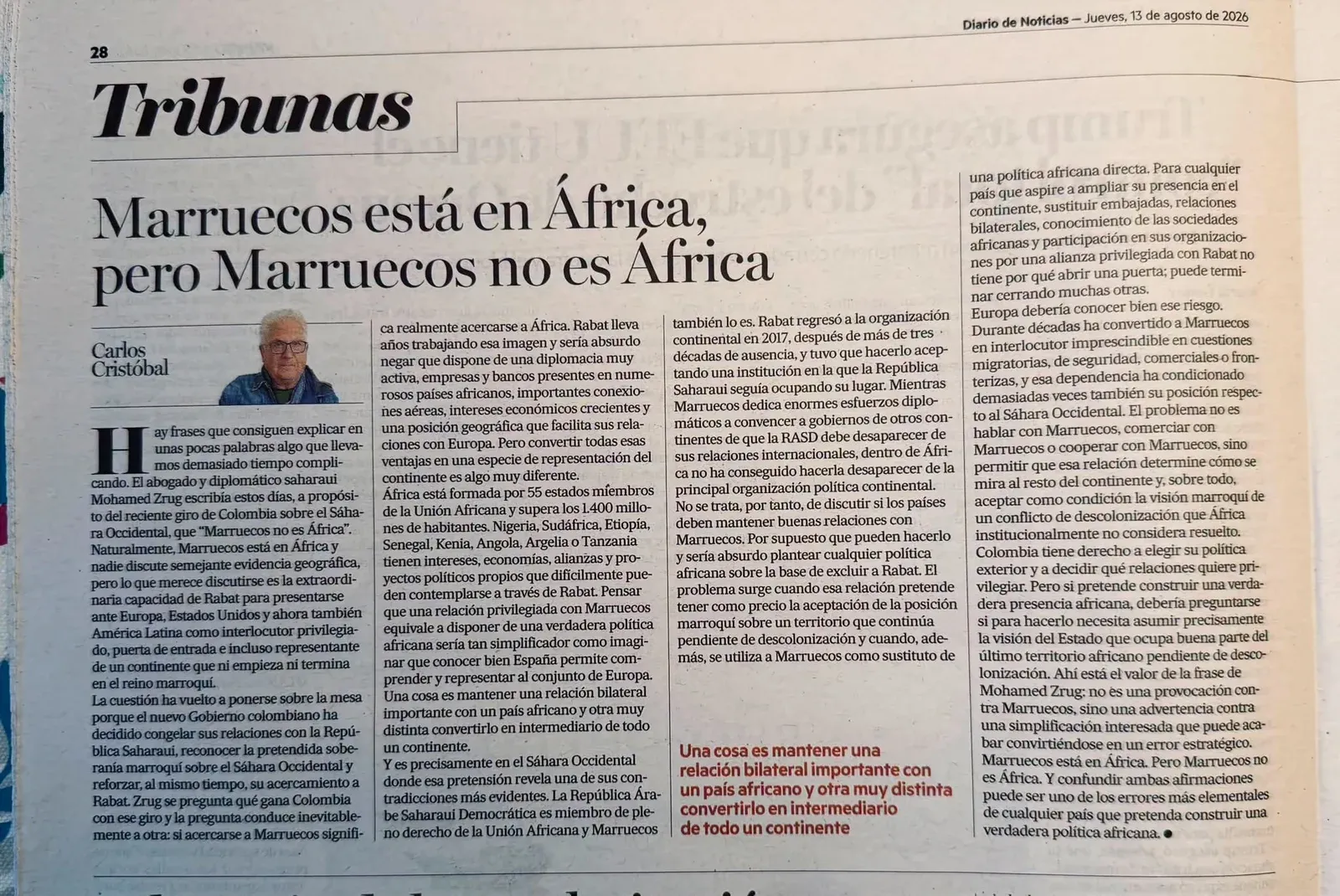
The recent discourse surrounding Morocco's role as a gateway to Africa has sparked significant reflection, particularly from Sahrawi diplomat Mohamed Zrug. This discourse raises a critical question: does engaging with Morocco genuinely equate to engaging with Africa? In a thought-provoking article titled "Morocco is in Africa, but Morocco is not Africa," published by _Diario de Noticias de Navarra_ on August 13, 2026, author Carlos Cristóbal explores this theme in depth, particularly in light of Colombia's recent policy shift regarding Western Sahara.
While Morocco is undoubtedly an African nation, actively participating in the continent's diplomatic and political landscape, it is essential to recognize that Africa comprises 55 member states within the African Union, home to over 1.4 billion people. Each of these states encompasses its own unique societies, economies, and political interests that cannot be encapsulated solely through the lens of Moroccan perspectives. Zrug succinctly encapsulates this notion with his assertion: "Morocco is not Africa." This statement, while seemingly simple, challenges the assumptions underlying many international relations with the continent.
The Western Sahara Dispute
One of the most illustrative examples of Morocco's complex relationship with Africa is the situation regarding Western Sahara. Both Morocco and the Sahrawi Arab Democratic Republic are full members of the African Union. Morocco's return to this continental organization in 2017, after over three decades of absence, necessitated its acceptance of the Republic of Sahrawi’s continued presence within the union—a significant diplomatic hurdle for Rabat. Despite Morocco's extensive efforts to persuade various governments outside Africa to sever or suspend their relations with the Sahrawi Arab Democratic Republic, it has not succeeded in excluding it from the African Union, which remains its principal political platform. This ongoing dynamic emphasizes the need for a nuanced understanding of Africa's diversity that goes beyond a singular focus on Morocco.
The conclusion of Cristóbal's article reiterates this vital distinction: "Morocco is in Africa. But Morocco is not Africa." This differentiation is crucial for any nation aiming to forge a genuine policy toward a continent characterized by its remarkable diversity, which cannot be reduced to a mere privileged relationship with Rabat. As the global community continues to engage with Africa, recognizing the multifaceted realities of the continent will be essential for fostering meaningful partnerships.
As reported by noteolvidesdelsaharaoccidental.org.