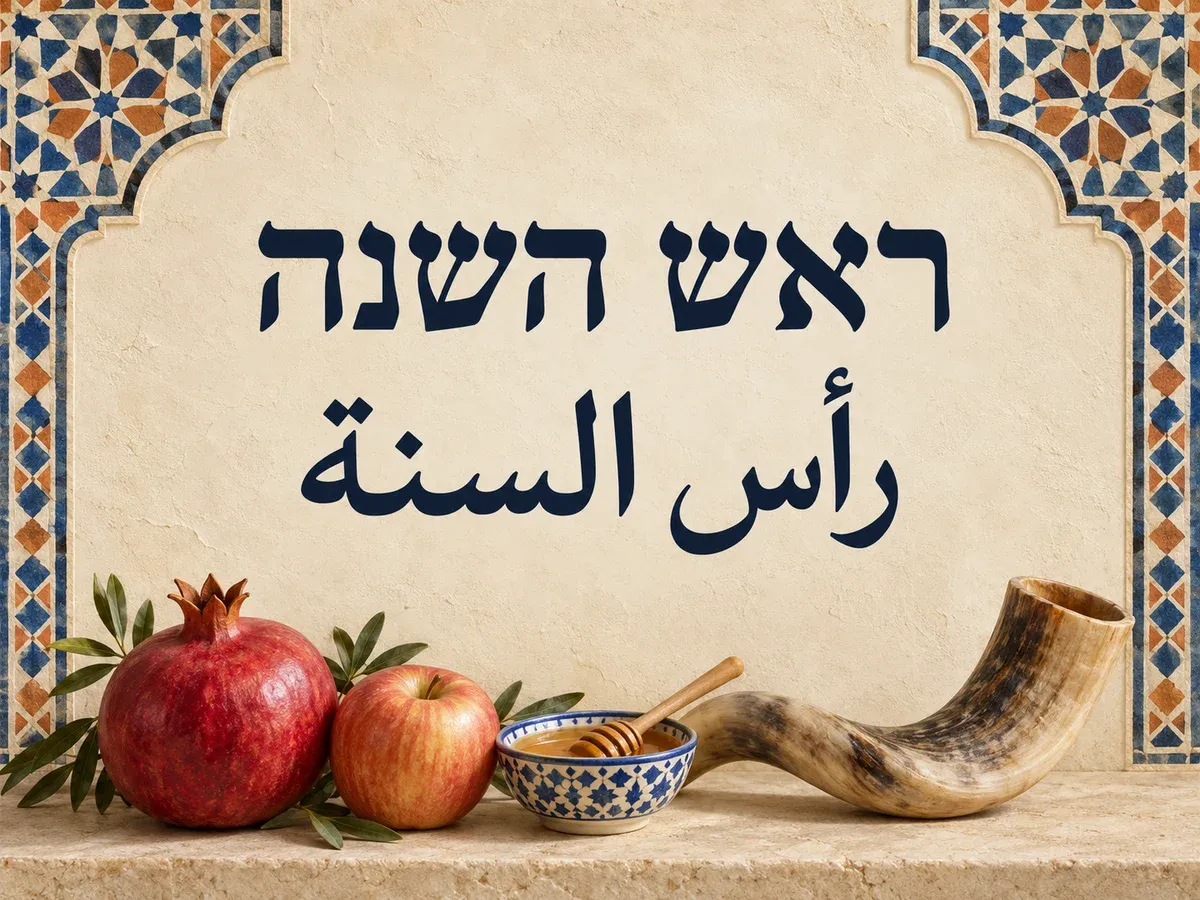

Rosh Hashanah, a term that resonates deeply within the Hebrew tradition, is a phrase I found myself nearly grasping even before its translation was offered to me. The word 'Rosh' closely aligns with the Arabic term 'ra’s,' meaning 'head,' while 'Shanah' sounds reminiscent of 'sana,' which translates to 'year.' In Arabic, the phrase 'ra’s al-sana' signifies the beginning of the year. Although these languages remain distinct, their lexical proximity allows me to sense the meaning before it is articulated, bridging a cultural gap.
As an Amazigh Moroccan fluent in Arabic, I acknowledge that the Jewish New Year is not a religious observance I partake in. I cannot assume the weight of its prayers, nor can I claim that recognizing two words provides me with the full essence of what it means to hear the shofar after the trials that Jewish communities have faced over the past year. However, this linguistic resemblance serves a more humble yet significant purpose: it prevents me from viewing your celebration as something alien.
This perspective holds particular importance in my hometown of Marrakech, a city where one can wander through the mellah, stumble upon a synagogue, or pay respects at a Jewish cemetery, and leave with a deeper understanding of the city’s rich Jewish heritage. While it is effortless to admire these historical sites, the more challenging inquiry lies in what transpires after we depart from them. The existence of a Jewish past does not equate to the presence of Jewish individuals today.
In a notable development, Morocco acknowledged its Hebraic influences in the preamble of its constitution in 2011. This recognition carries weight, yet a mere constitutional sentence cannot dictate how we discuss Jewish identities in our daily lives, whether at a dinner table, in a newsroom, or across digital platforms. While restoring a synagogue is a meaningful endeavor, it does not absolve us of our responsibility toward the individuals who utilize those spaces for prayer and community.
Moroccan Jews are not simply subjects of a nostalgic narrative; many continue to reside among us, while others have established lives elsewhere, notably in Israel, maintaining their ties to their homeland. Their departures are integral to our shared history, just as much as the centuries they spent in Morocco. If we choose to remember only the aspects that glorify our past, we fail to honor their full story.
This reflection does not preclude me from voicing concerns regarding Gaza. Palestine is not an abstract concept to me; it is a reality intertwined with my understanding of human rights. The events of October 7, 2023, when Hamas executed Israeli civilians and took others captive, marked a tragic turning point, precipitating a war that has wrought unimaginable suffering on Palestinian civilians in Gaza. These facts do not negate one another; they coexist in the complex landscape of human suffering. A Jewish neighbor should not bear the burden of accountability for the actions of the Israeli government when receiving a New Year greeting, just as a Palestinian family should not have to justify its innocence before their grief is acknowledged.
As someone whose profession revolves around the power of language, I am acutely aware of how quickly careless rhetoric can broaden the scope of blame. The term “Jews” should not be equated with the Israeli cabinet, nor should “Palestinians” be synonymous with Hamas. It is entirely possible to contest a government's actions vehemently while remaining precise about the individuals responsible. Precision in language represents a commitment to justice, refusing to hold someone accountable for transgressions they did not commit.
Rosh Hashanah does not offer a promise that merely changing the date can mend what has been broken. The days leading up to Yom Kippur invite reflection and accountability. Even for those who do not observe these days, the underlying question is clear: What steps will we take now that we have recognized the impact of our words?
For me, the answer begins with rejecting the notion that Moroccan Jewish life is merely a beautiful chapter that has concluded. It is crucial to engage with Jewish individuals as fellow human beings, allowing holiday greetings to exist independently of political contexts. I can firmly advocate for Palestinian rights while simultaneously wishing for Jewish families to enter synagogues without fear. Each commitment stands on its own merit, requiring no validation from the other.
Perhaps this is why the phonetics of these terms linger in my mind. In both 'ra’s al-sana' and 'Rosh Hashanah,' I perceive a point of convergence rather than a resolution. Languages possess the ability to carry memories of intimacy across vast stretches of time, yet they cannot replace the genuine connections we must foster ourselves.
To the Jewish communities celebrating the year 5787 in Morocco, Israel, and around the world, I extend my heartfelt wishes: shanah tovah. I hear these words echo in my own language, and the more challenging yet hopeful endeavor lies in ensuring that, when I express them, you understand the sincerity behind my sentiment.
As reported by blogs.timesofisrael.com.