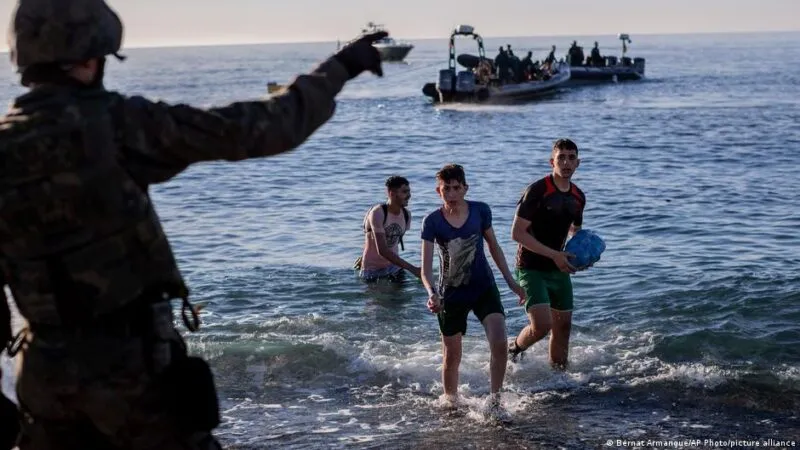

Historical Context of Child Migration
Hanane Serghini, a professor at Cadi Ayyad University in Marrakech and a researcher at the Moroccan Institute for Policy Analysis, emphasizes that the recurring attempts at irregular migration towards the Spanish enclaves of Ceuta and Melilla, particularly involving unaccompanied minors, should not be viewed as a mere temporary or exceptional event triggered by recent developments. Instead, these attempts represent a continuation of a long historical trajectory of irregular migration dynamics within the Mediterranean space. This perspective challenges the simplistic interpretation of current events, urging a deeper understanding of the historical and social roots that have contributed to the phenomenon and its ongoing reproduction over time.
In her statement to «اليوم 24», Serghini points out that the migration of minors is not a new phenomenon strictly linked to recent events in Ceuta. Data and historical accumulations reveal that the presence of minors in Moroccan border areas, particularly in Tangier, Nador, and Beni Ansar, dates back to the 1990s. Over the decades, informal waiting networks have developed around transportation hubs and ports, where vulnerable minors gather in hopes of finding opportunities to cross into Ceuta and Melilla.
Structural and Socioeconomic Underpinnings
This temporal extension clearly indicates that the phenomenon is structural and not merely a response to transient conditions; it has become an integral part of a continuously evolving social economy of migration influenced by contextual transformations. Serghini further elaborates that understanding this phenomenon also requires attention to the reception and protection systems in Spain. While shelters and care centers for unaccompanied minors provide essential legal protection and temporary integration mechanisms, they can inadvertently shape social perceptions among families and minors in sending countries. This leads to the notion that migration may represent an institutional opportunity for improving social conditions or integrating into European society.
Serghini asserts that reducing the phenomenon to what is termed institutional attraction is an incomplete explanation. The actual determinants of migration are far more complex and intertwined. Child migration is fueled by an unequal social and economic structure where poverty and vulnerability play a central role, alongside educational dropout rates identified by international reports, including those from UNESCO, as significant driving factors for early migration. Additional factors such as the mismatch of training with labor market needs, high rates of family disintegration, and rising social instability contribute to creating an environment that compels minors to consider leaving.
The phenomenon is also intertwined with cultural aspects and social representations associated with migration, where, in various local contexts, migration is perceived as a means for rapid social advancement and achieving a better life amid limited local opportunities. The convergence of these representations with economic and social vulnerabilities leads to complex migration decisions that cannot be explained by a single factor or a unilateral approach.
Serghini concludes that the migration of minors towards Ceuta and Melilla should be understood as a multifaceted and complex phenomenon in which structural factors intersect with public policies, social representations, and protection and reception mechanisms. Any serious analysis of this phenomenon must transcend security or situational approaches and adopt a comprehensive framework that considers its historical extension and current transformations, viewing it as a product of a complex social, economic, and political structure rather than a mere transient border event.
She recommends developing legal and safe migration pathways to reduce the reliance of minors on smuggling networks and irregular crossings, while also enhancing cooperation between Morocco, Spain, and the European Union in areas such as the protection of migrant children, information exchange, and coordination of policies aimed at preventing this phenomenon.
As reported by alyaoum24.com.