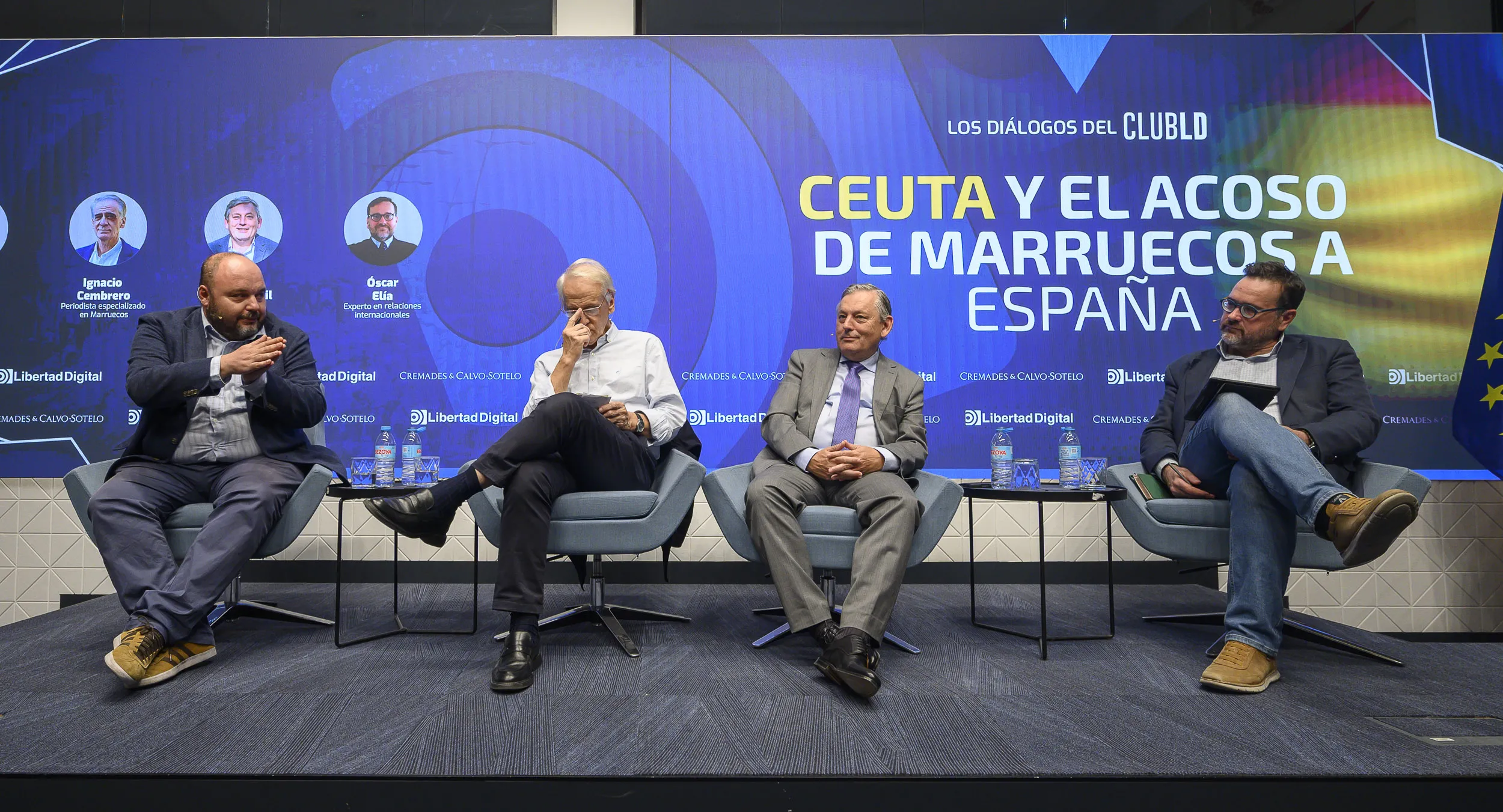

The recent **invasion of Ceuta** has prompted one of the most significant crises in contemporary Spanish history. The apparent submission of President **Pedro Sánchez** and the inaction of his government raise critical questions about the future dynamics between Spain and Morocco, especially when their interests are at odds. The exclusive dialogue hosted by **Club Libertad Digital** last Thursday featured prominent figures including **Ignacio Cembrero**, **Óscar Elía**, **Enrique Navarro Gil**, and **Raúl Vilas**, the director of **LD**.
Under the title _**The Invasion of Ceuta and the Future of Relations with Morocco**_, the discussion featured insights from journalist Ignacio Cembrero, a specialist on the Maghreb; geopolitical and defense expert Enrique Navarro Gil; and political philosophy and international relations professor Óscar Elía, moderated by Raúl Vilas. They delved into the circumstances surrounding the invasion of Ceuta and the strategic implications it poses for the future integrity of Spain.
Cembrero reported that testimonies from some immigrants arriving in Ceuta during the initial days indicated a lack of opposition; others from different regions of Morocco claimed they had received guidance on how to reach the autonomous city. He elaborated that immigrants coming from further away in the Tétouan province admitted they were “told how to get there.” **“What more do we want?”** he questioned, highlighting the organized nature of the influx.
Elía remarked that **“the subsequent reaction from Rabat illustrates the extent of authorship”**, indicating that the Moroccan response should not be categorized merely as a migration crisis. The discussion then shifted to a fundamental issue: **Spain's stance towards Morocco**. Raúl Vilas observed that **“Spain fears Morocco more than Morocco fears Spain.”** This fear stems from years of cautious policy by Spain, which has been hesitant to make decisions that could provoke a reaction from Rabat. Cembrero pointed out that **“Spain has far more leverage over Morocco than Morocco has over Spain,”** suggesting that **“we haven’t even shown them our weapons.”**
Enrique Navarro further emphasized that **Ceuta and Melilla face evident geographical vulnerabilities**, being entirely surrounded by Moroccan territory, a situation recognized for decades that complicates any defense strategy. However, he noted that Spain has historically maintained **“absolute military superiority over Morocco,”** making deterrence effective in the past, a condition he believes no longer exists today.
Consequently, the challenges extend beyond the borders of Ceuta, as the invasion has led to a more profound realization: **Spain needs to reclaim authority to ensure its warnings are credible and that its borders are supported by a cohesive state strategy**.
**Join the Club LD** to access high-level discussions with experts who analyze reality with the rigor and depth you seek. [**Become part of Club LD**](https://www.libertaddigital.com/colabora/), as your support ensures an independent voice and unwavering defense of fundamental principles.
As reported by libertaddigital.com.