The legal dispute arising from the **2025 Africa Cup of Nations final** transcends the boundaries of a mere sporting disagreement. It embodies a complex web of rules, procedures, and principles that currently structure international sports law. Last week in Rabat, a meeting organized by the **lawyers' sector of the Party of Progress and Socialism** brought together jurists and experts who offered a profound legal interpretation of the case. They emphasized that beyond the media treatment of an incident that marred an exemplary AFCON, it is crucial to understand how decisions in sports are constructed, intertwined with specific regulations, arbitration logic, and the demands of justice.
A Self-Sufficient Legal Framework Governed by Its Own Rules
Initially, the speakers unanimously highlighted a fundamental point: sports law no longer merely borrows from existing legal frameworks; it organizes itself according to its own rules, complete with its institutions and mechanisms. This was articulated by Me El Arbi Fendi, coordinator of the lawyers' sector of the Party of Progress and Socialism and a member of the **Sports Arbitration Chamber**. He acknowledged that the case of the 2025 AFCON final sheds light on a major sporting event with significant legal implications for Morocco. The stakes, in his view, extend beyond the match itself, igniting a national and international debate that requires an in-depth legal reading.Building on this premise, the discussion shifted to the very nature of sports law. Me Tarik Mossadak, a lawyer from the Casablanca bar, pointed out that “sport is no longer a leisure activity; it has become an industry” that generates billions with enormous economic and political stakes. Hence, “sports justice is distinct from state justice,” he emphasized, while insisting on a normative framework unique to sports – **lex sportiva** – which “surpasses national legal frameworks.”
However, this order cannot exist outside of legal requirements, as emphasized by Me Issam El Ibrahimi, a lawyer from the Casablanca bar and president of the Mediterranean Center for Studies and Research in Sports Law. He noted that “the decisions of sports federations must remain subject to the principle of legality and respect the rights of the defense as well as the rules of fair trial.”
A Specialized and Hierarchical Normative System
It is important to note that within this framework, the rules do not exist on the same level. Me Taha El Meskouri, a lawyer from the Rabat bar and sports law specialist, distinguished several levels: the statutes of CAF adopted by the general assembly, the disciplinary regulations, and the specific regulations of competitions, including those of the Africa Cup of Nations. This structuring is not merely a formal arrangement; it conditions how the texts combine and are interpreted, he clarified. It is from this point that certain principles gain precedence. “The special rule takes precedence over the general rule”; “the superior norm prevails over the inferior norm,” he reminded, establishing interpretative markers that concretely guide the analysis of situations and the resolution of disputes.In this context, the applicable law becomes more defined. “The Court of Arbitration for Sport primarily rules based on the regulations of CAF and FIFA,” indicated Me El Meskouri, with recourse to Swiss law intervening as a supplement when it comes to filling gaps or clarifying difficulties in interpretation. Thus considered, the normative architecture is not merely a juxtaposition of texts; it outlines a structured order, where each level interacts with others and contributes to overall coherence.
Consequently, the structured pathway followed by the dispute over the 2025 AFCON final was clarified by Me Taha El Meskouri, who reminded us of the various stages of its treatment: the initiation of a procedure before CAF's disciplinary committee, a first decision, and then an appeal before the appeals committee. Following this internal process, a final decision may open the door to a referral to the Court of Arbitration for Sport. However, this referral can only occur if there is a final disciplinary decision, as the expert noted, recalling that access to the Court of Arbitration for Sport, an international arbitration body based in Lausanne specializing in sports dispute resolution, remains subject to the prior exhaustion of internal remedies.
Despite this, the proceedings do not always adhere to a strict linearity. Me Issam El Ibrahimi drew attention to the adjustments that practice imposes: some decisions may not be immediately notified, which can delay and sometimes even suspend the effective exercise of appeals. Additionally, the configuration of the case itself involves multiple parties – the Senegalese Federation, the African Football Confederation, and the Moroccan Royal Football Federation – with positions that may evolve throughout the procedure, thereby reshaping, at times, the procedural roles of each party. Viewed in this light, the trajectory of the dispute does not reduce to a series of formal stages; it reflects a more flexible sequence where procedural demands, deadlines, and the positions of the parties intersect and directly influence the handling of the case.
At the core of this architecture, the **Court of Arbitration for Sport** occupies a unique position, as it serves as the venue where the dispute is replayed – not in its sporting dimension, but in its legal translation. Me Issam El Ibrahimi asserted that “the CAS has broad jurisdiction as long as an arbitration basis exists.” This jurisdiction extends beyond mere control. “It conducts a comprehensive review of the dispute,” he added, which involves a reexamination of the entire case, in both fact and law.
This logic finds a natural extension in the treatment of evidence. “All evidence can be produced and discussed,” he emphasized. The case is not fixed in its initial state; it can be enriched, confronted, and reexamined. The parties are heard, along with officials or anyone who might clarify the facts. However, this latitude has its limits. “The CAS does not substitute the referee for purely technical decisions made on the field,” Me El Ibrahimi reminded. Thus, the dispute is revisited in its legal dimension, without replaying the match itself.
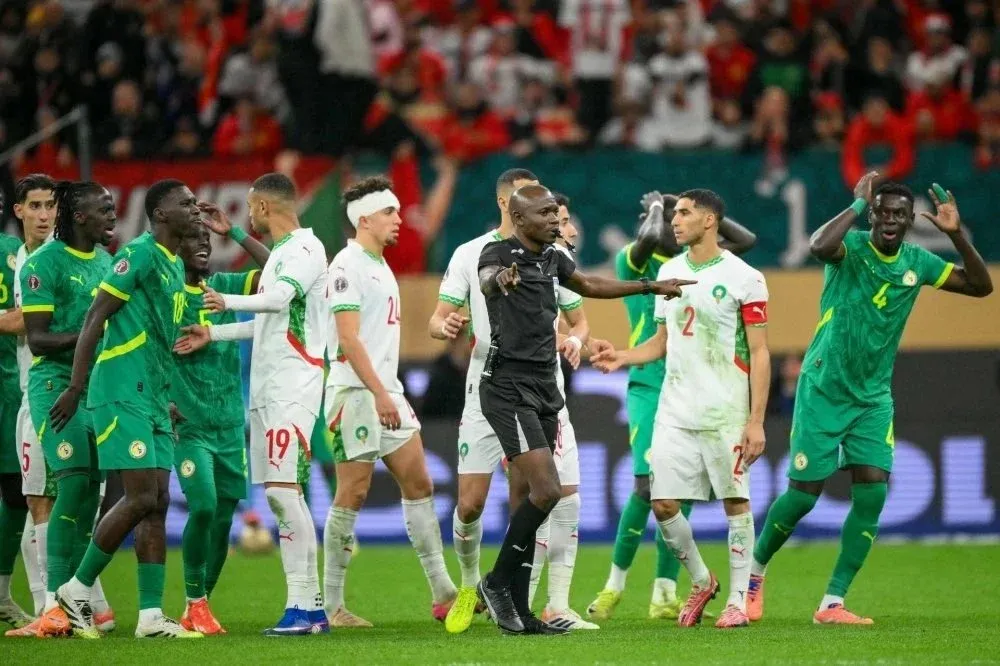
In this context, the legal qualification of the facts becomes critically important. In the case of the **Morocco-Senegal final**, the incident itself is not up for debate. Senegalese players leave the field to protest against a referee's decision, without authorization and before the match ends. No disciplinary sanction is imposed at that moment, and play resumes. The question remains as to its legal implications. An initial reading, tied to the text, suggests that the mere exit from the field without authorization could suffice to characterize a violation of applicable rules.
However, this approach requires nuances. Me Issam El Ibrahimi reminds us that “abandonment or refusal to play can only be held based on clear behavior and an explicit referee's decision.” Therefore, the qualification does not mechanically derive from the observed facts; it necessitates an appreciation of the circumstances in their precision. Along the same lines, Me Tarik Mossadak urges a distinction between situations that are sometimes conflated: interruption, suspension, or abandonment do not encompass the same realities or legal effects. Thus, what might initially seem evident actually calls for a more demanding reading, where each element – players' behavior, the referee's decision, the context of the match – plays a role in determining the final qualification.
The reasoning then finds its foundation in Article 82 of the Africa Cup of Nations regulations. For Me Taha El Meskouri, the text does not address an isolated situation; it encompasses several distinct hypotheses – refusal to play, non-presentation, withdrawal, or exit from the field without authorization before the end of the match – whose apparent proximity should not obscure their differing legal implications. The question shifts to the nature of the act in question: is it a characterized abandonment, indicating a refusal to continue the match, or an interruption that did not possess a definitive character?
Positions begin to take shape around this dividing line. From the Moroccan side, the analysis relies on a direct reading of the text: “The text is clear, and the exit from the field is sufficient to characterize the violation.” The emphasis is placed on the materiality of the behavior and the rule that governs it. Conversely, the Senegalese position introduces a nuance. “There was no definitive refusal to play nor a clear instruction from the referee,” it is argued, leading to a recontextualization of the analysis within the concrete unfolding of the match, beyond mere factual observation. Thus, behind a common reference to the same article (82), two readings emerge. The divergence does not solely hinge on the facts, but on how to qualify them in light of the text and the circumstances under which they occurred.
In terms of evidence, the examination of the dispute fits into a specific framework for sports disputes, which guides its interpretation. “The reports from the referee and the delegate benefit from a presumption of veracity,” particularly for facts observed during the match, Me Taha El Meskouri emphasized. According to him, these elements serve as a cornerstone in the analysis, yet do not definitively set its contours. Their significance remains open to discussion, subject to confrontation with other elements and appreciated in light of the entire case.
In this regard, the examination is not confined to official documents alone. Me Issam El Ibrahimi noted that “the decision rests on a reasoned conviction,” situated midway between civil law standards and those of criminal law. This approach allows for a comprehensive appreciation of the case. In this framework, audiovisual elements, testimonies, and expert opinions can complement, nuance, or even, where necessary, shift the significance of the initial reports. Thus, a comprehensive logic emerges: evidence is not reduced to an isolated element; it is constructed through corroboration, via an overall reading of the facts and available elements.
To support this reading, recourse to jurisprudence provides complementary insights. In this regard, Me Issam El Ibrahimi mentioned several situations in which matches were replayed to preserve “the integrity of the competition and the sporting truth” when irregularities had compromised their conduct. These precedents are not merely illustrative; they reflect a consistent line of analysis: the decision does not solely attach to the facts taken in isolation but to their effects on the regularity and fairness of the competition as a whole.
The issue of sanctions then appears as a direct extension of the qualification retained, which it constitutes, in a sense, the culmination. On this terrain, Me Tarik Mossadak refocuses the debate: “The central question is that of the proportionality of the sanction.” It is no longer only about establishing a violation but also about assessing the response concerning the facts. Furthermore, Me Taha El Meskouri clarifies the framework. “When the text provides for a specific sanction, the margin of appreciation is reduced,” he emphasizes, recalling the weight of the regulatory framework. However, this constraint does not exclude any latitude: the circumstances surrounding the facts can still be taken into consideration and may influence, slightly, the final assessment.
Beyond the examined case, sports law is constructed on the autonomy of its institutions, a principle that ensures coherence and functionality. However, this autonomy does not unfold without a framework. It remains bound by requirements that set its limits: respect for the rights of the defense, motivation of decisions, and fairness of procedures. Me Issam El Ibrahimi articulates this clearly: “Decisions must respect the rights of the defense and the rules of fair trial.” This requirement, implicitly, clarifies the conditions for the legitimacy of the sports legal order.
As reported by lematin.ma.