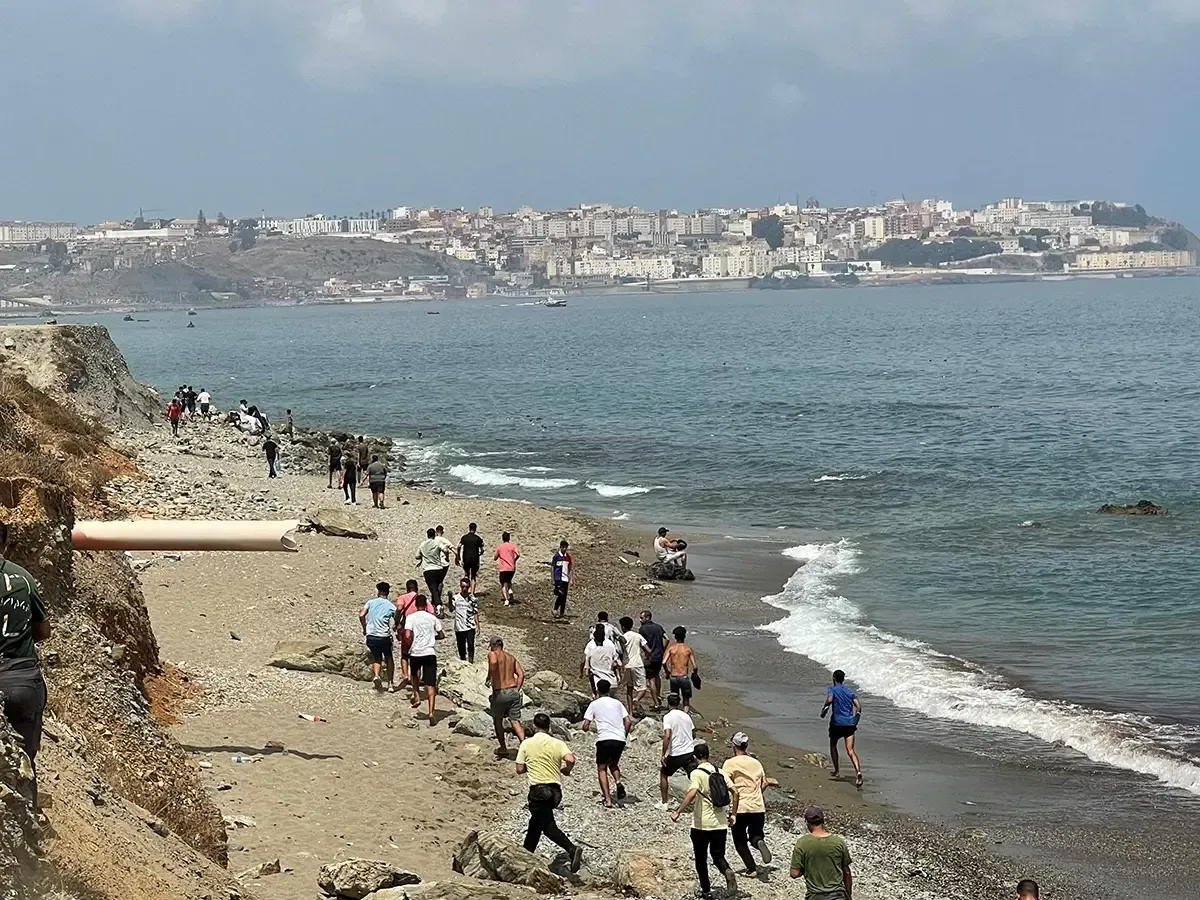

In light of recent events in Ceuta, where tens of thousands of migrants have arrived from Morocco, the program "De Cara al Mundo" on Onda Madrid featured geopolitical analyst Nourdine Mouati, who is also responsible for institutional and entrepreneurial cooperation projects between Spain and Morocco. The latest migration crisis in Ceuta has prompted swift diplomatic and security responses from both Spain and Morocco, aimed at the immediate repatriation of all migrants who entered Ceuta illegally, in accordance with existing collaboration mechanisms. This decision is also expected to apply to Melilla, as the two governments have intensified their coordination to manage the rising tide of irregular entries, which occur both by sea and on foot. The Spanish and Moroccan governments attribute this surge in migration to human trafficking networks that are reportedly exploiting a recent Supreme Court ruling to encourage irregular crossings into Ceuta and Melilla.

The crisis is particularly detrimental to Morocco’s image, which is undergoing significant development and modernization. King Mohammed VI's recent speech highlighted important advancements while also acknowledging challenges such as integration and inequality. Members of the Moroccan government have expressed regret over these events and have offered support to Spanish authorities to ensure that those who entered Ceuta illegally can be repatriated, with some individuals already returning voluntarily.
Coincidentally, these events occurred during a significant national celebration in Morocco, known as the Throne Day. Some individuals and clandestine networks took advantage of the celebrations, using social media to encourage people to travel to Ceuta. Furthermore, the timing coincided with the Supreme Court ruling stating that immediate repatriation of migrants who swim to Ceuta and Melilla is not permissible. The situation echoes past occurrences, such as in 2021, when individuals entered, were turned back, and Spanish NGOs took legal action against authorities for these pushbacks. This issue risks overshadowing Morocco's recent achievements highlighted by King Mohammed VI in his Throne Day speech.

On July 31, we find ourselves amidst Operation Crossing the Strait, with thousands of Moroccans returning from Europe to spend their summer vacations, while police forces are deployed not only to protect the authorities and the king, situated 40 kilometers from Ceuta in Tetouan, but also to manage the ports for this operation. Months prior, protests were organized via social media against the construction of football stadiums in Morocco, demanding jobs for the youth. Although these protests did not last long, one must question if external forces are orchestrating these events.
Indeed, social media has played a significant role in inciting people to approach the border. Investigations have already identified individuals both domestically and abroad, particularly in Europe, who are using social media to encourage crossings. It is imperative to address this issue firmly, as the impact of social media messages is often underestimated. Today's youth primarily seek inspiration and information from these platforms, necessitating considerable efforts to monitor such content, especially messages that incite hostility or illegal activities.
Moreover, it is unreasonable to assume that Moroccan authorities orchestrated these events on the day of the Throne Day celebration, especially when the royal reception was held just 40 kilometers away. Rather, this was likely a coordinated effort to undermine the festivities and cast a shadow over Morocco's impressive economic growth and social progress. Morocco has made strides in social protection, providing increased opportunities for youth, while some factions seek to tarnish the image of a nation that is advancing, developing, and leveraging its own resources without relying on oil.
Contrary to certain claims, Morocco does not need to prove itself to Spain, engage in blackmail, or provoke tensions that could escalate beyond Ceuta into the European Union. This notion is simply illogical. The recent visit of President Sánchez to Algeria has yielded positive outcomes without any distrust arising.
Morocco is primarily focused on its internal matters; it is a solid and reliable partner for the European Union. Since 2007, Morocco has opened its market to Spanish businesses, becoming the largest export market for Spain in Africa and the third-largest outside the EU, following the United States and the United Kingdom, even surpassing China. The nation operates a liberal economy that allows Spanish companies to sell their products. If Morocco were hostile towards Spain, it would close its market and exclude Spanish entrepreneurs from public tenders. On the contrary, Morocco is facilitating Spanish business operations and enabling profits within its territory.

Furthermore, Morocco is contributing to the European effort in border control, which is expensive both economically and socially, as it cannot afford to alienate all African nations by acting as Europe's gendarme. Nonetheless, there are clearly foreign elements attempting to destabilize the country. However, they will not succeed, as Morocco is a regional power with a rich history, overcoming structural challenges without significant resources, unlike other countries in the region such as Libya, Tunisia, or Algeria. Morocco is now the leading industrial power in Africa in the automotive and aerospace sectors, as emphasized by the King in his latest speech. We are witnessing a burgeoning middle class with job opportunities rising. The main issue appears to be a territorial imbalance in development levels, with some regions growing much faster than others.
The core of the King's discourse emphasizes stability and security in Morocco, which fosters both confidence and optimism among citizens and foreign investors alike; the economic growth derived from a focus on industrialization and technological development; and an 80% self-sufficiency rate in food and pharmaceutical sectors, along with advancements in renewable energy and green hydrogen. The King directly addressed the necessity of tackling inequality and ensuring that integration plans are implemented so that the benefits of macroeconomic development translate into the daily lives of Moroccans.
We are currently navigating a complex international situation concerning energy prices that have surged. Yet, Morocco has managed to overcome this crisis as well as other more complicated ones, such as COVID-19. The King has insisted that, despite our considerable achievements and a current annual growth rate of 5%, we have made progress in self-sufficiency in food, pharmaceuticals, social protection, healthcare, and education. Morocco is emerging as a financial and industrial hub in Africa. However, we must continue working diligently, and the message is directed at the Moroccan political class to fulfill their responsibilities in effectively implementing national and territorial development strategies. This will be critical in the upcoming legislative elections on September 23. The political class must take ownership of their responsibilities; the King provides direction, but ultimately, it is the mayors, regional presidents, and heads of local councils who are responsible for policy execution.

Incidents like the one that occurred in Ceuta, which some in Morocco refer to as a "mega-farce" since most of those who entered were minors, reflect a curiosity and desire to see if crossing the peninsula is indeed feasible. Many people return voluntarily, reaffirming that Morocco is a forward-moving nation, a stable country, as confirmed by global powers such as the United Kingdom, the United States, and the European Union, all of whom continue to place their trust in Morocco.
Moreover, Morocco stands as a beacon of democratic, economic, and social progress across the African continent. No other country exhibits such positive trends; instead, in many nations, the social and economic situations deteriorate daily, while multinationals and the international financial system firmly invest in Morocco. These incidents should not overshadow the remarkable advancements achieved over the past decades during the 27-year reign of His Majesty King Mohammed VI, during which we have made significant strides, and we will continue to advance alongside friendly nations like Spain.
Lastly, regarding the Sahara issue, the dispute is being addressed at the United Nations, driven by the Trump administration: a negotiated solution based on the autonomy plan, which advances Morocco's claim to sovereignty over the Sahara. We are at a crucial stage where many may have an interest in seeing this fail, despite the support of over 120 countries for Morocco's autonomy plan.
This primarily involves so-called "banana republics" or "failed states" that seek to encourage terrorist or separatist groups to exert regional influence, which is not the case here. The Sahara issue is now settled: Morocco is moving forward, and the Moroccan Sahara is one of the richest regions in the country. The government has made colossal investments across all sectors during the 27 years of His Majesty's reign.
As reported by atalayar.com.